🎧 Listen to this story
Narrated by Kore · 8,317 characters
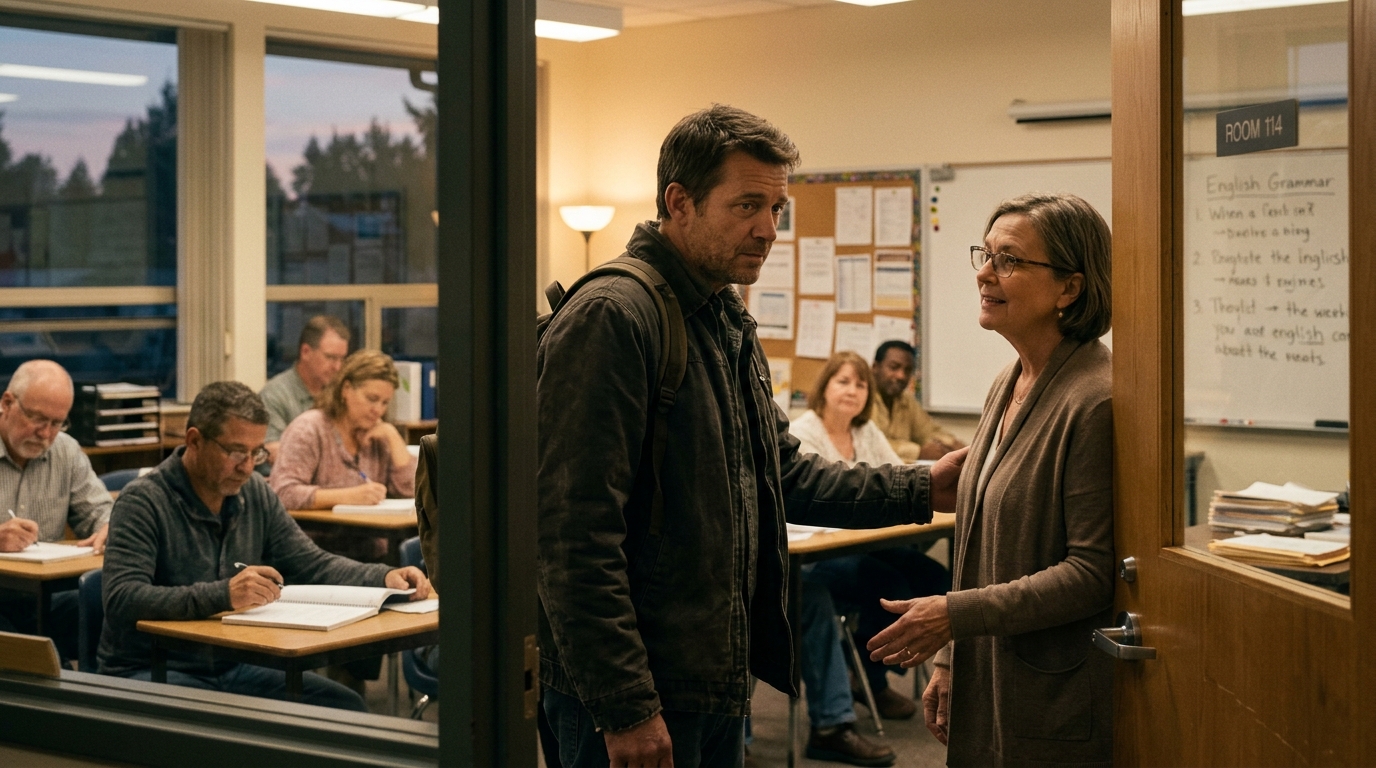
The fluorescent lights in Room 114 hummed the way they always did at 7:40 in the evening, a low electric sound that most people in the building had learned to stop hearing. But Daniel Okonkwo-Reyes heard everything that night. He heard the hum, the scrape of chairs, the teacher’s patient voice repeating the difference between “ship” and “sheep,” and underneath it all, a quiet voice in his own head saying: you are forty-three years old, and you cannot even pronounce your own job title.
This is the story of what happened next. It is told as it was shared with us, in pieces, over several conversations, and with Daniel’s blessing. Some details have been softened to protect the privacy of people who helped him along the way.
Before the Classroom: A Career Left at the Border
In his home country, Daniel had been a structural engineer for nearly eighteen years. He had signed off on bridges. He had managed teams of thirty. Colleagues called him at midnight when a calculation looked wrong, because he was the person who would find the error.
When he arrived in the United States with his wife and two children, none of that traveled with him. His degree was real, his experience was real, but on paper he was a stranger with an accent and a résumé no one could verify. The first job he found was loading trucks in a warehouse on the night shift. The second was cleaning offices downtown.
“People talk about losing a job,” he told us. “I lost something different. I lost the version of myself that other people could see.”
The Small Humiliations Nobody Writes About
It was never one big moment. It was a hundred small ones, the kind that pile up quietly:
- A pharmacist speaking slowly and loudly to him, as though volume could fix a language gap.
- His daughter translating a parent-teacher conference for him, her ten-year-old voice carrying words he should have been able to say himself.
- A supervisor handing him a mop and saying, kindly but without looking up, “You don’t need to understand everything. Just do the floors.”
He understood far more than people assumed. What he lacked was the ability to say it back.
The Evening Class He Almost Quit
The community college offered free evening English classes, two nights a week, starting at 6:30. Daniel signed up after his wife, Marisol, left the flyer on the kitchen table without saying a word. She knew better than to push. She simply left it where he would see it each morning over his coffee.
He went. For six weeks, he went straight from a day of manual labor to a plastic chair that was too small for him, his hands still smelling faintly of cleaning solution. He sat in the back. He rarely spoke.
Then came the night of the mock job interview.
The assignment was simple: pair up, ask each other questions, practice answering. His partner, a young woman from Vietnam named Linh, asked him, “Can you tell me about your work experience?”
Daniel opened his mouth. Eighteen years of expertise sat behind his teeth, and what came out was: “I am… work with… buildings. Before. Long time.”
Linh smiled gently. It was the gentleness that undid him. He realized she was being kind to him the way you are kind to someone who is struggling, and he could not stand it.
He gathered his notebook, said he needed water, and stood in the hallway with every intention of never coming back.
The Hallway at Dusk
Room 114 had a long window at the end of the corridor, and that evening the sky beyond it had gone the color of a bruised peach, orange fading into violet. Daniel stood there for what felt like a very long time. The parking lot lights were flickering on one by one. A janitor, someone with the same tired posture he recognized in himself, nodded at him as he pushed a cart past.
It was the instructor, a retired schoolteacher named Mrs. Abernathy, who found him there. She did not tell him to come back. She did not give a speech. She stood beside him and looked at the sky for a moment, then said something he has repeated to himself ever since.
“The first language you learn is never the one you’re ashamed of,” she said. “The second one is. That shame is just proof you still care how you sound. Keep that. Just don’t let it drive.”
He went back in. Not because he felt brave, but because he was too tired to walk to the bus stop yet, and the chair was there.
The Slow Work of Rising
What followed was not a montage. Anyone who has learned a language as an adult knows it is not cinematic. It is repetitive, humbling, and often invisible, even to yourself.
Here is what Daniel says actually changed things, in the order it happened:
- He stopped practicing for the test and started practicing for the day. He narrated his own tasks aloud on the night shift. “I am lifting the box. I am placing the box on the shelf.” His coworkers thought it was strange. One of them started correcting him, and became a friend.
- He wrote his work history in English, badly, then less badly. Mrs. Abernathy read every draft. She circled grammar errors in green pen, never red, because she believed red ink taught people to fear the page.
- He found a credential evaluation service. A classmate mentioned it almost in passing. It would translate and verify his engineering degree against American standards. The paperwork took months.
- He volunteered. A local nonprofit needed someone to assess the safety of a community center building. He did it for free, in halting English, with a borrowed clipboard. His report was flawless. The director noticed.
What the Evenings Gave Him
Daniel talks about those evening classes now the way some people talk about a long walk that changed their thinking. The ritual mattered as much as the content. After a day when he was invisible, he had two nights a week when he was a student, a person with a notebook and a goal and a place to be.
“When I walked into that room,” he said, “nobody knew what I used to be. But nobody cared what I was not, either. We were all just people trying to say the next sentence.”
He remembers the drive home in those months, or rather the bus ride, forehead against the cold window, city lights smearing past. He would rehearse the evening’s new words under his breath. Inspection. Load-bearing. Compliance. By the time he reached his stop, the words felt a little less foreign in his mouth.
The Night It Came Together
Eighteen months after the night in the hallway, Daniel sat across a table from a hiring manager at a mid-sized civil engineering firm. He had a verified degree, a stack of volunteer references, and an English that was still accented but clear and confident.
The manager asked him, “Can you tell me about your work experience?”
It was the same question Linh had asked him in Room 114. This time he answered for four full minutes.
He did not get that job. He got the one after it, six weeks later, as a junior engineer at a firm that specialized in infrastructure inspection. The salary was modest. The title was below what he once held. He did not care. He called Marisol from the parking lot and could not speak for a moment, and she waited on the line without filling the silence.
What He Wants You to Take From It
When we asked Daniel what he would say to someone sitting in a plastic chair tonight, considering whether to quit, he thought for a long time. Then he gave us three things.
- Go back in for the water, not for the lesson. Some nights you cannot summon the will to learn. You can summon the will to sit down. Sit down.
- Let people be kind to you. He used to hear kindness as pity. Now he hears it as company.
- Protect your evenings. The tired hours at the end of a hard day are where he built the whole bridge back, plank by plank.
An Evening Thought
There is something about the end of the day that makes honesty easier. The noise drops. The performance ends. What is left is the plain question of who you are becoming.
Tonight, somewhere, someone is walking into a classroom with tired hands and a heavy heart, wondering if any of it is worth it. If that is you, know this: the hallway window will still be there at dusk, the sky will still turn that impossible peach and violet, and someone like Mrs. Abernathy may be standing beside you before you realize it.
Go back in. Sit down. Say the next sentence.
Daniel did, and last spring he signed off on his first bridge in America.