🎧 Listen to this story
Narrated by Kore · 6,555 characters
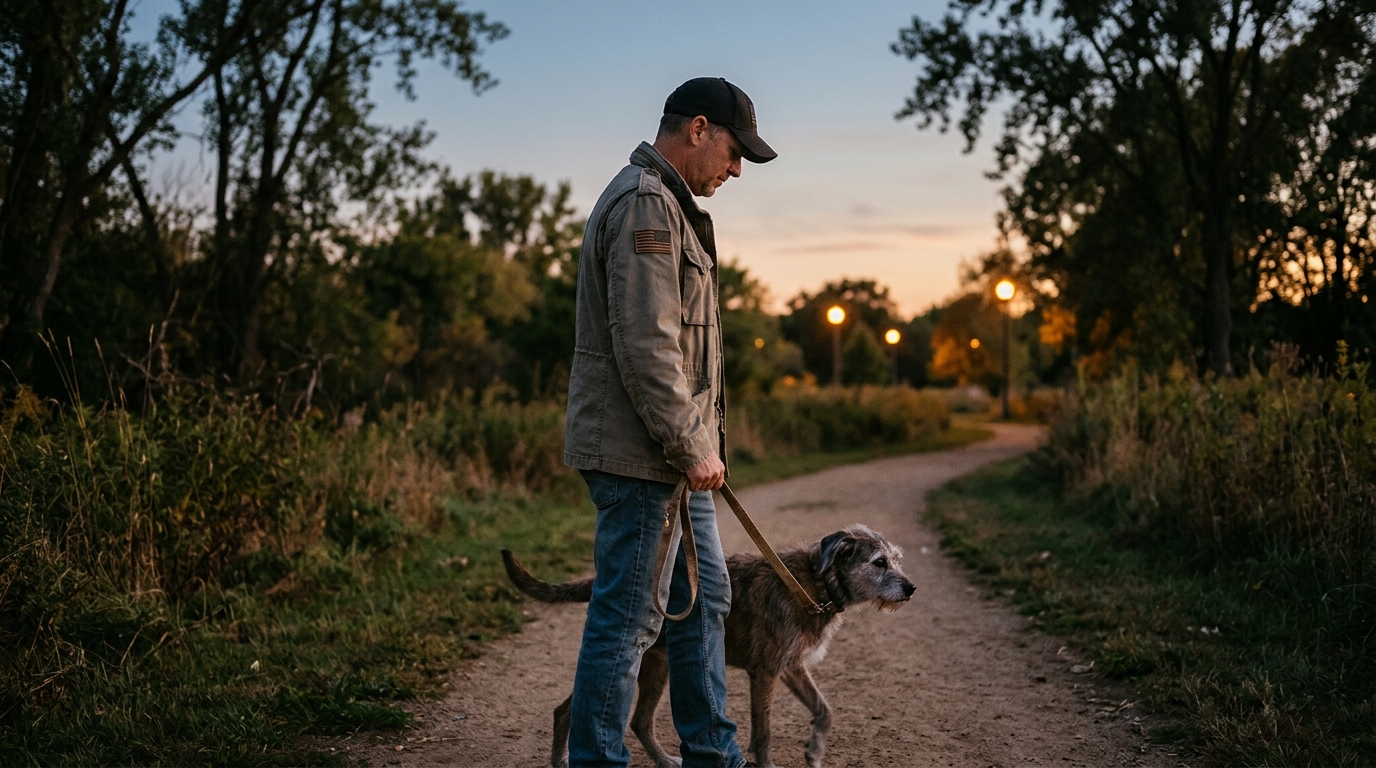
The light is already softening when Daniel Reyes clips the worn blue leash onto Biscuit’s collar. It is a little past six in the evening, that quiet hour when the neighborhood exhales, when porch lights flicker on and the smell of other people’s dinners drifts across the sidewalk. For most people, this is the hour of winding down. For Daniel, a retired Army sergeant who served two tours overseas, it used to be the hour he dreaded most.
Now it is the hour he lives for.
The Hour That Used to Be the Hardest
Daniel came home eleven years ago with all his limbs and a heavy silence he could not explain to anyone. He found work, kept his apartment tidy, and paid his bills on time. By every outside measure he was fine. But evenings were another matter.
“Daytime, you have noise,” he told me when we sat on his porch swing recently, Biscuit curled across his boots. “Traffic, work, the radio. Evening is when the noise goes away, and everything you’ve been outrunning catches up. I would sit in my kitchen with the lights off and just wait for it to be morning.”
Sleep came in broken pieces. Anxiety sat on his chest like a hand. His sister called every Sunday and he told her he was doing great. He wasn’t. He had simply gotten good at the performance.
The Dog in the Last Kennel
It was his sister who finally pushed him toward the county animal shelter, mostly as a way to get him out of the apartment. Daniel went along reluctantly, intending to walk the aisles, nod politely, and leave.
In the very last kennel, pressed against the back wall, was a gray-muzzled, scruffy brown mix with one ear that never quite stood up. The volunteers called him Biscuit. He had been returned twice. The shelter notes said he flinched at loud noises, avoided eye contact, and “doesn’t show well.”
“Everyone walked past him,” Daniel said. “He didn’t even try to get their attention anymore. He’d just turned his face to the wall. And I knew that posture. I’d been doing it for years.”
Daniel did not adopt him that day. He asked, instead, if he could take the dog for a walk. It was nearly closing time, the sky going amber over the parking lot. For the first ten minutes, Biscuit refused to move, frozen at the end of the leash. Daniel did not pull. He simply stood beside him in the evening air and waited.
Then, slowly, the dog took one step. Then another.
What Evening Walks Gave Them Both
Daniel took Biscuit home that week. And because the dog was anxious indoors, pacing and whining as the sun went down, Daniel started taking him out every evening just to settle him. A loop around the block at first. Then a longer loop. Then the old railroad path behind the elementary school.
What neither of them expected was how much the walk would do for the man holding the leash.
Daniel describes the shift not as a dramatic breakthrough but as a slow accumulation of small, ordinary mercies:
- A reason to leave the kitchen. The dog needed him at six o’clock, whether Daniel felt like moving or not. Being needed pulled him out of the dark apartment and into the living world.
- A rhythm for the day to end on. Instead of dreading the evening, he built something to look forward to inside it.
- Presence without pressure. Biscuit never asked how he was feeling. He only asked to sniff the same fence post for the fortieth time, which gave Daniel permission to slow down.
- Movement that quieted his mind. Walking steadied his breathing, and the fading light seemed to soften the edges of his thoughts.
- Small encounters. Neighbors began to stop and say hello to the man with the one-eared dog. For the first time in years, Daniel had casual, easy conversations.
The Quiet Science Behind It
There is a growing body of research on the bond between people and dogs, and many veterans’ organizations now pair service members with shelter animals precisely because of stories like Daniel’s. Regular walking has been linked to lower stress and better sleep, and the steady companionship of a dog can ease feelings of isolation. Anyone dealing with trauma should also lean on professional support, and Daniel is quick to say that counseling mattered too. A few months after Biscuit came home, he finally joined a veterans’ support group, something he credits the dog with helping him find the courage to do.
“Biscuit didn’t fix me,” he said. “He made it possible for me to want to be fixed. There’s a difference.”
Two Healing at the Same Pace
The part of the story Daniel lingers on is that the healing ran both ways. Biscuit, once the dog who turned his face to the wall, began to change too. Within a month he was greeting Daniel at the door. Within three, he had stopped flinching at the sound of the kitchen cabinets. The first time he leaned his full weight against Daniel’s leg on the railroad path, Daniel had to stop walking for a moment.
“I remember thinking, he trusts me,” he said quietly. “Somebody trusts me with their whole self. I hadn’t felt that in a long time.”
Each of them gave the other something to be brave for. Each walk was a small act of mutual rescue, repeated every evening until it became a life.
The Walk, As It Looks Now
If you happen to be on the railroad path just as the sun slides behind the water tower, you might see them. A man with a slight limp in his stride and a gray-muzzled dog trotting a half step ahead, ear flopping, tail up. They stop at the same bench every night. Daniel sits for a few minutes while Biscuit watches the swallows dip over the field. Neither of them says anything. Neither needs to.
Daniel sleeps through most nights now. Not all, he is honest about that. But most. And when the hard nights come, he knows what to do. He puts on his shoes, clips the blue leash to the collar, and steps out into the dusk.
A Gentle Thought to Carry Into Your Own Evening
As the day winds down for you, it is worth asking: who or what is waiting for you at the end of the day, and who might be waiting for you to show up? Sometimes healing is not a grand gesture or a perfect plan. Sometimes it is simply a leash, a quiet street, and a loyal companion who needs you as much as you need them.
If you are carrying something heavy this evening, consider stepping outside for a few minutes. Let the light change. Let your breathing slow. And if there is a shelter animal somewhere waiting in the last kennel with its face turned to the wall, know that the right pair of footsteps might be closer than you think.
Daniel says it best: “We found each other at the end of a long day, both of us. And we’ve been walking home together ever since.”