🎧 Listen to this story
Narrated by Kore · 7,400 characters
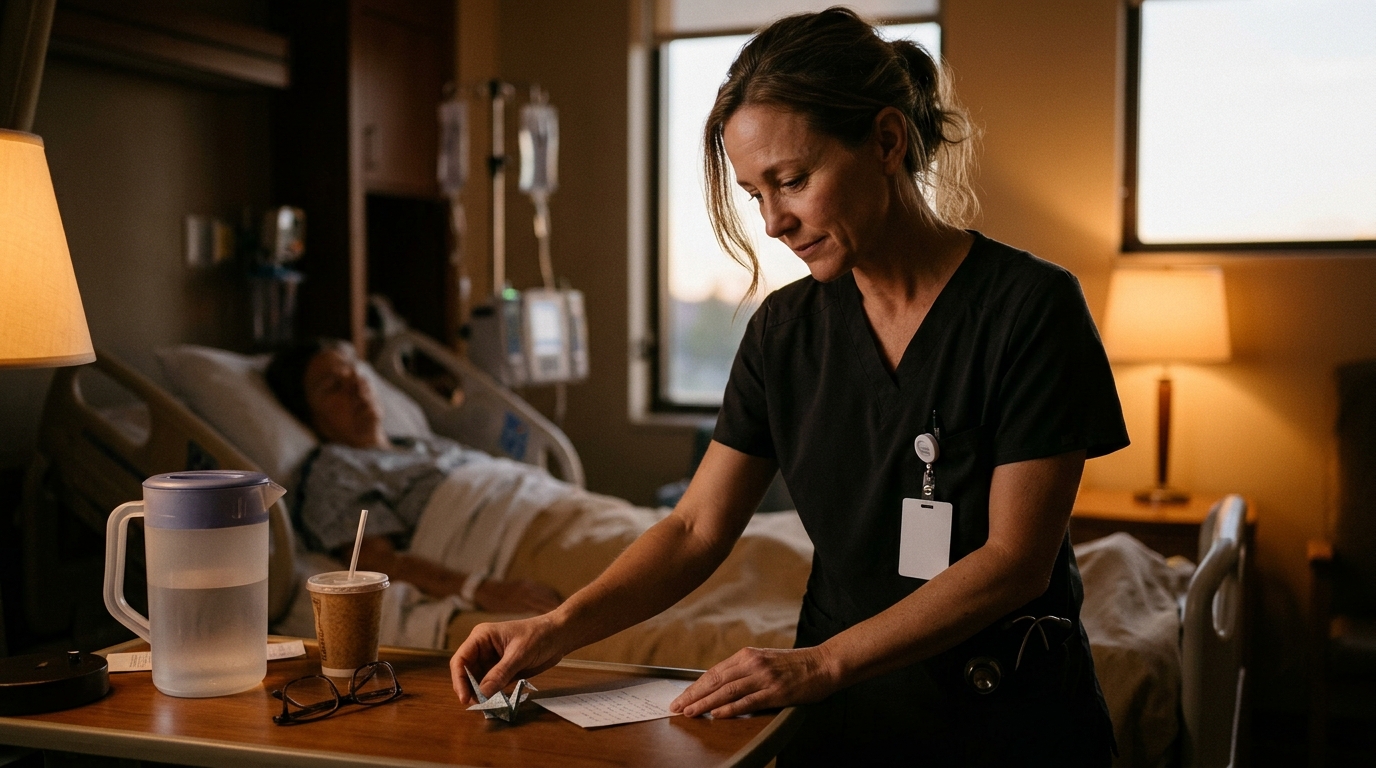
At 9:40 every evening, when the hallway lights on the fourth floor dim to their softest setting and the carts stop rattling, a night-shift nurse named Marguerite begins what her colleagues call “the walk.” She does not carry a chart or a syringe. She carries nothing at all, just two empty hands and about ninety seconds for every patient on her unit.
She stops at each doorway, knocks softly even when the person inside appears to be asleep, and asks one question: “Would you like some company before the lights go out?” Most say yes. Some say nothing and simply reach out. She takes their hand, sits for a moment, and stays until they let go.
This is the story of how a small, unofficial habit became something that administrators now study, nursing students ask about, and patients remember long after discharge.
How the Ritual Began
Marguerite did not set out to start a movement. Eleven years into her career, she was working a hard overnight when an elderly patient named Walter grabbed her sleeve as she adjusted his IV. He was not in pain. He was not asking for anything medical. He simply said, in a voice she described as barely a whisper, “It gets so quiet at night. That’s the hard part.”
She had thirty seconds before her next task. She sat down anyway and held his hand. He fell asleep within minutes, and she realized she had never seen him look that peaceful in four days.
The next night, she did it again, and then for the patient in the next room. Within a month, it had become a fixed part of her shift, a rhythm as dependable as the medication rounds.
Why Evening Is the Loneliest Hour in a Hospital
Anyone who has spent a night in a hospital, as a patient or as a worried family member, knows that the building changes after dark. Visitors leave. The daytime bustle of doctors, therapists, and volunteers fades. What remains is the beeping of monitors, the hum of ventilation, and a person alone with their thoughts.
For many patients, the evening is when fear arrives. During the day, there are distractions: a procedure to prepare for, a nurse to chat with, a television murmuring in the corner. At night, the mind has room to wander toward the questions that are hardest to answer. Will I get better? Will I go home? Who is waiting for me there?
Marguerite describes it simply: “The day is for treatment. The night is for the part of you that no machine can reach.”
What Happens in Those Ninety Seconds
Observers who have watched the ritual describe it as strikingly unhurried. Marguerite does not rush, fill the silence with small talk, or offer reassurances she cannot guarantee. She sits at eye level, rests her free hand lightly on the bed rail, and lets the patient set the pace.
Some patients talk. A man recovering from heart surgery once spent his entire ninety seconds describing his late wife’s garden. A young woman waiting on test results said only, “Thank you for not telling me it’ll be fine.” Others say nothing at all and simply breathe more slowly as the minute passes.
What she offers, she says, is not comfort in the dramatic sense. It is presence. It is the quiet message: you are not forgotten, even now, even at this hour.
What the Research Suggests
While Marguerite’s ritual is informal, the science around human touch and presence in healthcare is increasingly well documented. Studies in nursing and psychology journals have explored several themes that line up closely with what she does:
- Calming the stress response: Gentle, supportive touch has been linked to lower measures of stress and anxiety in hospitalized patients.
- Easing the transition to sleep: Patients who feel emotionally secure at bedtime often report falling asleep more easily, which matters because rest is central to recovery.
- Reducing the sense of isolation: Loneliness is associated with poorer health outcomes, and even brief, consistent human contact can soften its effects.
- Strengthening trust: Patients who feel genuinely cared for tend to communicate more openly about symptoms and worries, which helps clinicians treat them better.
None of this replaces medicine. But it suggests that the small, unmeasured moments of a hospital stay may carry more weight than the system has traditionally acknowledged.
The Ripple Through the Unit
The most surprising part of the story is what happened next. Other nurses noticed. A colleague named Daniel, a skeptic by his own admission, asked if he could shadow her one night. He came away quiet. “I realized I’d been so focused on the checklist that I’d forgotten the person attached to it,” he said.
Within a few months, several nurses on the floor had adopted their own versions. Some sit for a minute with the patient they are most worried about. Others use the time to read a short passage aloud or simply to ask, “How are you really doing tonight?” The unit’s managers began to notice something small but telling: fewer call-bell requests in the late hours, and patients reporting that the nights felt less frightening.
No one tracked it as a formal program. It spread the way kindness usually does, from one person to the next, without a memo.
The Cost of Doing the Right Thing
It would be dishonest to pretend this is easy. Nursing is demanding, understaffed in many places, and relentlessly busy. Ninety seconds per patient adds up across a full unit. Marguerite acknowledges that she can only sustain the ritual because she plans her rounds carefully and because her colleagues cover for one another.
She is also clear that she is not a replacement for proper staffing or support. “This isn’t a solution to the big problems,” she says. “It’s what I can do inside them.” There is humility in that, and perhaps wisdom. Change in a large system often begins not with sweeping reform but with one person deciding what small thing she can do well.
What We Can Take From Her Evening Walk
You do not need to work in a hospital to learn from Marguerite. Her ritual points to something true about all of us. At the end of a long day, when the noise falls away, we are all a little more tender, a little more in need of someone to simply stay.
Small ways to carry this into your own evenings
- Check in at the close of the day. A short call or message to someone who lives alone can mean more than you realize.
- Offer presence, not solutions. When someone is struggling, resist the urge to fix. Sit with them first.
- Put the phone down. Ninety seconds of undivided attention is rarer, and more valuable, than it sounds.
- Notice who is quiet. The person who says the least often needs the most company.
- Make it a habit. Rituals work because they are reliable. People can lean on what they know will come.
The Quiet After the Walk
When Marguerite finishes her rounds, the unit settles into its deepest stillness. The monitors keep their soft rhythm. Down the hall, a patient who was awake and anxious an hour ago is breathing slowly, hand loosened on the blanket.
She returns to the nurses’ station, pours a cup of tea that has gone lukewarm, and begins her charting. Nobody applauds. There is no award for ninety seconds of held hands. But on the fourth floor, in the soft dark before morning, people are sleeping a little easier, and that is its own kind of healing.
Tonight, as your own day winds down, consider who might need a little company before the lights go out. It may take only a minute. It might be the best minute of their night.