🎧 Listen to this story
Narrated by Kore · 7,958 characters
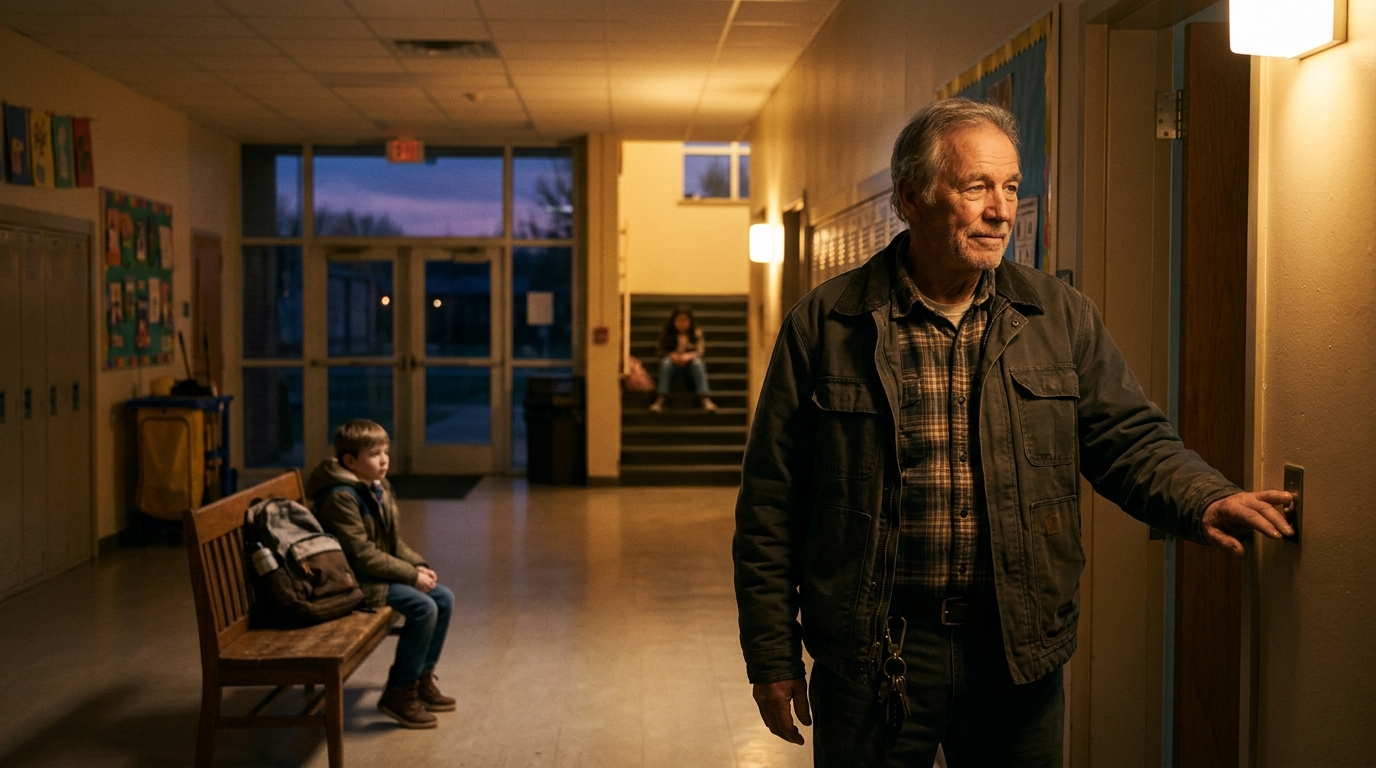
There is a sound a school makes at 4:45 in the afternoon that most people never hear. It is not silence, exactly. It is the sound of a building exhaling: radiators ticking, a distant door settling on its hinges, the low hum of fluorescent lights that no longer have anyone to shine for. For twenty-two years, Walter Okafor has been the person who listens to that sound, and he has learned to tell the difference between an empty building and a building where someone still needs him.
This is a reported piece, pieced together from conversations with teachers, a former student, and Walter himself, who agreed to talk only after being assured the story would not make him sound like a saint. “I’m a man with a mop,” he told me, smiling. “The mop is just the reason I’m allowed to be here.”
The Job Description Nobody Wrote
On paper, Walter is the head custodian at a middle school on the edge of a mid-sized town. His official duties include cleaning classrooms, repairing broken lockers, managing the boiler, salting the front steps in winter, and locking up at night. Nowhere in the paperwork does it say: stay late in case a child has nowhere to go.
But that is the part of the job he takes most seriously.
Walter’s routine at the end of each day follows a pattern that staff have come to rely on without ever discussing it:
- He waits until the final bus pulls away, then does a slow lap of the hallways rather than a quick one.
- He checks the bathrooms, the stairwells, the corner by the gym where kids sometimes hide when they do not want to be found.
- He turns off lights one wing at a time, never all at once, leaving the main corridor lit until he is certain no one is lingering.
- He locks the doors last, and he always checks the front steps one more time before he does.
“The lights go off in order,” he explained. “If a kid is still in the building, I want him to see the lights going out slowly. I don’t want him to be in the dark all of a sudden. That’s scary at thirteen.”
The Evening That Started It
Walter can pinpoint the night this habit began. It was a gray November Tuesday, early in his career. He was finishing the second-floor hallway when he noticed a pair of sneakers sticking out from behind a stack of folding tables.
A seventh grader was sitting on the floor with his backpack in his lap. His ride had not come. His mother worked a late shift, his phone had died, and he had been too embarrassed to tell anyone. He had simply waited, quietly, as the building emptied around him.
“He wasn’t crying,” Walter said. “That’s what got me. He was just sitting very still, like he’d practiced being invisible.”
Walter did not make a speech. He sat down on the floor nearby, pulled a granola bar out of his jacket pocket, and asked if the boy liked basketball. They talked about nothing in particular for forty minutes until a car finally pulled up out front. Before the boy left, he asked, quietly, whether Walter would be there tomorrow.
“I told him I’m always here,” Walter said. “And then I realized I had better make that true.”
What the Stillness Teaches
Ask Walter what he has learned from two decades of evening shifts, and he will tell you the building is a different place after dark. During the day it belongs to the noise: the schedules, the tests, the social maneuvering. But in the hour after dismissal, the pretending falls away.
“Kids tell the truth in the evening,” he said. “Not because they’re asked. It’s just quiet enough that the truth can fit in the room.”
Over the years, Walter says he has heard things in those quiet hallways that no one else in the school knew:
- A girl who admitted she was skipping lunch because she could not afford it, and did not want anyone to know.
- A boy who had been sleeping badly because his parents were fighting, and who found the empty gym calmer than his own kitchen.
- A student who was being picked on in ways that never showed up in any incident report.
In each case, Walter did what he describes as his only real rule: listen first, fix later, and always bring in someone who can actually help. He is not a counselor and does not pretend to be. He quietly connects kids to the school social worker, tells the front office when something seems off, and keeps a small stash of granola bars, spare gloves, and phone chargers in a closet he calls “the pantry.”
A Teacher Remembers
Marisol Danvers, who has taught seventh-grade science at the school for eleven years, said she learned about Walter’s evening habit by accident. She had stayed late to grade papers and walked out to find him sitting on the steps beside a student, both of them watching the sky turn orange.
“I asked if everything was okay and he just nodded,” she recalled. “Later he told me the girl had been waiting for a ride that was an hour late. He didn’t want her sitting alone in the dark. That was it. That was the whole thing. But I thought about it all the way home.”
She says that what moved her was not the grand gesture, because there was none. It was the consistency. “Anyone can be kind once. Walter is kind every single night, and nobody is clapping.”
The Student Who Came Back
Last spring, a young man in a work uniform walked into the school’s front office and asked if the custodian still worked there. His name was Dante, and he had graduated from the school nearly ten years earlier. He had come, he said, to say thank you.
Dante had been the boy behind the folding tables, though he was a different boy in a different year, one of many. He remembered the granola bar. He remembered the way the lights went off one by one. What he remembered most was a feeling he had struggled to name for years.
“I remember thinking, someone is paying attention to whether I’m okay,” Dante told me. “I was twelve and I didn’t have a lot of that. It sounds small. It wasn’t small.”
Walter, characteristically, did not remember the specific night. “There were a lot of nights,” he said, a little embarrassed. “But I’m glad it landed.”
Why It Matters More Than It Looks
It is tempting to treat stories like this as sweet but minor, a nice anecdote about a nice man. But the more I sat with Walter’s routine, the more I thought it points at something bigger.
We tend to measure care by its volume: the big donation, the viral rescue, the dramatic intervention. But a great deal of the world is held together by people whose care is quiet, repetitive, and unwitnessed. The person who checks the back stairwell. The one who stays five minutes past clocking out. The one who leaves the porch light on.
These acts rarely make headlines, yet they quietly change the shape of a child’s evening, and sometimes the shape of a life.
A Small Practice for Your Own Evening
You do not have to work in a school to borrow a little of Walter’s approach. As the day winds down tonight, consider a few gentle questions:
- Is there someone in my life who is quietly waiting for a ride, a call, or a kind word?
- What is one small thing I can leave a light on for, whether a person, a promise, or a possibility?
- Who stayed late for me once, and have I ever told them?
Walter would say none of this has to be dramatic. A text. A granola bar. Ten extra minutes on the front steps.
The Last Light
When I asked Walter what he thinks about as he walks the final hallway each night, he took a long moment before answering. Outside, the sky had gone the deep blue of early evening, and the only light in the corridor was the one he had left burning.
“I think about whether anybody’s still in here who shouldn’t be alone,” he said. “And if the answer’s no, I turn off the last light and I go home feeling like the day did its job.”
He paused, jingling the ring of keys at his belt.
“And if the answer’s yes,” he added, “then I guess I’m not going home yet.”
Somewhere tonight, a building is settling into darkness. And somewhere inside it, a man with a mop is making sure no child is left behind in it. May we all be a little more like the one who stays.