
🎧 Listen to this story
Narrated by Kore · 7,364 characters
A Commute Like Any Other
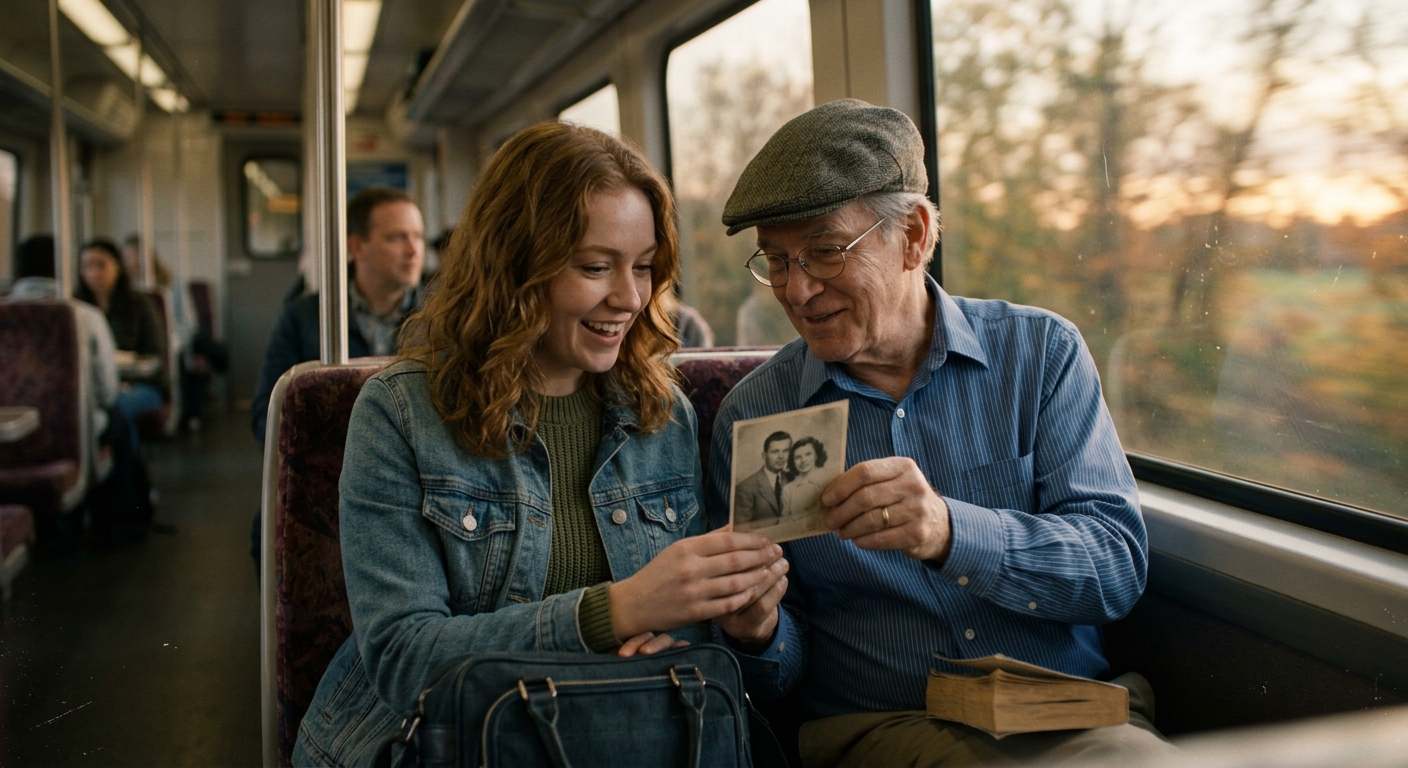
It was a Tuesday morning in late October, the kind of grey, unremarkable day that blurs into every other grey, unremarkable day. Maya Hendricks, a 34-year-old graphic designer from Portland, Oregon, had been riding the same commuter train for six years. She knew which cars were quietest, which seats had the most legroom, and which conductors would let you slide by with an expired monthly pass if you smiled politely enough.
She was not looking for a life-changing conversation. She was not open to new experiences. She had her headphones in, her coffee cup cradled in both hands, and a deadline looming over her like a storm cloud. The last thing she wanted was to talk to anyone.
And then an elderly man sat down beside her and asked if the seat was taken.
The Man with the Leather Notebook
His name was Arthur. He was 79 years old, a retired civil engineer with warm brown eyes and a battered leather notebook tucked under his arm. He apologized immediately for interrupting her, noticed her headphones, and started to look away. But something made Maya pull one earbud out.
She would later say she had no idea why she did it. Maybe it was the notebook. Maybe it was the way he apologized so genuinely. Maybe, after six years of silent commutes, some quiet part of her was tired of being alone in a crowd.
Whatever the reason, she said: “No, it is fine. Go ahead.”
That small sentence, four words, started a conversation that would last 47 minutes and change the direction of her life.
What He Said That No One Had Ever Said to Her
Arthur was not a guru. He was not a life coach or a motivational speaker or someone with a podcast. He was a widower who had been married for 51 years, a grandfather of seven, and a man who had learned, slowly and painfully, that most of the regrets in his life came from the same source: waiting.
“I waited to tell my wife I loved her the way she deserved to hear it,” he said. “I waited to change careers until I was almost too old. I waited to forgive my father until after he was gone. Waiting,” he told Maya, “is just fear wearing a patient face.”
Maya had been waiting for two years to leave a job that was slowly hollowing her out. She had been waiting to start the illustrated children’s book she had sketched ideas for in notebooks just like Arthur’s. She had been waiting for the right moment, the right savings account balance, the right sign.
She had not told any of that to Arthur. He did not know her story. But somehow, in the casual, unguarded way that strangers sometimes speak to each other, he had said exactly what she needed to hear.
Why Strangers Tell the Truth
There is something remarkable about the honesty that passes between strangers. Psychologists call it the “strangers on a train” phenomenon, and it is more documented than you might think. Without the weight of history, without the fear of judgment from someone who will see you at the holidays or remember this conversation forever, people say things to strangers that they cannot say to those closest to them.
Dr. Nicholas Epley, a behavioral scientist at the University of Chicago, has studied this dynamic extensively. His research suggests that people consistently underestimate how much they will enjoy talking to strangers, and how meaningful those conversations will turn out to be. We protect ourselves with headphones and phone screens, believing we are preserving peace. But what we are often doing, his research implies, is cutting ourselves off from unexpected connection.
Maya was living proof.
The Notebook He Left Behind
When the train pulled into Arthur’s stop, he stood slowly, tucked his notebook under his arm, and wished Maya a good day. She thanked him. She almost left it there.
But she did not.
“Can I ask what you write in that notebook?” she called after him.
He turned back and smiled. “Things I do not want to forget,” he said. “And things I do not want to regret.”
He reached into the notebook and tore out a single page. On it, in neat engineer’s handwriting, was a list. He handed it to her without explanation and walked off the train.
The list read:
- Tell people what they mean to you before it becomes too late to matter.
- The right moment is almost always right now.
- Fear dressed as practicality is still fear.
- Make the thing. Finish it. Share it.
- One brave conversation is worth ten years of waiting.
Maya folded the page and put it in her bag. She still has it.
What She Did Next
She did not quit her job the next day. Real life does not work like the movies. But she did open a new document that night and start writing the outline for her children’s book. She did schedule a meeting with her manager to discuss reducing her hours. She did text her mother, with whom she had a complicated and long-neglected relationship, and ask if they could have lunch.
Over the following eight months, those small acts compounded. The book, titled Where the Slow River Goes, was picked up by a small independent publisher fourteen months after that train ride. The lunch with her mother became a weekly tradition. The job became part-time, and then a stepping stone to the freelance career she had been too afraid to pursue.
“I do not think Arthur had any idea what he handed me,” Maya said in a conversation earlier this year. “He was just being kind. He was just being honest. But it hit me at exactly the right moment, and I was finally quiet enough to hear it.”
The Lesson Hiding in Plain Sight
This is not a story about fate or magic or the universe aligning. It is a story about what happens when two people choose, even briefly, to be present with each other instead of retreating into their own worlds.
Arthur was not carrying wisdom that Maya could not have found elsewhere. The ideas he shared were not revolutionary. But they were spoken by a real human being, in real time, with warmth and without agenda. And that, it turns out, makes all the difference in the world.
Three Things This Story Teaches Us
- Connection is opt-in. Maya chose to take out her earbud. That choice cost her nothing and gave her everything. Every day, we make dozens of micro-decisions about whether to engage or withdraw. Sometimes engaging changes your life.
- Wisdom travels in unexpected vehicles. It does not always arrive in a TED Talk or a bestselling book. Sometimes it sits down next to you with a worn leather notebook and 79 years of lived experience.
- Strangers carry no baggage. The people who love us most sometimes cannot tell us hard truths because the relationship is too precious to risk. Strangers have nothing to lose, and sometimes that freedom produces the most honest kindness of all.
A Note to Anyone Riding the Train Right Now
You do not have to talk to everyone. You do not owe your time and energy to every person who glances your way. But the next time someone sits beside you and the moment feels open, consider letting it be. Consider pulling out one earbud. Consider asking a question.
You have no idea what someone might be carrying. You have no idea what they might give you without even knowing they did it. And you have no idea, if you are honest with yourself, what you might be carrying and how much lighter it might feel after 47 minutes with the right stranger.
Arthur, wherever you are: thank you. Maya, for those of us still waiting: your story is the sign we needed too.