🎧 Listen to this story
Narrated by Vindemiatrix · 7,864 characters
A Patient With No Visitors
Room 14 at Cedarview Long-Term Care Facility in rural Tennessee had been occupied by Harold Mints for nearly three years. He was 81 years old, a former high school shop teacher, a widower, and, according to his intake paperwork, completely without next of kin. No emergency contacts. No listed relatives. The space on the form that asked for a primary visitor had been left blank since the day he arrived.
Most of the staff at Cedarview knew Harold as the quiet man at the end of the hall. Polite, never complained, always said thank you when his tray was delivered. He kept a small paperback dictionary on his nightstand and read it the way other people read novels, one word at a time, learning something new every single day. But beyond the warmth of those brief interactions, Harold was, by every measurable standard, alone.
That changed when a traveling nurse named Diane Kohler accepted a short-term contract at Cedarview in the spring of 2021.
The Moment That Changed Everything
Diane had spent the better part of two decades moving between hospitals and care facilities across the Southeast. She had seen a lot. She had learned, sometimes painfully, how to keep professional distance. But something about Harold got through her armor in a way she still struggles to explain.
“It was a Tuesday,” Diane recalls. “I had just finished a twelve-hour shift and I stopped by his room to say goodnight. He looked up from his dictionary and said, ‘You’re the first person who’s talked to me today who wasn’t doing it as part of their job.’ He said it so plainly, like he was just stating a fact. No self-pity, nothing. And I just stood there in the doorway thinking, what kind of world have we built?”
Diane’s contract at Cedarview ended six weeks later. She relocated to her next placement, a hospital in Knoxville, roughly 100 miles away. She could have, reasonably and understandably, moved on. Most people would have.
She did not move on.
The Weekly Drive
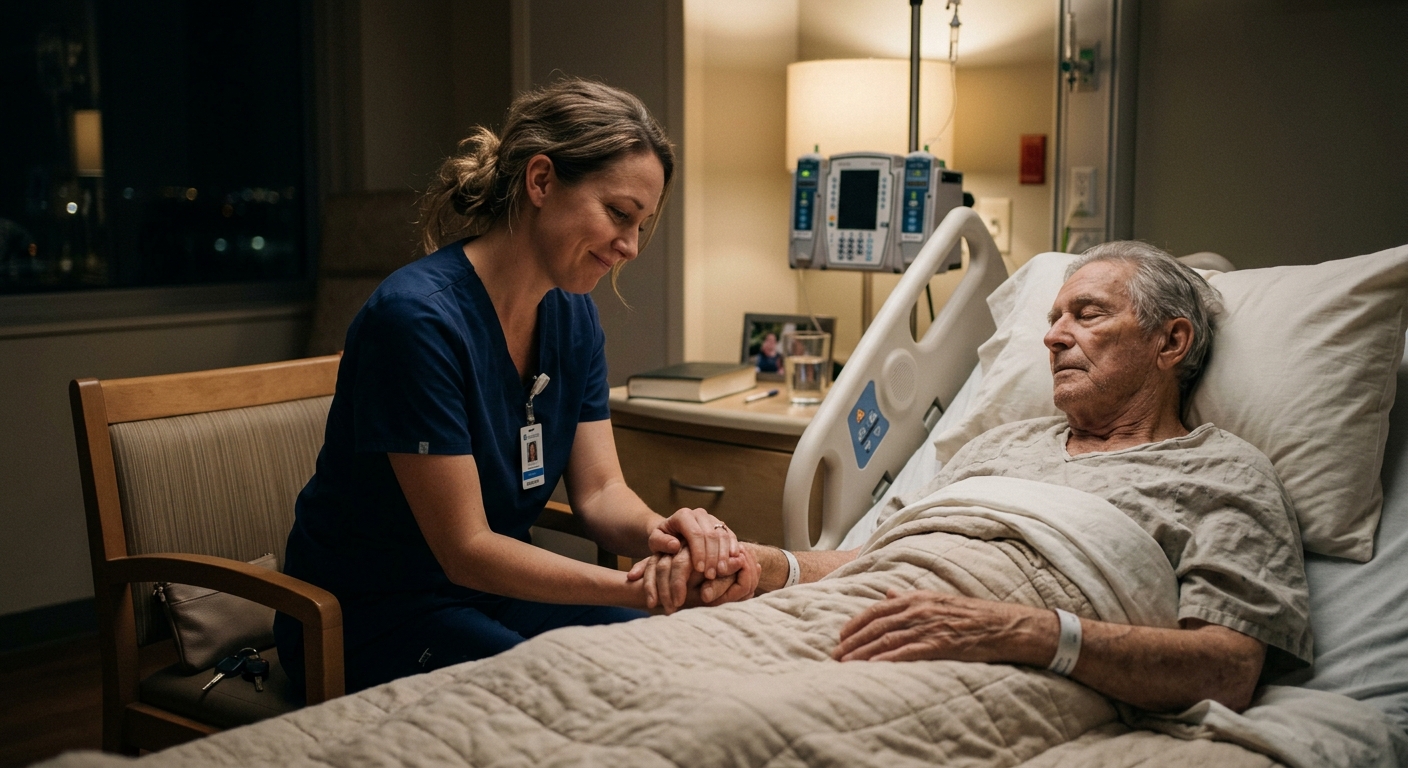
Every Saturday morning, without exception, Diane Kohler got into her car and drove two hours to visit Harold Mints. She brought things: a newspaper, sometimes a crossword puzzle book, occasionally a slice of pie from a bakery she passed on the interstate. More than anything, she brought time and attention, two things Harold had been starved of for years.
“People always ask me if it was hard to keep it up,” Diane says. “Honestly, the drive was the easy part. The drive gave me time to think, to decompress from the week. Harold gave me something I didn’t even know I was missing. He reminded me why I got into nursing in the first place.”
The visits were simple. They talked about words Harold had discovered in his dictionary. They debated old movies. He told her stories about his students from the 1970s and 1980s, kids who had gone on to build things with their hands, who had sent him Christmas cards for years until, eventually, they stopped. Diane listened to all of it.
What the Staff Noticed
The nurses and aides at Cedarview began to notice a change in Harold. He smiled more. He started attending the facility’s weekly group activities, something he had previously declined. His appetite improved. His doctor noted in his chart that his overall affect had brightened considerably.
“We see it all the time and it never stops being true,” said one of the facility’s social workers, who spoke about Harold’s case with his permission. “Human connection is not supplemental care. It is care. It is medicine. What Diane did, giving that man consistent, reliable presence, it changed his health outcomes in ways that no prescription could have.”
Staff members began leaving small notes for Diane at the front desk, thanking her for what she was doing. Several of them started making their own extra efforts with isolated residents, inspired by what they were witnessing.
What Harold Taught Diane
If you ask Diane what she got out of those drives, she answers without hesitation. She will tell you Harold taught her at least seven things she carries with her every day.
- Presence is a gift that costs nothing and means everything. Harold never asked for grand gestures. He asked for someone to sit with him.
- Curiosity keeps you alive. A man in his eighties still learning new words every morning because he believed life deserved attention, right up to the end.
- Gratitude does not require perfect circumstances. Harold was genuinely, visibly grateful for his life, even a life that had grown very small and very quiet.
- Loneliness is a public health crisis hiding in plain sight. Millions of elderly people in this country live Harold’s reality. We just don’t talk about it enough.
- The off-the-clock version of us matters just as much as the professional version. Who we choose to be when no one is evaluating us is the truest measure of character.
- Small rituals build enormous trust. Harold knew Diane would show up every Saturday. That reliability, that predictability, gave him something to look forward to every single week.
- It is never too late to matter to someone. Harold had spent years feeling invisible. One person deciding to see him changed the entire architecture of his final years.
The Harder Part of the Story
Harold Mints passed away on a Thursday morning in February 2023, peacefully, in his sleep. He was 83 years old. Diane was not there when it happened. She found out through a phone call from one of the nurses on staff, someone she had grown close to over the two years of weekly visits.
She drove out anyway that Saturday. Not to visit Harold, but to sit in the parking lot, drink her coffee, and think about everything he had given her. She says she does not regret a single mile.
“People ask me if it was sad,” she says. “Of course it was sad. But it wasn’t tragic. Harold didn’t die alone. He died knowing someone had chosen him, specifically him, not because they were assigned to him, not because they were paid to care, but because he was worth the drive. I hope everyone gets that. I really do.”
The Ripple That Keeps Moving
Since sharing her story with colleagues at a nursing conference last fall, Diane has been contacted by dozens of healthcare workers across the country who have started similar informal relationships with isolated patients at their own facilities. Some visit weekly. Some just make a point to linger a few extra minutes after a shift, to ask a real question and wait for a real answer.
None of them think they are doing anything extraordinary. That, perhaps, is exactly the point.
Acts of profound human kindness rarely feel like history while they are happening. They feel like a Saturday morning, a long drive, a slice of pie, and an old man with a dictionary who has a new word he is dying to share with you.
How You Can Make a Difference
You do not need to drive 100 miles to reach someone who is isolated. The isolated person might be in your own neighborhood, your own family, your own building. Consider these small but meaningful actions:
- Volunteer with a local senior center or long-term care facility as a companion visitor.
- Check in on elderly neighbors, especially those who live alone.
- Contact organizations like the AARP Foundation’s Connect2Affect program, which connects isolated seniors with resources and human contact.
- If you work in healthcare, take one extra minute with the patient who never has visitors. Ask them something real. Listen to the answer.
- Advocate for better funding and programming around elder loneliness at the local and national level.
Harold Mints left no estate, no legacy project, no public memorial. What he left was a nurse who drives a little differently now, who looks at every patient file and wonders what the blank space next to “emergency contact” is really trying to say.
It is usually trying to say: someone should show up here. Someone should care.
Be the someone.