🎧 Listen to this story
Narrated by Sulafat · 6,544 characters
A Small Box. A Big Idea. A Street That Changed Forever.
It started with a wooden box, a can of paint, and a woman named Delores Mitchen who was tired of watching her neighbors go hungry in silence.
Delores, a retired school librarian from Akron, Ohio, had spent decades watching kids come to school without breakfast, eyes glazed and stomachs empty. When she retired, she thought that part of her life, the worrying part, would soften. It did not. If anything, it grew louder.
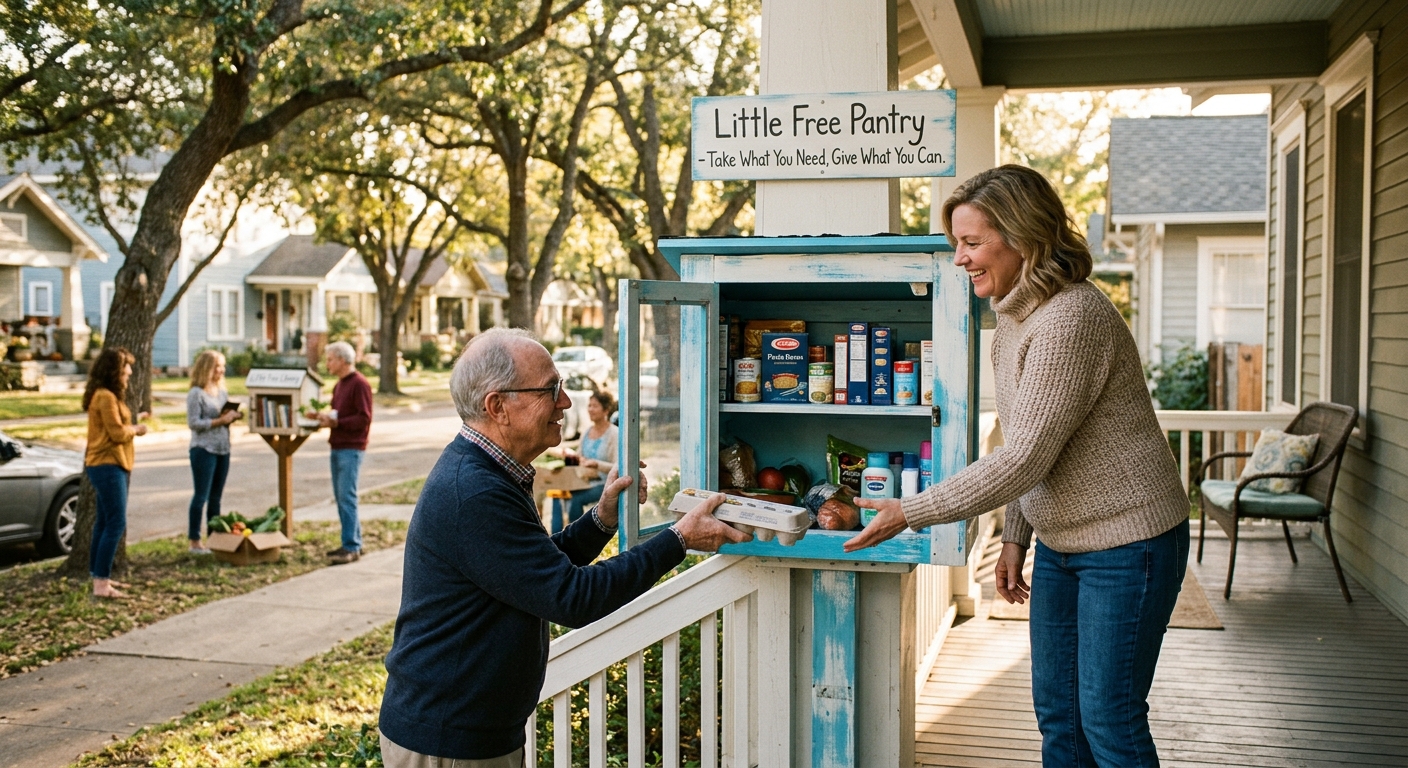
In the spring of 2021, while scrolling through a community Facebook group, she came across a photo of a Little Free Pantry, a small wooden cabinet mounted on a post outside someone’s home, filled with nonperishable food and household items, free for anyone to take, free for anyone to contribute. The caption read simply: Take what you need. Leave what you can.
Delores closed her laptop, walked to her garage, and started building.
The First Week: More Questions Than Cans
She painted the cabinet sky blue with white trim and stenciled sunflowers along the sides. Her neighbor Raymond from across the street watched from his porch, arms crossed, curious but skeptical.
‘I asked her, are people actually going to use that thing?’ Raymond recalled in a conversation earlier this year. ‘She just smiled and said she figured they would.’
The first week was slow. Delores stocked it herself every morning: canned soup, pasta, rice, peanut butter, dish soap, diapers. She did not set up a camera. She did not ask questions. She simply refilled what was taken and left the rest.
By the end of the week, something had shifted. The pantry was not just being emptied. It was being restocked by other people.
What Happens When Neighbors Start Paying Attention
Within two weeks, Delores noticed handwritten notes tucked between the cans. One read: Thank you. The baby formula helped more than you know. Another said: I left some extra pasta sauce. Hope it helps someone.
Raymond, the skeptic from across the street, quietly left a bag of groceries one morning before Delores was even awake. When she saw the bag, she knocked on his door to say thank you. That conversation lasted forty-five minutes and ended with Raymond offering to build a second, larger cabinet for the end of the block.
That second cabinet went up in June. By August, there were four pantry stations along Delores’s street, each one adopted, decorated, and maintained by a different household.
The Ripple Effect Nobody Planned For
What Delores had not anticipated, and what she describes as the most surprising part of the whole experience, was not the food. It was the conversations.
‘People who had lived on this street for ten, fifteen years and never spoken to each other started talking,’ she said. ‘Someone would be out checking the pantry and a neighbor would walk over. And suddenly you’d have two people standing there for half an hour, just talking.’
A retired nurse named Gloria began leaving printed health tips alongside the food. A young father named Marcus started organizing monthly donation drives and pulling in contributions from a local grocery chain. Two teenagers, sisters named Amara and Jade, took over the social media account Delores had set up and grew its following to over three thousand people in surrounding neighborhoods.
What the Pantry Actually Gave People
It would be easy to measure the success of this story in pounds of food donated or number of families served. But the people on Delores’s street will tell you the numbers miss the point entirely. Here is what they say the pantry actually gave them:
- A reason to stop and look up. In a world of heads-down, phone-in-hand routines, the pantry gave people a reason to pause, notice, and interact.
- Permission to ask for help without shame. Because the pantry required no sign-ups, no proof of need, and no eye contact to access, people who had been too proud or too private to ask for assistance found a quiet, dignified way to receive it.
- A sense of responsibility for each other. When you restock a pantry, you are actively choosing to care for a stranger. That choice, made repeatedly, changes how you see your neighborhood.
- Unexpected friendships. At least three households on the street credit the pantry with introducing them to neighbors who became genuine friends.
- A model others could copy. Word spread. By the end of 2022, Delores had been contacted by people in eleven states asking for advice on starting their own.
The Hard Days Too
It would not be an honest story without this part: there were hard days. The pantry was raided once, completely cleaned out overnight, in a way that felt more like vandalism than need. Someone left a passive-aggressive note once suggesting the pantry was ‘attracting the wrong kind of people to the neighborhood,’ a comment that stung Delores deeply.
‘I cried about that one,’ she admitted. ‘And then I restocked the pantry and kept going.’
That is, in many ways, the quiet lesson at the heart of what she built. Community is not a destination you arrive at. It is a practice you return to, even when it is uncomfortable, even when it costs you something, even when not everyone claps.
Three Years Later
As of this writing, Delores’s original sky-blue cabinet is still standing, still stocked, still decorated with those hand-painted sunflowers, now slightly faded and all the more beautiful for it. The street holds a block party every September. A neighborhood WhatsApp group keeps nearly sixty households connected. Raymond, the former skeptic, now runs a monthly food drive out of his garage.
And Delores? She says she still refills the pantry every morning, coffee in hand, sometimes alone, sometimes with a neighbor who happens to be passing by.
‘I didn’t set out to build community,’ she said, looking at the little blue box on its post. ‘I just put out some soup and hoped someone would take it. The rest of it, that was everybody else. That was people being people, once they had a reason to.’
Could Your Street Be Next?
You do not need a big budget, a nonprofit status, or a master plan to do what Delores did. You need a box, a post, a can of paint, and the belief that your neighbors, even the ones you have never met, are worth showing up for.
The Little Free Pantry organization offers free plans and resources at littlefreepantry.org. Your city may also have mutual aid networks looking for hosts. But honestly, a hammer and some leftover lumber might be all the permission you need.
Take what you need. Leave what you can. And see what happens to your street.