🎧 Listen to this story
Narrated by Sulafat · 7,445 characters
A Simple Observation That Became a Two-Decade Mission
Most teachers notice when a student is struggling. Fewer ask why. And almost none do anything about it for twenty years straight, out of their own pocket, without fanfare or recognition.
But that is exactly what elementary school teacher Carol Simmons of rural Ohio has done since 2004. What started as a quiet act of compassion for one child has grown into a personal mission that has given the gift of clear vision to hundreds of students who might otherwise have spent their school years seeing the world as a blur.
This is not a story about a grant, a nonprofit, or a viral fundraiser. This is a story about one woman, a modest teacher’s salary, and an unshakeable belief that every child deserves to see the board.
The Moment It All Started
Carol remembers the exact moment with startling clarity. It was the third week of September 2004. A boy named Marcus sat in the back row of her fourth-grade classroom, squinting so hard at the whiteboard that he had developed a permanent crease between his eyebrows.
“I thought he was frustrated with the lesson at first,” Carol recalls. “But then I moved him closer to the board, and something just lit up in his face. He started answering questions. He started participating. He had not been disengaged, he had been unable to see.”
Marcus’s family could not afford an eye exam, let alone a pair of glasses. Carol paid for both. She did not tell his parents it was from her own wallet. She told them she had found a “community resource.” In a way, she had. The resource was herself.
By the end of that school year, she had quietly done the same for two other children. The year after that, four more. She never announced it. She never asked for anything in return. She simply watched her students carefully, noticed the signs, and acted.
The Signs She Learned to Look For
Over the years, Carol developed what she calls her “squinting checklist,” a set of behavioral cues that often go unnoticed by parents and even by other educators. She shared some of them in a conversation with a local education newsletter, and her observations are worth noting:
- Frequent squinting or narrowing of the eyes, especially when looking at the board or reading from a distance
- Tilting the head to one side while trying to focus
- Sitting unusually close to books or holding reading material very close to the face
- Complaining of headaches, particularly at the end of the school day
- Losing their place while reading or skipping lines repeatedly
- Behavioral changes like disengagement, frustration, or appearing “checked out” during lessons
- Rubbing their eyes frequently, especially during reading or writing tasks
“A lot of these kids get labeled as distracted or unmotivated,” Carol says, her voice steady and matter-of-fact. “And nobody stops to think that maybe they literally cannot see what we are asking them to look at. That is not a discipline problem. That is a vision problem. And vision problems have solutions.”
Twenty Years, Hundreds of Children
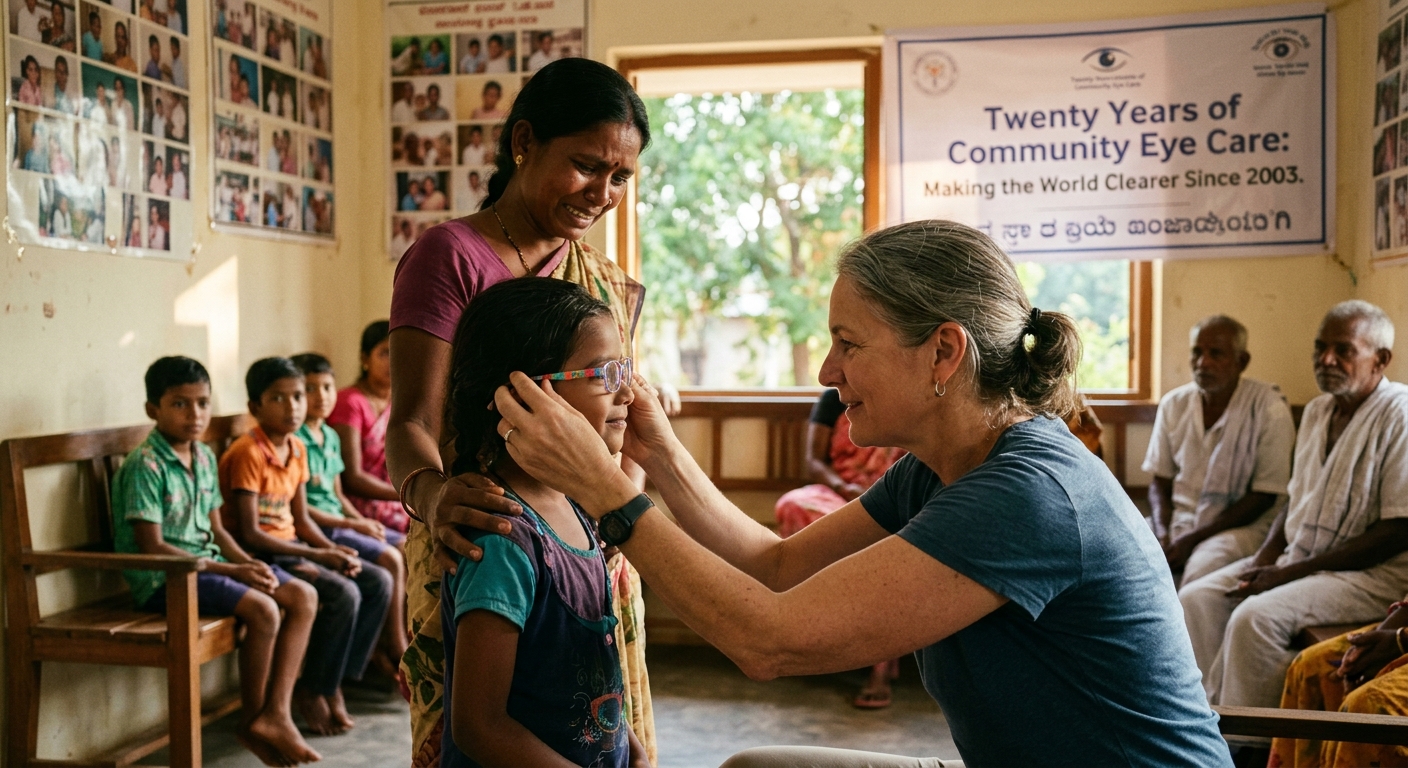
By conservative estimate, Carol has purchased glasses for well over 200 students across her teaching career. She keeps no official count because, as she puts it, “I was never doing it to keep score.” Her approach has never changed: she identifies the child, quietly arranges an eye exam at a local optometrist who eventually began offering her a discounted rate, and ensures the glasses are ready before the child’s academic momentum suffers further.
She typically spends between $80 and $150 per child, depending on the prescription and frame needed. On a teacher’s salary, that is a genuine sacrifice made dozens of times over two decades. She estimates she has spent somewhere between $20,000 and $30,000 of her own money over the course of her career on this singular act of care.
When asked if she regrets any of it, she laughs. “Not for a single second. What would I regret? Helping a kid read the board? Come on.”
What Her Students Remember
Marcus, now 29 and working as an engineer in Columbus, found Carol on social media a few years ago to thank her. He had not known until his mother told him as an adult that it was Carol who had paid for his first pair of glasses.
“I thought I was just bad at school,” he wrote in a message to her. “I thought something was wrong with me. And then I got those glasses and I realized I had just never been able to see. You did not just fix my vision. You fixed how I saw myself.”
His message was one of dozens Carol has received over the years. Former students who grew up, looked back, and connected the dots. A pair of glasses at age nine that changed the trajectory of a childhood. A teacher who noticed, and chose not to look away.
Why She Never Made It Public
For most of her career, Carol told almost no one what she was doing. She worried that publicizing it would embarrass the families involved, many of whom were already navigating the quiet indignity of financial hardship.
“These are proud families,” she says firmly. “They are doing their best. The last thing I wanted was for a child to feel like a charity case, or for a parent to feel like they had failed. So we kept it simple. The child needed glasses. The child got glasses. That was the whole story.”
It was only when a colleague spotted a receipt on Carol’s desk and put the pieces together that her story began to circulate among local educators. Even then, Carol deflected attention with characteristic directness: “Anyone would do it,” she said. To which her colleague replied, “But they don’t. You do.”
The Ripple Effect She Never Planned
Carol’s quiet example has inspired several of her colleagues to start their own informal support systems, covering everything from school supplies to winter coats to bus fare. The optometrist who partnered with her years ago now offers discounted exams to any teacher in the district who refers a student in need.
A local Lions Club chapter, which has long supported vision initiatives nationwide, reached out to Carol two years ago after hearing her story through local news coverage. They now collaborate with her, expanding the reach beyond what she could manage alone. She was grateful, though she was careful to make one thing clear to them from the start: the dignity of the families must always come first.
“It cannot feel like charity,” she told them. “It has to feel like care. There is a difference, and children feel that difference deeply.”
What We Can Learn From Carol Simmons
Carol is retiring at the end of this school year. She is not writing a book. She is not launching a foundation. She is going to garden, visit her grandchildren, and probably, if we know Carol at all, find some other quiet way to make the world a little clearer for someone who needs it.
Her story does not come with a grand moral or a call to action. It is simply a portrait of what sustained, unglamorous, deeply personal kindness looks like in practice. It looks like showing up every day for twenty years. It looks like watching carefully and acting quietly. It looks like believing, without needing anyone else to agree, that a child’s ability to see the world is worth every penny.
There are children today, now adults, who can read road signs and spreadsheets and bedtime stories to their own kids because one teacher decided that squinting was not acceptable when she could do something about it.
That is the whole story. And it is more than enough.