🎧 Listen to this story
Narrated by Sadachbia · 7,788 characters
A Quiet Mission With a Massive Heart
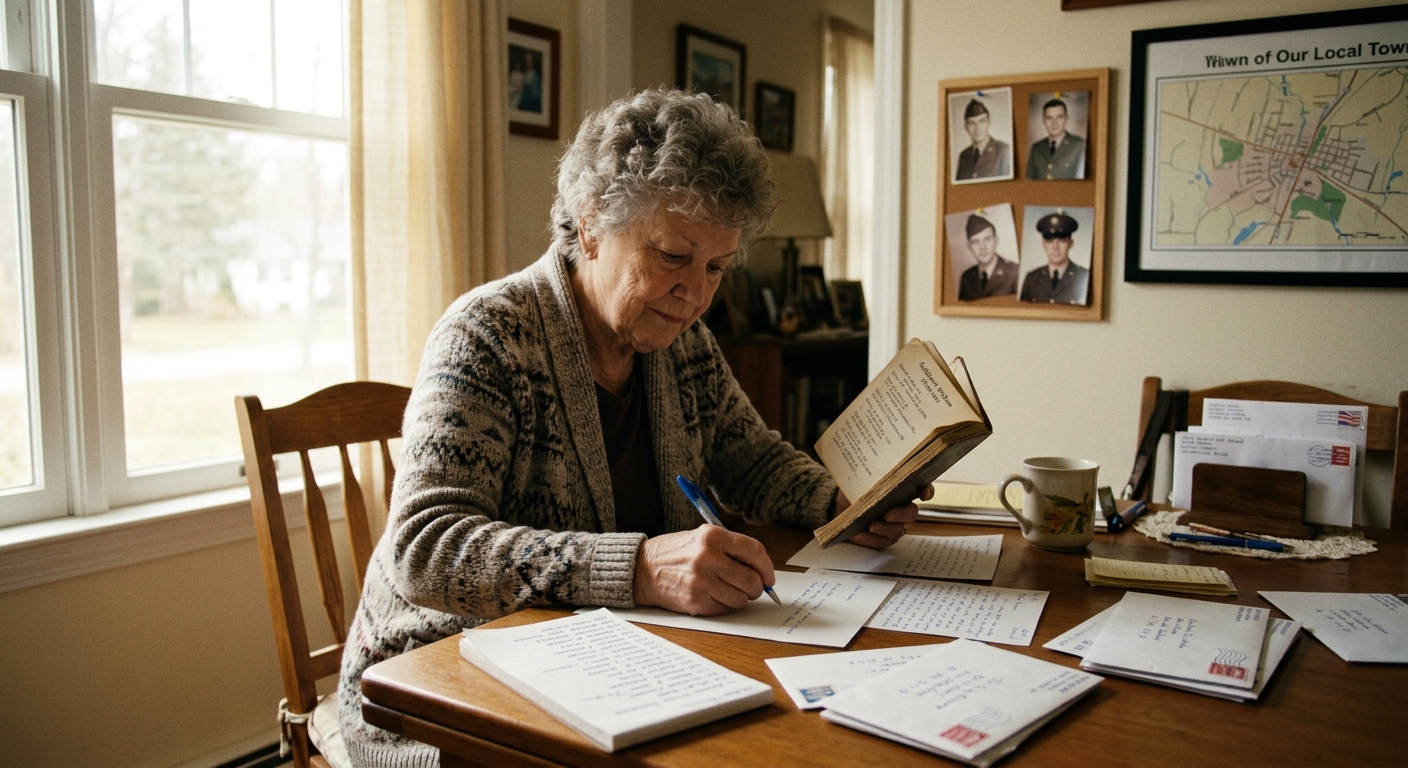
In a small suburb of Columbus, Ohio, a retired schoolteacher named Donna Merritt spends her Tuesday and Thursday mornings the same way she has for the past eleven years: surrounded by boxes, bubble wrap, beef jerky, wet wipes, and handwritten notes. Her dining room table disappeared under the project long ago. Her husband, Gary, jokes that he hasn’t eaten a proper dinner in a decade.
But nobody in the Merritt household is complaining. Because what Donna does in that cramped, cheerful room is nothing short of remarkable. She tracks down the name and mailing address of every active-duty service member deployed overseas who lists her zip code as their home, and she sends each one a care package. Every single one. No exceptions.
As of this spring, she has mailed over 4,200 packages.
How It Started: One Name on a News Ticker
Donna didn’t set out to build a movement. In 2013, she was watching a local news segment when she saw the name of a young man she recognized scrolling along the bottom of the screen. He had been deployed to Afghanistan. She had taught his older sister in fourth grade.
‘I thought, does he have what he needs? Does anyone think about him on a Tuesday?’ she recalls. ‘Not just his family. I mean strangers. Does a stranger think about him?’
She called the local VA office, asked a few questions, got redirected several times, and eventually found a contact who helped her understand how to obtain deployment rosters through coordination with family readiness groups and local National Guard units. It took three weeks of phone calls. The first package she sent contained a paperback novel, a bag of trail mix, two pairs of wool socks, and a note that said: ‘You are seen. You are appreciated. Come home safe.’
He wrote back. And that, as Donna puts it, ‘was that.’
The Anatomy of a Care Package
There is more science to this than you might expect. Over the years, Donna has refined her approach based on feedback from the hundreds of service members who have written back or connected with her on social media after returning home. She now maintains a running checklist she updates every six months based on what people actually say they needed.
Standard Items in Every Box
- High-protein snacks: jerky, nuts, protein bars, and peanut butter crackers
- Personal hygiene items: travel-size deodorant, chapstick, foot powder, and wet wipes
- Entertainment: a paperback book chosen based on gender and age when possible, a small puzzle or card game
- Comfort items: a soft pair of socks, a small candle (unscented, per postal regulations for certain regions), and a prayer card or motivational quote card
- A handwritten note, always personal, never generic
‘The note is the most important thing,’ Donna says firmly. ‘I spend more time on the note than on anything else in the box. I want them to feel like a real human being wrote it, not a template.’
When she knows details about the recipient, she uses them. When she doesn’t, she writes something universal but deeply warm. She once spent forty-five minutes composing a note to a 19-year-old she knew nothing about, trying to strike the right balance between encouragement and honesty.
‘I told him that being scared doesn’t mean you’re not brave,’ she says. ‘That fear and courage live in the same place.’
He was one of the people who came to find her in person when he got home.
The Community That Grew Around Her
What started as one woman’s Tuesday project has since pulled in an entire neighborhood. A local grocery store now holds a quarterly donation drive specifically for Donna’s mission. A church group meets every other Saturday morning to help her pack boxes. A retired postal worker volunteers his time to handle the shipping logistics, which have grown complex enough to require a spreadsheet.
Three high school students approached her two years ago and asked if they could make it a service project. They now run a social media page that has gathered over 12,000 followers and helps Donna crowdfund shipping costs, which can run into the hundreds of dollars per month.
‘I never asked for any of this help,’ she says, laughing softly. ‘But I was never going to say no to it either. This is bigger than me. It always was.’
What the Recipients Say
The responses Donna has received over the years fill four binders that she keeps on a shelf in her living room. She calls them her ‘treasury.’ Some letters are short, just a few lines. Others run for pages.
One Army sergeant wrote: ‘I’m not from a big family and I don’t get a lot of mail. Opening your box was the first time in four months that I cried. Good tears. The kind that remind you you’re still a person and not just a rank.’
A female Air Force officer wrote to say that she had been having one of the worst weeks of her deployment when the package arrived. ‘The socks were perfect. The note made me call my mom. I hadn’t called her in three weeks because I didn’t want to worry her. You broke that open.’
A Marine who served two tours and is now back home visited Donna last Thanksgiving with his wife and two kids. He sat at her table, ate some of Gary’s cooking, and spent an hour telling stories. Before he left, he handed her a small framed photo of himself in uniform.
‘It’s on the shelf with the binders,’ Donna says. ‘Right in the middle.’
The Cost, and How She Manages It
Running this operation is not cheap. Donna estimates that between supplies and shipping, each package costs between $28 and $45 depending on the destination. In years when she sends 400 or more packages, that adds up quickly. She and Gary contribute a portion of their retirement income to cover costs, but the community fundraising now shoulders a significant share of the burden.
She has been approached about setting up a formal nonprofit. She has thought about it seriously. For now, she prefers the intimacy of the current structure, where she knows every dollar and every box. ‘The minute it becomes a bureaucracy, I worry it loses the thing that makes it work,’ she explains. ‘Right now, it’s still just me knowing someone’s name and caring about what happens to them.’
7 Things We Can Learn From Donna’s Mission
- Specificity is kindness. Generic gestures are fine. Personal ones are transformative. Donna writes individual notes because details signal genuine attention.
- Start with one. Every massive act of sustained goodness begins with a single decision directed at a single person.
- Ask questions and then listen. Donna updated her care package list based on real feedback. Kindness improves when you stay curious.
- Community follows sincerity. She never recruited volunteers. They came because what she was doing was clearly real.
- Consistency matters more than scale. One package a week for eleven years beats one thousand packages once.
- You don’t need permission to care. Donna made phone calls, got redirected, and figured it out. She didn’t wait for someone to hand her a system.
- The return is unexpected and enormous. Donna says she has received far more from the letters and visits than she has ever given in beef jerky and paperbacks.
A Tuesday in the Merritt House
On the Tuesday I visited, Donna was packing nine boxes. The local news had recently run a short feature on her, and two new families had contacted her with names of deployed relatives from the zip code. She had added both to her list without hesitation.
Gary brought us coffee and quietly disappeared back into the kitchen. A folded note sat on top of an open box, written in Donna’s rounded, careful handwriting. I didn’t read it. But I saw the last line before she folded it closed.
It said: ‘Somebody at home is thinking about you today. That somebody is me.’
She pressed the flap shut, reached for the packing tape, and moved on to the next one.