
🎧 Listen to this story
Narrated by Callirrhoe · 7,445 characters
The Ward That Never Fully Sleeps
Children’s hospitals are places of controlled urgency. Monitors beep, nurses move quickly between rooms, and somewhere down a corridor, a small voice is asking for something no medication can provide: a familiar presence at bedtime. For many hospitalized children, that presence simply does not come. Parents work night shifts, live hours away, or are caring for other children at home. Some children have no family to call at all.
It is into this gap that one pediatric nurse, Diana Flores, has quietly stepped, not as a policy, not as a program, but as a personal commitment she has maintained for nearly six years at a children’s hospital in the Pacific Northwest.
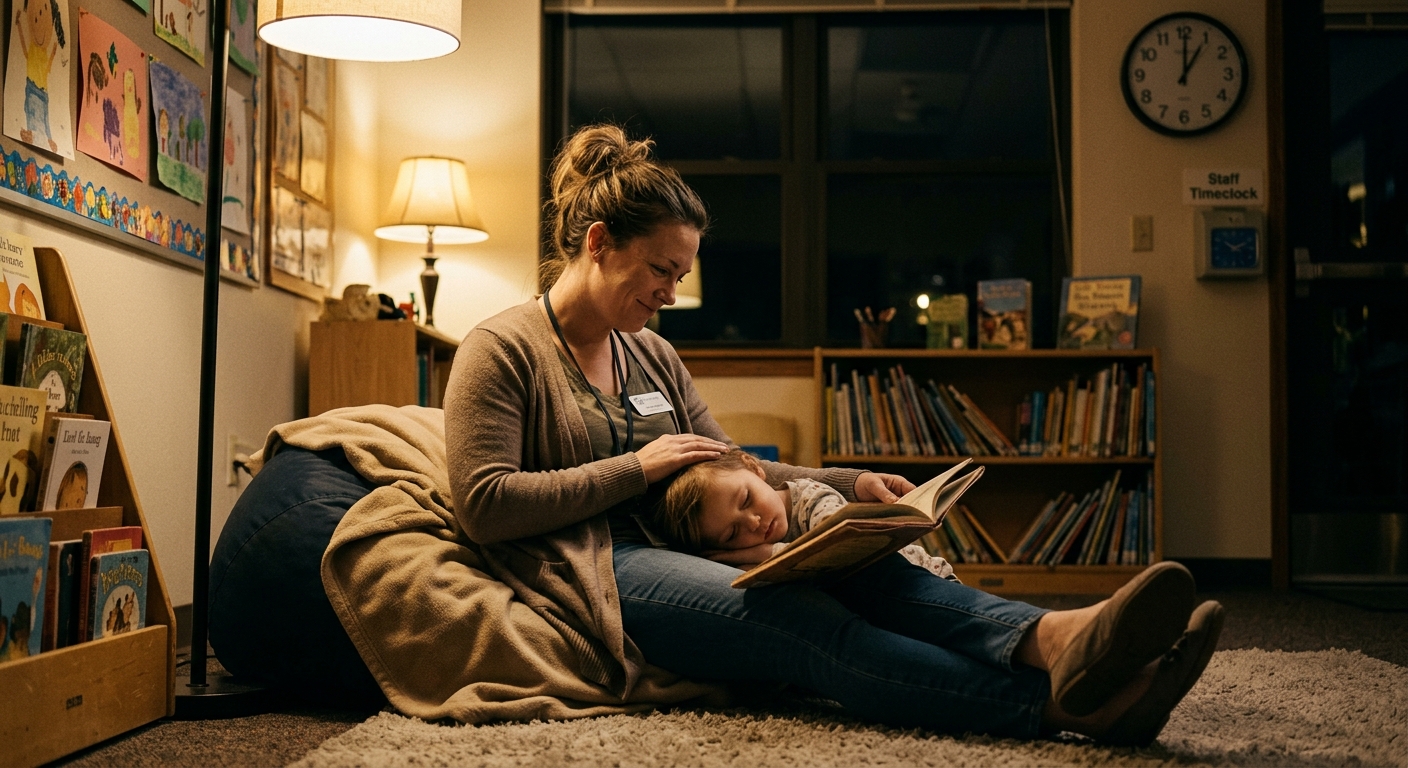
Every weeknight, after her official shift ends, Diana changes out of her work scrubs and into regular clothes. Then she walks back into the ward.
How It Started: A Tuesday Night in February
Diana did not set out to become the nurse who reads bedtime stories. She describes herself as practical, organized, and not particularly sentimental on the surface. But in February 2018, she stayed late to finish charting and passed a room where a seven-year-old boy named Marcus was lying completely still, staring at the ceiling. His mother had just called to say she could not make it that night. The drive was three hours each way, and the roads were icy.
Diana asked if he was okay. He said yes. She asked if he was tired. He said no. She asked what he would normally be doing at home right now. He thought about it and said, probably getting a story read to him.
She pulled the only book from his bedside table, a worn copy of Charlotte’s Web that a volunteer had left, and she sat down. She read for forty minutes. Marcus was asleep before Wilbur even met Charlotte.
She did not think much of it that night. But the next week, she passed another room. And the week after that, another child. And slowly, without ever making an announcement or a formal decision, Diana began showing up.
What the Routine Actually Looks Like
Diana’s approach is deliberately low-key. She does not want children to feel like a project or a recipient of charity. She walks in casually, asks what they are in the mood for, and lets them lead the conversation. Some nights they want a picture book. Some nights they want her to make up a story entirely. One eleven-year-old girl asked her to read from a Harry Potter book for twelve consecutive nights until she finished the whole thing.
She keeps a small canvas bag near the nurses’ station filled with donated books sorted loosely by age group. Staff members have started adding to it. A janitor named Phil brings in books his grandchildren have outgrown. A radiologist leaves new additions in the break room with a sticky note that just says for Diana’s bag.
She spends anywhere from twenty minutes to over an hour with each child, depending on what they seem to need. She does not rush. She does not check her phone. She is, for that stretch of time, entirely present in a way that is increasingly rare and, for a sick child alone in a hospital bed, profoundly meaningful.
What the Children Say
Hospital staff have quietly collected comments from children and, where appropriate, their families. A few that have been shared with permission:
- A nine-year-old recovering from appendix surgery: “She does the voices. My mom doesn’t even do the voices.”
- A twelve-year-old with a chronic illness who was hospitalized for two weeks: “It was the only part of the day that felt normal.”
- A five-year-old who had never met Diana before her first story night: “Is she magic? She made me not scared.”
- A father reached by phone after his daughter’s discharge: “I didn’t know this was happening until my daughter told me at home. I cried for about ten minutes.”
The Science Behind Why This Matters
What Diana does instinctively, research strongly supports. Studies in pediatric psychology consistently show that familiar routines, including bedtime rituals, dramatically reduce anxiety in hospitalized children. The act of being read to engages the parasympathetic nervous system, slowing heart rate and promoting the kind of calm needed for restorative sleep.
Dr. Anita Reyes, a child psychologist who consults with several regional hospitals, explains it this way: “When a child is sick and away from home, their nervous system is in a near-constant state of low-grade alert. Even a brief period of calm, predictable, nurturing interaction can interrupt that stress response in a significant way. Sleep quality improves, pain perception decreases, and emotional resilience increases. This is not a soft benefit. It is clinical.”
Diana did not know any of this when she started. She just knew that a child was staring at a ceiling and she had forty minutes and a worn copy of a book about a spider who loved a pig.
The Quiet Ripple Effect
What began as one nurse’s habit has begun to spread without any formal coordination. Two other nurses on Diana’s ward have started doing their own versions of it. A hospital chaplain now reads on Sunday evenings. A retired teacher volunteers twice a week after seeing a social media post that a parent wrote about her daughter’s experience.
Diana is not entirely comfortable with the attention. She gave one short interview and then asked to step back from the spotlight, concerned that the focus on her would overshadow the children. Her supervisor describes her as someone who is slightly embarrassed by admiration and very comfortable with just doing the work.
That discomfort, perhaps, is part of what makes her example so worth talking about. She did not do this to be seen. She did it because a child needed something and she had the capacity to give it.
7 Things Her Story Teaches Us About Everyday Kindness
- It starts with noticing. Diana did not seek out an opportunity. She walked past an open door and paid attention.
- The smallest actions carry the most weight. Reading aloud for forty minutes costs nothing and changes everything for the child receiving it.
- Consistency builds trust. The children who benefit most are those who learn they can count on someone to show up. Reliability is its own form of love.
- Kindness is contagious when it’s visible. Two other nurses, a chaplain, and a retired teacher all joined in without being asked, simply because they saw it happening.
- You do not need a program. You need a decision. Diana never filed paperwork, formed a committee, or applied for a grant. She just kept showing up.
- Presence is the rarest gift. In a world full of distractions, choosing to put your phone away and be fully present with someone is increasingly extraordinary.
- The people doing the most meaningful work are often the least interested in talking about it. The most powerful acts of kindness frequently come from people who would rather you not write about them at all.
A Final Word
Marcus, the seven-year-old boy from that first February night, has been back to the hospital twice since then, once for a follow-up procedure and once when his asthma flared badly in winter. Both times, Diana was working. Both times, she came back after her shift. Both times, she read to him.
He is thirteen now. He knows her name. He knows she will come. And in a place where so much is uncertain and frightening, that knowledge, that one reliable, warm, story-shaped certainty, is not a small thing. It is, for a child alone in a hospital bed at night, just about everything.