🎧 Listen to this story
Narrated by Kore · 7,983 characters
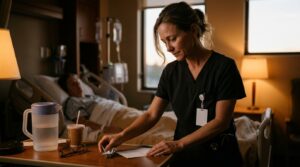
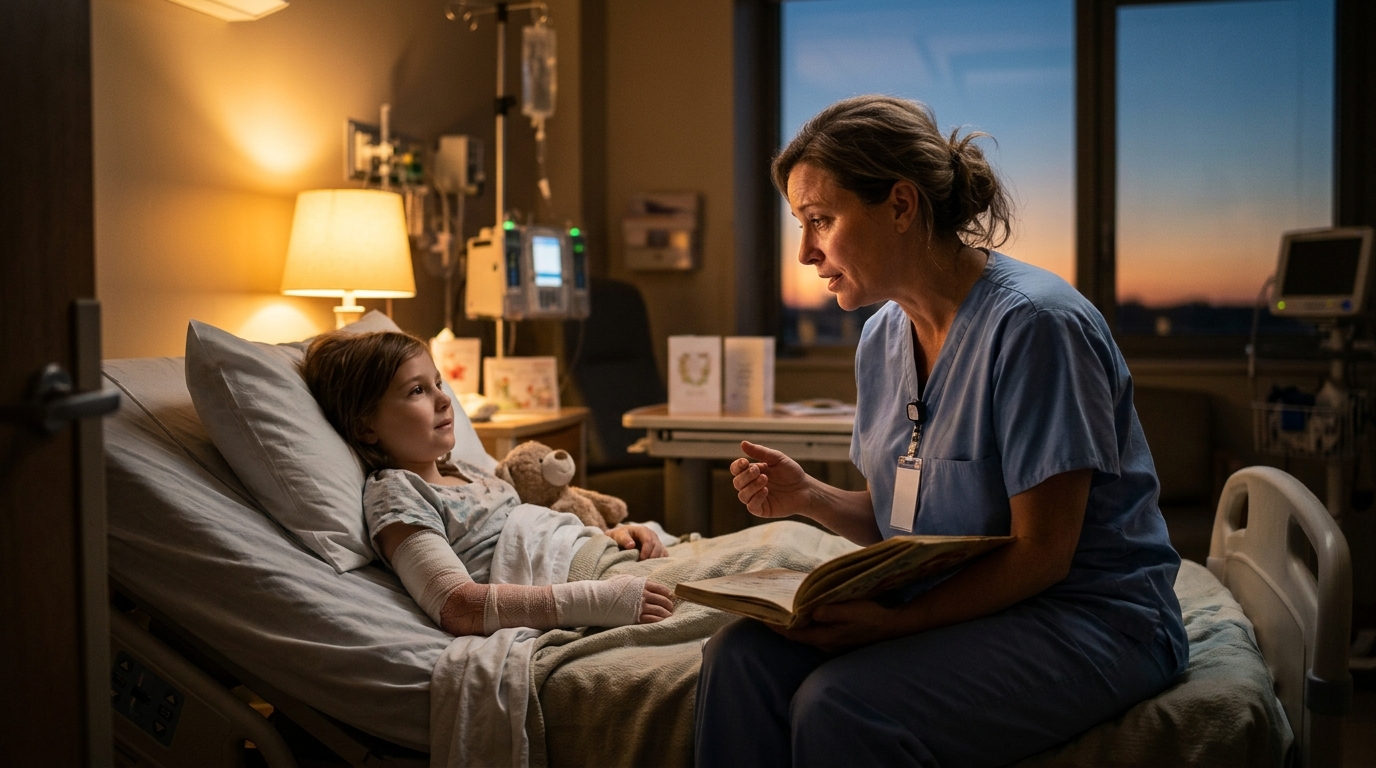
There is a particular kind of quiet that settles over a burn unit after the evening visitors leave. The monitors keep their soft rhythm. The hallway lights drop to amber. And somewhere down the corridor, a nurse pulls a chair up to a bed, lowers her voice, and begins a story.
This is a portrait of that hour, and of the nurse who made it matter. We have changed her name to Marguerite, and softened a few identifying details, because she asked us to. She did not want credit. She said the stories were never really hers anyway.
The Hour Nobody Scheduled
Marguerite spent nineteen years working the evening-to-night shift on a regional burn unit. Her days, as she describes them, were a blur of dressing changes, fluid calculations, whirlpool debridement, and the relentless arithmetic of pain management. Burn care is among the most physically and emotionally punishing work in medicine. Patients endure procedures that make even seasoned clinicians wince. Healing is slow, and it is rarely linear.
What the charts could not capture was what happened after the last scheduled task was done.
“Around eight or nine, the unit changes,” she told a colleague who later wrote down her recollections. “The day staff are gone. The family has gone home to sleep. The procedures are over. And that is when the fear comes out. People can be brave all day. Nighttime is when they run out of brave.”
So she started doing something small. On her slower evenings, once her rounds were complete, she would sit with whoever couldn’t settle and tell them a story. Not a clinical explanation. Not a pep talk. A story, with a beginning and a middle and an ending that let the listener rest.
How It Began
The first time, she says, was an accident. A teenage patient, recovering from burns sustained in a kitchen fire, could not sleep. Every position hurt. Every shadow on the ceiling looked like something from the night of the accident. Marguerite had already given what pain relief she could. She sat down because her feet were tired, and because she did not know what else to offer.
“I asked him what the best day of his life had been,” she recalled. “He said it was a fishing trip with his grandfather. So I asked him to tell me about it. Then I started telling him about a fishing trip of my own, one that went terribly wrong in a funny way. He laughed, which hurt him, and then he apologized for laughing, and then he fell asleep mid-sentence.”
She sat there another twenty minutes, just listening to him breathe.
What the Stories Looked Like
Over the years, Marguerite developed a loose collection of bedside tales. She never wrote them down. She adapted each one to the person in front of her. Some patterns emerged:
- Small, specific, and sensory. She favored stories about kitchens, gardens, rainstorms, and long drives, anything with textures and smells that gently pulled attention away from the body’s alarm signals.
- Low stakes, soft endings. No cliffhangers. No tragedies. Every story landed somewhere safe.
- Room for the patient. She often stopped midway and asked, “What do you think happens next?” Patients who could barely speak about their injuries would suddenly have opinions about a runaway goat.
- Told in a steady, unhurried voice. The cadence mattered as much as the content. Many patients said afterward that they remembered the sound more than the words.
What the Research Quietly Suggests
Marguerite was not a researcher, and she would be the first to say she never set out to prove anything. But the instinct behind her practice lines up with what many clinicians already observe. Distraction, calm human presence, and predictable soothing routines are widely recognized as helpful companions to medical pain management, particularly for patients facing repeated, difficult procedures. Sleep, in turn, is deeply tied to recovery: the body does a great deal of its repair work during rest.
None of this replaces medicine. Marguerite was meticulous about her medications, her sterile technique, and her documentation. The stories lived in the margins of her care, not in place of it. But she came to believe, and many of her patients agreed, that the margins mattered more than anyone admitted.
The Patient Who Asked for the Ending
One story stays with her more than the rest. A man in his fifties, a welder who had suffered severe burns to his hands and arms, was struggling with something deeper than pain. His hands were his livelihood and his identity. He barely spoke for the first two weeks.
One evening, Marguerite told him a story about a stonemason who rebuilt an old garden wall one stone at a time, and who discovered that the wall, once finished, looked different from the one he had remembered. Not worse. Different. Stronger in places he had not expected.
The welder said nothing. But the next night, when she came on shift, he was awake and waiting.
“Did the mason ever plant anything by the wall?” he asked.
She had not planned that part. She improvised. The mason planted climbing roses, she said, and they took years to cover the stone, but they did.
“That night was the first time he talked about going home,” she said. “Not about whether he would work again. Just about his yard. He had a yard. He wanted to see his yard.”
Why Evening Is Different
Ask anyone who has spent a night in a hospital and they will tell you the hours after dark feel longer, heavier, and lonelier than the day. The distractions fall away. The mind turns inward. Worries that were manageable at noon grow teeth at midnight.
Marguerite understood this instinctively. “Daytime is for fixing,” she said. “Nighttime is for holding. They need both. But nobody schedules the holding.”
She often thought about that phrase on her own drive home, in the gray hours just before sunrise, when she would sit in her car for a few minutes before going inside. Some nights she cried. Some nights she simply breathed. The work asked a lot of her, and she paid for it quietly, the way caregivers often do.
Lessons From the Chair by the Bed
When Marguerite retired, a younger nurse asked her what she had learned. She thought about it for a long time before answering. These are the things she shared:
- Presence is a clinical skill. Sitting down, truly sitting, changes the entire feel of a room. Patients can tell the difference between someone who is leaving and someone who is staying.
- You do not have to fix the fear. You only have to keep it company.
- Let patients be the authors. A story they help write belongs to them in a way that reassurance never will.
- Protect the small rituals. The unit grew busier every year. She fought to keep ten quiet minutes, because those minutes were often what a patient remembered.
- Take care of the person doing the caring. Compassion is not bottomless. She learned to rest, to talk to someone about the hard days, and to forgive herself for the things she could not change.
What Remains
Several of her former patients still write to her. One sends a card every winter with a drawing of a fishing boat. Another, the welder, mailed her a small iron rose he forged himself, the petals slightly uneven, the stem a little thick. It sits on her kitchen windowsill.
“It is not a perfect rose,” she said, smiling. “That is exactly why I love it.”
A Gentle Thought for Your Own Evening
You do not need to work in a hospital to practice what Marguerite practiced. Tonight, somewhere near you, someone is struggling to wind down. A tired parent. A grieving friend. An elderly neighbor. A child who is afraid of the dark.
You might sit with them for ten minutes. You might tell them about a rainstorm you once loved, or ask them about the best day they remember. You do not have to be a gifted storyteller. You only have to be willing to stay, and to speak softly, and to let the evening be a little less lonely than it would have been.
The day’s work is done. The lights are low. Somewhere, a chair is waiting to be pulled up to a bed. Maybe, just maybe, it is yours to fill.