🎧 Listen to this story
Narrated by Kore · 7,809 characters
The hospital hallway changes after dinner trays are collected. The overhead lights dim a notch, the rolling carts go quiet, and a hush settles over the rooms like a blanket being pulled up. For eleven months, Marisol Vega-Alden walked that hallway at exactly seven o’clock, and for eleven months, the woman in room 214 waited for the sound of her footsteps.
The Morning Everything Stopped
Marisol’s mother, Lucía, was sixty-eight when the stroke came. It arrived on an ordinary Tuesday, in the middle of watering the tomato plants she had grown on the same patio for thirty years. A neighbor found her, and by the time the ambulance reached the hospital, the damage was already written across her scans in the language that doctors dread.
The prognosis was delivered gently but without ambiguity. A massive stroke on the left side of the brain. Loss of speech. Paralysis on the right side. The neurologist used careful phrases like “significant limitations” and “manage expectations,” and Marisol understood what was underneath them. Her mother, the woman who had sung in the kitchen every morning of her childhood, would probably never speak again.
“They didn’t say never,” Marisol told me later. “But they said it in every way except the word itself.”
A Decision Made in the Quiet
Marisol worked full days as a school administrator. She had a husband, two teenagers, and a calendar that never had a blank square. She could not sit at her mother’s bedside all day, and the guilt of that sat on her chest like a stone.
So she made a small promise instead, the kind you make because a big one feels impossible. She would come every night. Not for hours. Just from seven until the nurses gently signaled that visiting time was ending. Whatever kind of day she had survived, she would walk through that door.
She did not go in with a plan to heal anyone. She went in because she could not bear the thought of her mother lying alone as the sky outside the window turned from gold to gray.
What the Evenings Looked Like
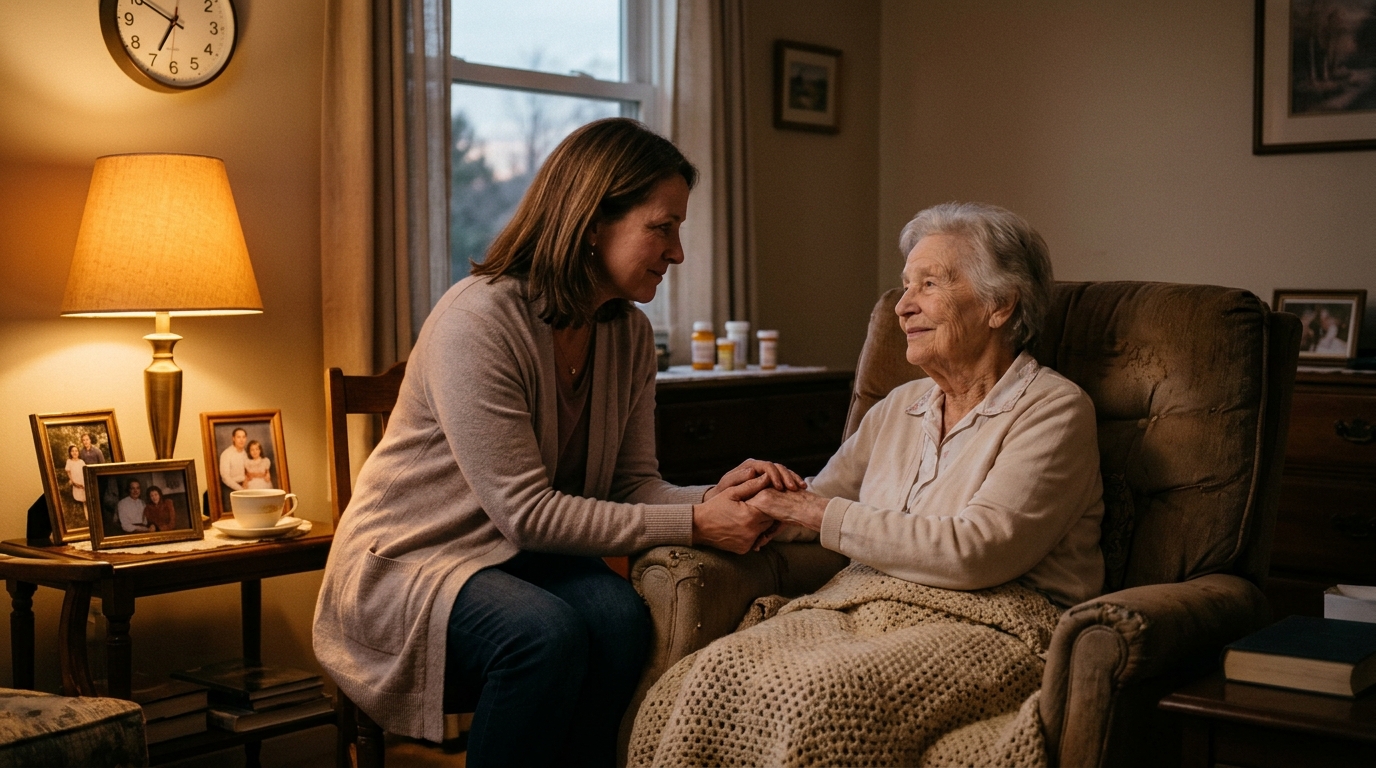
In the beginning, there was very little to show for it. Lucía lay still, her eyes tracking but rarely settling. Marisol pulled a chair close, took her mother’s left hand, the one that could still squeeze, and simply talked.
She talked about the school day. She described the kids who tracked mud through the front office. She read from the novels her mother used to love, doing the voices badly on purpose. When she ran out of things to say, she hummed, and eventually she began to sing the old songs, the ones Lucía had sung over the stove.
Over those first weeks, a few small rituals took shape:
- The window. Marisol always opened the blinds so they could watch the light fade together. She narrated the sunset the way you might describe a painting to someone who couldn’t see it.
- The hand cream. She massaged lavender lotion into her mother’s paralyzed right hand, slowly, speaking to it as if it were still listening.
- The song. Always the same lullaby to close the visit, a soft Spanish melody Lucía had sung to her as a child.
- The goodbye. A kiss on the forehead and the same words each night: “I’ll be back tomorrow. I promise.”
The Night Something Shifted
It was the ninth week. Marisol was halfway through the lullaby, her voice cracking from a long day, when she heard something that did not belong to the room’s usual sounds.
It was a note. Thin, uneven, a half-step off. But unmistakably a note, and it was coming from her mother.
Lucía could not form words. The part of her brain that built language had been devastated. But music lives in a different neighborhood of the mind, and somewhere in that neighborhood a door had stayed unlocked. Marisol froze, then kept singing, and her mother hummed along, tracing the melody she had known for six decades.
“I cried so hard I had to stop,” Marisol said. “And she looked at me, and I swear she knew exactly why.”
The next morning, Marisol told the speech therapist. The therapist, who had seen this before, was not surprised. Rhythm and melody can sometimes route around damaged language centers, and singing has been used in stroke rehabilitation for exactly this reason. What mattered was that someone had found the way in.
Why Evening Mattered
Here is the part that stays with me, and the reason I wanted to share this story at the end of a day rather than the start of one.
The therapists and nurses noticed something about Lucía’s evenings. During the day, she was often fatigued, frustrated, tangled in the effort of therapy. But after Marisol’s visits, she slept more deeply. Her vitals settled. The staff began to schedule the gentlest parts of her care around that seven o’clock window.
There is a particular kind of safety that arrives at the close of a day. The demands recede. The noise drops. A body that has been braced all day against pain and effort finally has permission to soften. For someone recovering from a brain injury, rest is not a break from the healing. It is the healing. And Lucía, soothed each night by a familiar voice and a familiar song, was finally resting well.
The Slow Climb
Recovery did not arrive in a rush. It came the way dusk comes, so gradually you only notice it when you look back and realize the light has changed.
First came the hummed melodies. Then single syllables, formed on the rhythm of a song. Then, in month four, a whole phrase, sung rather than spoken: “Mi hija, mi hija.” My daughter, my daughter.
Her therapists built on it, using melodic exercises to coax speech back one stubborn word at a time. The right hand, so long still, began to twitch under the lavender lotion, then to curl, then to grip. By month eight, with a brace and a lot of stubbornness, Lucía stood between parallel bars and took three shaking steps.
No one in that first meeting had predicted any of it.
What We Can Learn From a Hospital Chair
I am cautious about stories like this. Recovery is complicated, and Lucía’s progress owed everything to a team of skilled doctors, nurses, and therapists, along with her own formidable will. Not every stroke survivor regains what she did, and no one should walk away from this believing that love alone is a treatment plan.
But the story does carry a few quiet truths worth holding onto:
- Consistency can matter more than intensity. Marisol did not give grand gestures. She gave one reliable hour, every single night.
- Familiar things reach us when words cannot. A song, a voice, the smell of a certain lotion can travel pathways that language has abandoned.
- Rest is part of recovery. The calm that closes a day is not wasted time. It is where the body rebuilds.
- Presence is not a small thing. Sitting beside someone, simply staying, tells them they are not facing the dark alone.
Home, Finally
Eleven months after that Tuesday on the patio, Lucía went home. She walks with a cane. Her speech is slow and sometimes searching, but it is hers, and she uses it freely, mostly to boss her family around, which they treasure.
The tomato plants on the patio are thriving again. Marisol planted them herself the spring before her mother came home, so there would be something green waiting.
And at seven o’clock most evenings, the two of them sit outside. They watch the sky turn amber and then violet. Sometimes they talk. Sometimes they just sit. And sometimes, when the light is just right and the day has been kind, Lucía begins to sing, and her daughter joins in.
A Thought for Tonight
As you settle in tonight, consider who in your life might be waiting for a familiar footstep at the end of their day. It does not take much. An hour, a phone call, a song hummed badly on purpose. The people we love are often healed less by what we do than by the simple, steady fact that we came back tomorrow, just as we promised.
Goodnight, and be gentle with the day behind you.