🎧 Listen to this story
Narrated by Iapetus · 10,169 characters
A Room Full of People With Every Reason Not to Laugh
Picture a hospital wellness center on a Tuesday morning. Fluorescent lights hum overhead. Some people arrive in wheelchairs. Others clutch chemotherapy ports beneath their sleeves. A few have lost their hair. Nearly all of them look, understandably, like they would rather be anywhere else on earth.
Then the instructor walks in, claps her hands together, and says, with complete sincerity: “Okay, everyone. Let’s laugh.”
For the first session of a laughter yoga program launched at a regional cancer treatment center, the room was filled with skepticism so thick you could almost taste it. But something happened over the following eight weeks that nobody, not the patients, not the nurses, not even the study coordinators, fully expected. One hundred cancer patients discovered that laughter, even forced, even awkward, even ridiculous laughter, could change the way they experienced one of the hardest chapters of their lives.
This is their story.
What Is Laughter Yoga, Exactly?
Before diving into what happened in that room, it helps to understand what laughter yoga actually is, because it is almost certainly not what you are picturing.
Developed in 1995 by Indian physician Dr. Madan Kataria, laughter yoga combines intentional laughter exercises with yogic breathing techniques called Pranayama. The core philosophy is deceptively simple: the human body cannot distinguish between fake laughter and real laughter. Both trigger the same physiological responses. Both release endorphins. Both reduce cortisol. Both increase oxygen flow throughout the body.
In other words, you do not need a punchline to get the benefits. You just need to laugh.
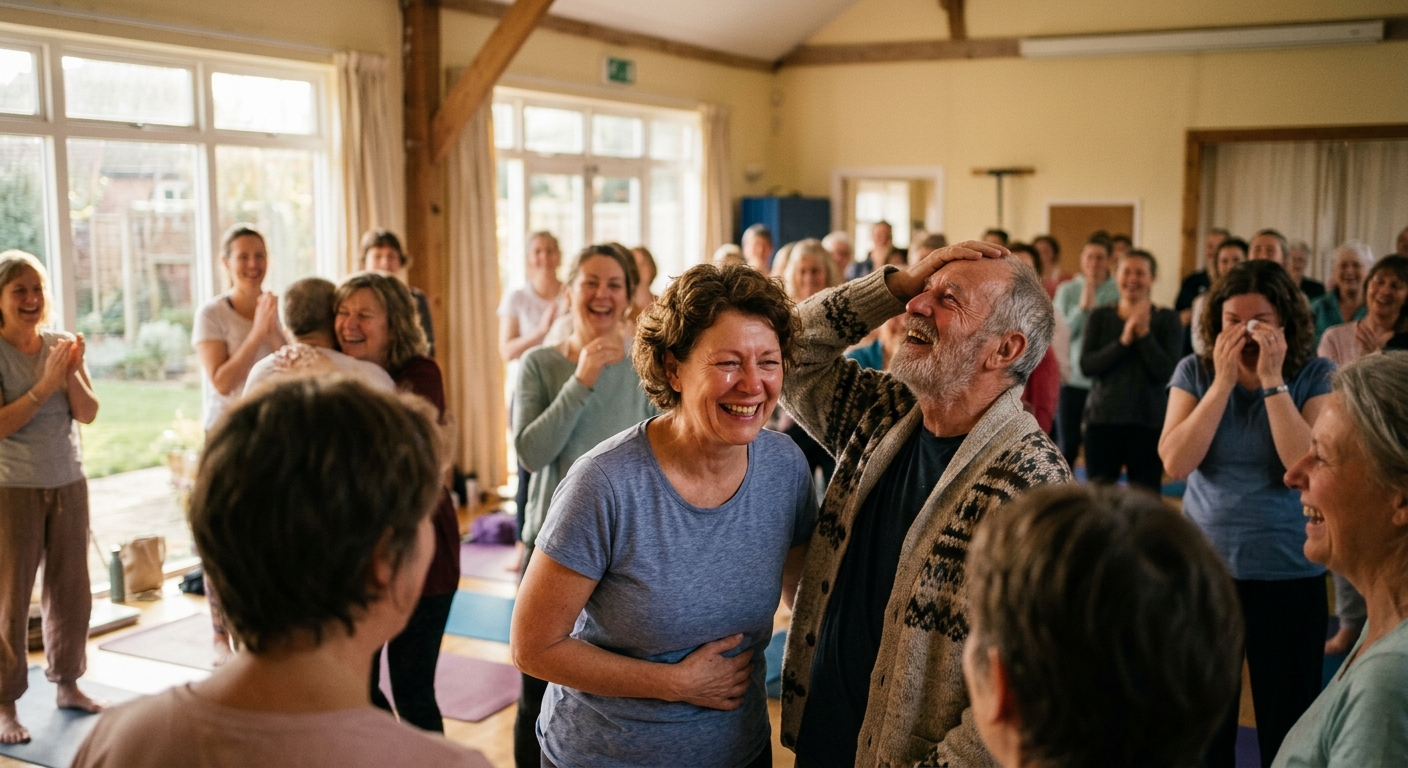
Sessions typically involve a facilitator guiding participants through a series of playful exercises, clapping, eye contact, childlike movement, and simulated laughter that almost always becomes genuine within minutes. It is part theater, part therapy, and entirely disarming.
How the Program Came Together
The program that brought these 100 patients together was spearheaded by certified laughter yoga instructor and oncology social worker Dana Reeves, who had been quietly integrating laughter-based techniques into her individual counseling sessions for years.
“I kept seeing patients who were doing everything right physically, but emotionally they were completely depleted,” Dana explained in a recorded interview for the hospital’s wellness newsletter. “They were surviving, but they weren’t really living. I wanted to give them something that was purely joyful. No agenda, no clinical distance. Just joy.”
After receiving a small wellness grant, Dana launched an eight-week group program. Participation was voluntary. Patients ranged in age from 28 to 79. They represented a wide variety of diagnoses, including breast cancer, colorectal cancer, lymphoma, and lung cancer. Some were in active treatment. Others were in remission but still carrying the psychological weight of their illness.
Before and after each session, participants completed standardized assessments measuring anxiety, depression, perceived pain levels, and overall quality of life.
What the Numbers Showed
The results, compiled after the final session, were striking enough that the program was written up in a regional healthcare journal and later cited in a broader meta-analysis on complementary therapies in oncology.
- 73% of participants reported a significant reduction in anxiety after completing the eight-week program.
- 68% reported lower perceived pain levels, a finding that aligned with existing research on endorphin release and pain modulation.
- 81% said they felt more socially connected to others as a result of attending.
- 89% said they would recommend the program to another cancer patient.
- And perhaps most remarkably: nearly 60% said laughter yoga had changed their overall outlook on their illness.
These were not minor, incidental improvements. For people navigating chemotherapy side effects, surgical recovery, and the grinding uncertainty of a serious diagnosis, these shifts were profound.
The Stories Behind the Statistics
Margaret, 67: “I Forgot I Was Sick”
Margaret had been living with stage three breast cancer for fourteen months when she attended her first laughter yoga session. She described herself as “deeply private” and admitted she almost didn’t come back after the first week.
“The clapping, the silly exercises, I thought it was absolutely absurd,” she said. “But somewhere around week three, I was in the middle of one of the exercises and I looked around the room and I just started laughing for real. And for about twenty minutes, I completely forgot I was sick. I forgot about the next scan, the next round of chemo. I was just a person laughing with other people.”
Margaret completed all eight sessions and continued attending monthly drop-in classes for over a year afterward.
James, 44: Finding Brotherhood in the Strangest Place
James, a construction supervisor diagnosed with colorectal cancer at 42, had struggled deeply with isolation. He described traditional support groups as “not my thing” and had largely withdrawn from friends and colleagues since his diagnosis.
“Men don’t really talk about this stuff,” he said. “But laughing? That I could do. And once you’ve made a complete fool of yourself laughing like a seal with a group of strangers, something breaks open. You start talking. You start connecting.”
By the end of the program, James had exchanged phone numbers with four other participants and met weekly with two of them for coffee long after the formal sessions ended.
Rosa, 52: Reclaiming Her Body
Rosa had undergone a double mastectomy and was midway through reconstruction when she joined the group. Her relationship with her body had become, as she put it, “purely functional and frightening.”
“My body felt like a battleground. Laughter yoga gave me back something I can’t quite name. It reminded me that my body could do something other than fight. It could play. It could be silly. That sounds small, but it wasn’t small at all.”
The Science of Why It Works
Laughter yoga’s benefits in oncology settings are not simply anecdotal. A growing body of research supports what these 100 patients experienced firsthand.
Cortisol Reduction
Chronic stress elevates cortisol, a hormone that, at sustained high levels, suppresses immune function. Cancer patients frequently experience prolonged stress responses that compound the physical challenges of treatment. Studies have consistently shown that laughter, including simulated laughter, lowers cortisol levels measurably, even after a single session.
Natural Killer Cell Activity
Research published in journals including Alternative Therapies in Health and Medicine has found that laughter increases the activity of natural killer cells, a type of immune cell that plays a role in the body’s ability to combat tumor cells. While laughter yoga is not a cancer treatment, this immune-supportive effect is considered meaningfully complementary to conventional care.
The Social Dimension
Group laughter creates what psychologists call “interpersonal synchrony,” a biological bonding mechanism activated when people move, breathe, or vocalize in rhythm together. This is the same mechanism behind why people feel closer after dancing, singing, or exercising together. For cancer patients who often feel profoundly isolated, this synchronized connection is not a luxury. It is medicine.
7 Things the Patients Learned That Might Surprise You
- You do not have to feel happy to laugh. Laughter can come first, and the shift in mood follows. The body leads, and the mind catches up.
- Vulnerability is contagious, in the best way. When one person was willing to look silly, everyone felt safer. The room’s emotional temperature changed in real time.
- Playfulness is not the same as denial. Laughing did not mean pretending the illness wasn’t serious. It meant choosing joy alongside difficulty.
- Shared absurdity builds deep bonds quickly. Patients who had nothing in common outside the group formed lasting friendships through the shared experience of doing something ridiculous together.
- Breathing deeply is its own medicine. The Pranayama component helped many patients manage anxiety and shortness of breath, both common treatment side effects.
- Laughter resets perspective. Multiple participants described a recurring experience of leaving sessions and finding their problems, while still very real, somehow less consuming.
- Joy is a form of resistance. Several patients described laughter yoga as an act of defiance against the heaviness of illness. Choosing delight felt, surprisingly, like strength.
What Happened After the Eight Weeks
The formal program ended, but the group did not. Seventeen participants petitioned the wellness center to continue offering sessions, which it now does twice monthly. A smaller cohort of six patients trained as laughter yoga facilitators themselves and began volunteering in the oncology ward, bringing the practice to patients who were too unwell to leave their rooms.
Dana, the program’s founder, summed it up with characteristic straightforwardness: “We gave people permission to laugh during the hardest time of their lives. And they ran with it. That permission turned out to be one of the most powerful things we could offer.”
Could Laughter Yoga Belong in More Hospitals?
The short answer, based on what these 100 patients showed us, is yes. The program required minimal equipment, low cost, and no medical credentials to facilitate, just training, warmth, and a willingness to look a little ridiculous in service of something genuinely healing.
For anyone currently supporting a loved one through cancer, or navigating it themselves, the takeaway is not that laughter cures anything. It is something more nuanced and perhaps more important: that joy is not something you have to earn or wait for. It is something you can choose, loudly, deliberately, even on the hardest days.
And sometimes, in a fluorescent-lit hospital room with a group of strangers who understand exactly what you are going through, that choice changes everything.