
🎧 Listen to this story
Narrated by Schedar · 7,081 characters
When the Pills Stopped Working
For three years, Maria Calloway did everything her doctors told her to do. She took her antidepressants on schedule, attended weekly therapy sessions, practiced the breathing exercises, and downloaded every mindfulness app recommended to her. She was doing everything right, and yet she still woke up most mornings feeling like the ceiling was pressing down on her chest.
“I wasn’t ungrateful,” says Maria, now 41, speaking from her home in Portland, Oregon. “I knew the medication was keeping me from the darkest places. But I still felt hollow. Like I was just… existing. Getting through days instead of actually living them.”
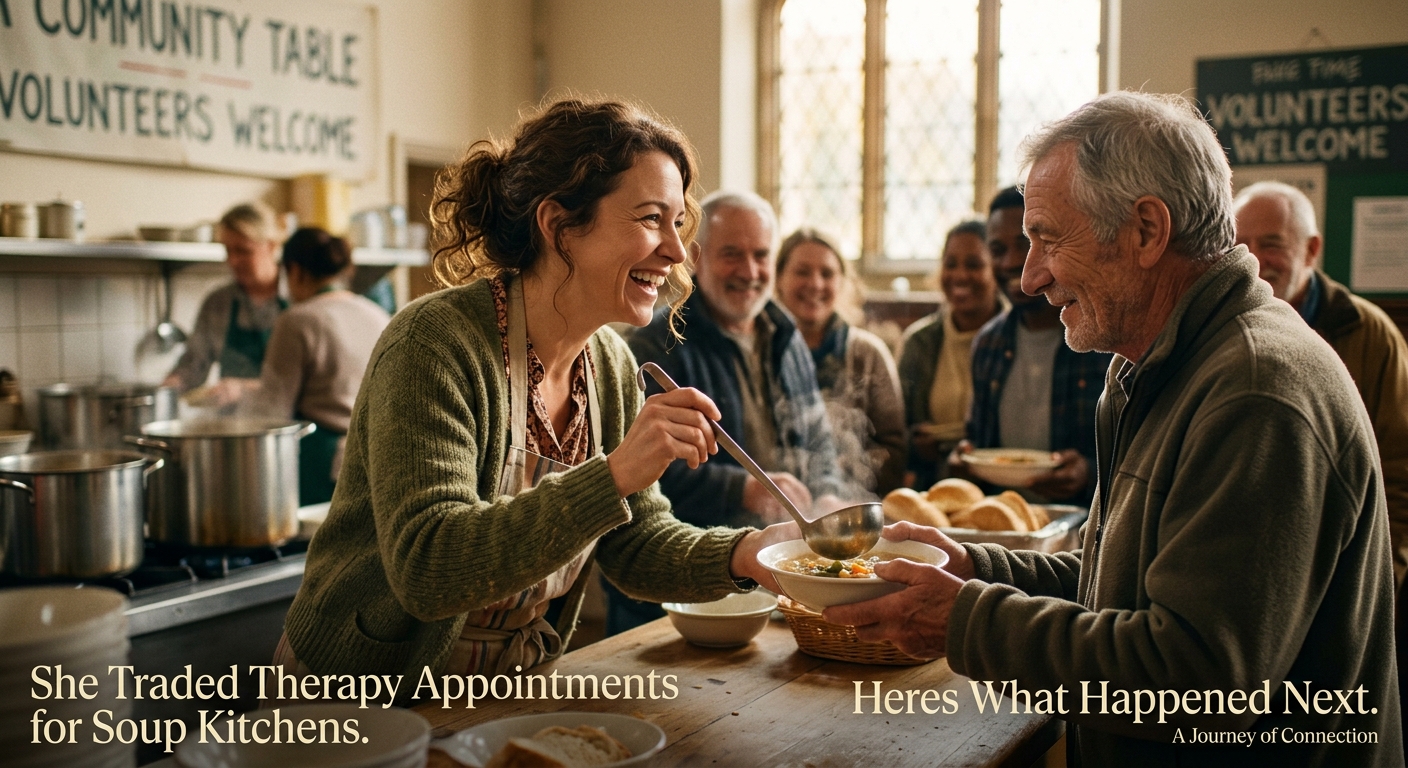
Her turning point didn’t come from a prescription pad or a breakthrough session on a therapist’s couch. It came from a Tuesday afternoon at a local food bank, where a friend had dragged her against her better judgment, and a 78-year-old man named Gerald who told her she made the best grilled cheese he’d had in decades.
She had been there for two hours. She came back the next week. And the week after that.
The Science Behind the Shift
Maria’s story isn’t just a feel-good anecdote. A growing body of research suggests that volunteering has measurable, physiological effects on mental health, particularly for people living with depression and anxiety.
A 2020 study published in the journal BMC Public Health found that people who volunteered at least once a month reported significantly lower rates of depression and higher levels of life satisfaction than non-volunteers. Another landmark study from Carnegie Mellon University showed that adults over 50 who volunteered regularly were less likely to develop high blood pressure, one of the key physical markers associated with chronic stress and depression.
Dr. Lena Forsythe, a clinical psychologist based in Seattle who works with patients managing treatment-resistant depression, explains it this way: “When we are depressed, we become intensely focused inward. Our world shrinks. Volunteering forces us outward. It activates parts of the brain associated with reward and social bonding. It gives us what I call a sense of earned purpose, and that is incredibly powerful.”
She is careful to note that volunteering is not a replacement for professional mental health treatment. “It is a complement, not a cure,” she says. “But for many of my patients, it has been the piece that made everything else start working.”
What Maria’s Week Actually Looks Like Now
Three years after that first Tuesday at the food bank, Maria’s life looks remarkably different. She still sees her therapist, though now only once a month instead of weekly. She still takes a low dose of her medication. But she also volunteers 6 to 8 hours per week across two organizations, and she credits that commitment as a cornerstone of her recovery.
Her schedule now includes:
- Tuesday evenings: Serving dinner at a downtown shelter for unhoused individuals
- Saturday mornings: Reading to children at the public library’s early literacy program
- Monthly: Packing food boxes at the regional food bank where her journey began
“People ask me if it’s exhausting,” she says, laughing softly. “And honestly, sometimes it is. But it’s a different kind of tired. It’s the tired you feel after you’ve actually done something. Not the tired of just surviving another day.”
The Unexpected Gifts That Came With It
What Maria didn’t anticipate when she started volunteering was how much she would receive in return. She went in thinking she was giving. She quickly realized the exchange was far more mutual than she expected.
Gerald, the man who complimented her grilled cheese on that first Tuesday, passed away the following spring. But before he did, he and Maria had dozens of conversations over trays of hot food. He told her about his late wife, about the years he spent as a jazz musician in New Orleans, about the neighborhood where he grew up. “He gave me his whole life in those conversations,” Maria says quietly. “I went there to help him eat. He helped me remember why any of it mattered.”
She also found community she hadn’t known she was missing. Two of her closest friends today are fellow volunteers she met at the shelter. “When you’re depressed, you isolate,” she explains. “Volunteering gave me a reason to show up somewhere that wasn’t about me. And somehow, through that, I found people who actually know me.”
Is This Path Right for You?
If you are living with depression and curious about whether volunteering might help, here are a few things worth considering before you begin:
Start Small and Specific
Maria’s therapist encouraged her to try just one two-hour shift, with no commitment beyond that. She didn’t sign up for a six-month program. She showed up once. The key is lowering the barrier to entry so that depression’s gravitational pull doesn’t stop you before you start.
Choose Something That Connects to Meaning, Not Obligation
Maria loved cooking. The food bank felt natural. Someone else might find meaning in animal rescue, environmental cleanup, or mentoring teenagers. The research suggests that the emotional connection to the cause matters. Volunteering out of guilt or social pressure does not produce the same psychological benefits as volunteering out of genuine care.
Tell Your Doctor or Therapist
Volunteering in certain environments, particularly crisis centers or shelters, can be emotionally intense. If you are in a fragile place mentally, it’s worth discussing the type of volunteer work you’re considering with a mental health professional. This is a wellness tool, not a solo mission.
Let It Be Imperfect
There will be days you show up and feel nothing. Days where the work feels mechanical and you wonder why you came. Maria had plenty of those. “Depression doesn’t vanish the moment you start being generous,” she says. “But I kept showing up anyway. And slowly, the good days started to outnumber the empty ones.”
A Prescription No One Expected
Maria is not anti-medication. She is not dismissing the years of therapy that helped rebuild her self-understanding. She is not suggesting that anyone abandon their treatment plan in favor of a soup ladle.
What she is saying, quietly and with hard-earned conviction, is that purpose heals in ways that are real and measurable and sometimes surprising. That the act of showing up for someone else, repeatedly and imperfectly, can slowly remind you that you are still capable of mattering to the world.
“I went to the food bank because my friend asked me and I had nothing else to do that day,” she says. “I stayed because it made me feel like a person again. Not a diagnosis. Not a set of symptoms. A person who could do something good.”
She pauses, then smiles. “Gerald would have gotten a kick out of all this, by the way. He always said helping people was just common sense. He was right.”
If you are struggling with depression or mental health challenges, please reach out to a qualified healthcare professional. The 988 Suicide and Crisis Lifeline is available by call or text at 988 for immediate support.