🎧 Listen to this story
Narrated by Iapetus · 10,258 characters
The Villages That Forgot to Get Old
There are places in the world where centenarians tend their own gardens, walk steep hillsides, and argue passionately at community dinners. Places where dementia is rare enough to seem almost mythological. Where people do not retire from life so much as simply continue living it, right up until the very end.
These are not fictional utopias. They are real, documented communities scattered across Greece, Japan, Costa Rica, Italy, and California. Researchers have spent decades traveling to these regions, clipboards in hand, trying to reverse-engineer the conditions that produce such extraordinary human health. And what they are finding is at once deeply surprising and somehow deeply familiar.
The secrets of longevity, it turns out, were never really secrets. They were just hiding in plain sight, embedded in daily routines, social structures, and attitudes toward life that modern society quietly dismantled over the past century.
The Blue Zones: A Quick Primer
In the early 2000s, author and researcher Dan Buettner, working alongside National Geographic and a team of demographers, identified five regions where people consistently lived longer and healthier lives than anywhere else on earth. They called these regions Blue Zones.
- Ikaria, Greece: A small Aegean island where residents have one of the lowest rates of middle-age mortality in the world, along with near-absent rates of dementia.
- Okinawa, Japan: Home to the world’s longest-lived women, with a diet rooted in sweet potatoes, tofu, and a powerful social framework called moai, small groups of lifelong friends who support each other through every stage of life.
- Sardinia, Italy: A mountainous island with one of the highest concentrations of male centenarians on the planet.
- Nicoya Peninsula, Costa Rica: A low-income region where residents outlive their wealthier urban counterparts by substantial margins.
- Loma Linda, California: A community of Seventh-day Adventists who live, on average, a full decade longer than typical Americans.
What links these wildly different cultures, cuisines, and climates? That is the question researchers are still working to fully answer. And the deeper they dig, the more they realize the answers challenge almost every assumption modern wellness culture has built its industry around.
It Is Not About the Superfoods
Walk into any health food store today and you will find shelves dedicated to the pursuit of longevity through consumption. Adaptogens, collagen powders, antioxidant supplements, fermented everything. The message embedded in every label is the same: buy this, and add years to your life.
But here is what the research from remote longevity communities actually shows. There is no single food or supplement responsible for extraordinary lifespans. What these communities eat varies enormously. Okinawans eat very little meat. Sardinian shepherds eat plenty of pecorino cheese and cured meats. Nicoyans rely heavily on beans and corn tortillas. Ikarians consume olive oil in quantities that would make a cardiologist nervous.
The pattern that emerges is not about any one ingredient. It is about eating mostly whole, locally sourced food, stopping before you are completely full, and treating meals as social occasions rather than fuel stops. In Okinawa, the concept of hara hachi bu, eating until you are about 80 percent full, is practiced almost unconsciously by elders who learned it in childhood.
Researchers are now beginning to study the microbiome differences between these populations and Western populations, and early findings suggest that the diversity of gut bacteria in Blue Zone communities is significantly richer. Not because of any single probiotic supplement, but because of lifelong exposure to varied, minimally processed foods and, crucially, because of lower chronic stress levels.
The One Factor We Consistently Underestimate
If you were to identify a single thread connecting all five Blue Zones, it would not be diet. It would not be exercise. It would be this: people feel they belong somewhere.
In Sardinia, multigenerational households are still common. Grandparents are not housed in separate facilities. They are present. They are needed. They wake up each morning with a reason to get out of bed that goes beyond their own comfort or survival.
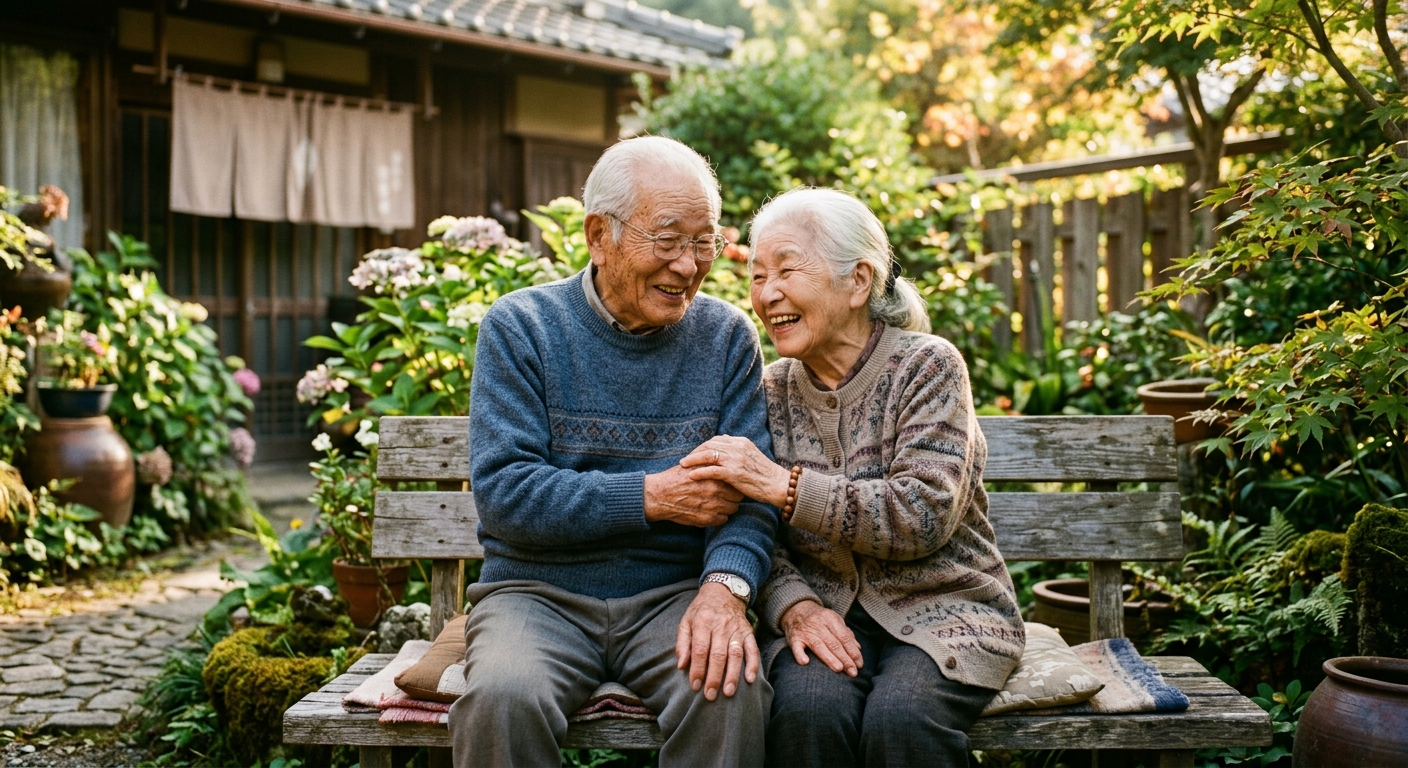
In Okinawa, the moai system means that from childhood onward, individuals are embedded in a small, committed social group. When an Okinawan elder loses a friend, the group mourns together. When finances are tight, the group pools resources. The sense of never being entirely alone is not a feeling, it is a structural reality.
Researchers at Brigham Young University analyzed data from over 300,000 people and found that social isolation carries a mortality risk comparable to smoking 15 cigarettes a day. That finding alone should reorganize our entire national conversation about health. We are spending billions on pharmaceutical interventions for chronic disease while the most powerful preventive medicine, genuine human connection, is quietly dissolving in the background.
Purpose: The Invisible Ingredient
In Japan, there is a word that does not have a direct English translation: ikigai. It is often described as your reason for being, the intersection of what you love, what you are good at, what the world needs, and what you can be compensated for. But in the daily lives of Okinawan elders, ikigai is less of a career framework and more of a lived orientation. It is waking up and knowing that today matters.
Researchers studying Nicoya, Costa Rica found a similar phenomenon. The elders there spoke frequently of plan de vida, a life plan or reason to live. Many were still farming small plots of land into their 90s. Not because they had no other option, but because the work connected them to the earth, to their families, and to a sense of identity that retirement culture never adequately replaces.
In the United States, retirement is often framed as freedom from work. In longevity communities, the concept barely exists. People do less as they age. They slow down. But they rarely stop entirely, and they rarely lose the thread of meaning that ties them to daily life.
What Modern Research Is Catching Up To
The science of longevity has undergone a quiet revolution in the past decade. New fields like epigenetics are revealing that lifestyle and environment can actually switch genes on and off, meaning that your genetic inheritance is less of a fixed destiny than previously believed. Studies on telomeres, the protective caps on chromosomes that shorten with age and stress, show that chronic loneliness and psychological stress accelerate biological aging in measurable ways.
Meanwhile, research into the vagus nerve is revealing just how deeply social connection is wired into our physiology. The vagus nerve, which runs from the brainstem through the heart, lungs, and digestive system, responds differently when we feel safe and socially connected versus isolated and threatened. Long-term activation of stress responses, common in modern isolated living, contributes to inflammation, which underlies nearly every chronic disease from heart disease to Alzheimer’s.
In short, science is slowly building a biological case for everything these remote communities have simply been living for generations.
7 Lessons We Can Actually Use Right Now
- Move naturally throughout the day. Blue Zone residents are not doing CrossFit. They are walking to neighbors’ homes, tending gardens, and doing the ordinary physical work of their lives. Consistent, low-intensity movement woven into daily routine may matter more than intermittent intense exercise.
- Eat with people. Meals in longevity communities are rarely solitary. The social dimension of eating is not an optional extra. It regulates how much we eat, slows us down, and creates the daily contact that sustains emotional health.
- Build a reason to get up. It does not have to be grand. A garden, a grandchild, a craft, a community role. Purpose is not a luxury. It is a biological necessity.
- Invest in your inner circle. Quality over quantity. One deeply trusted friend may do more for your health than fifty social media connections.
- Reduce the background noise of stress. Every Blue Zone has built-in rituals for downshifting, whether prayer, meditation, afternoon naps, or the simple act of sharing a glass of wine at sunset. Chronic, unmanaged stress is not a personality trait. It is a health emergency.
- Know your neighbors. Geographic community, not just digital community, appears to have protective health effects. Even brief, regular interactions with people who share your physical space matter more than we typically acknowledge.
- Let go of the optimization mindset. Perhaps most paradoxically, longevity communities do not appear to be trying to live long. They are simply living well. The obsession with tracking, optimizing, and biohacking that dominates wellness culture may itself be a source of the stress that shortens lives.
A Different Way of Imagining the Future
It would be easy to read about these communities and feel a pang of something close to grief. Many of us live in cities where neighbors do not know each other. We work jobs that feel disconnected from meaning. We eat alone in front of screens. We have traded the slow, embedded rhythms of community life for the frictionless convenience of modern individualism, and the trade has not been as good as advertised.
But the research from these communities is not meant to be a condemnation of modern life. It is an invitation. An invitation to look carefully at what actually sustains human beings over a long and healthy lifetime, and to make small but deliberate choices that move back toward those conditions.
You do not need to move to a Greek island. You need to call the friend you have been putting off calling. You need to find something that makes tomorrow feel worth showing up for. You need to sit down and eat with someone you love, without checking your phone.
The villages that forgot to get old were not doing anything extraordinary. They were just doing the ordinary things, together, for a very long time. And it turns out that may be exactly enough.