
🎧 Listen to this story
Narrated by Callirrhoe · 7,523 characters
A Childhood Measured in Buckets
Before Maya Okonkwo knew what an engineer was, she knew the weight of a full bucket. Growing up in a rural community in northern Nigeria, water was not something that came from a tap. It was something you walked for, sometimes more than a mile each way, before the sun got too high and the heat became unbearable. She was seven years old the first time her mother trusted her to carry the family’s water back from the communal well alone.
“I remember counting my steps to distract myself from how heavy it was,” Maya recalls. “By the time I got home, my arms were shaking. My mother looked at me like I had done something extraordinary. To her, I had. To me, I just wanted to know why we had to do it at all.”
That question, asked by a seven-year-old with aching arms, would eventually reshape the water infrastructure of three countries.
Growing Up on the Wrong Side of a Global Inequality
Maya’s story is not unique in its circumstances, and that is precisely the point. According to the World Health Organization, approximately 2.2 billion people worldwide still lack access to safely managed drinking water. In many sub-Saharan African communities, the responsibility of water collection falls disproportionately on women and children, pulling girls out of school and keeping families trapped in cycles of poverty and illness.
For Maya, the consequences were deeply personal. Her younger brother contracted a waterborne illness when he was four. She watched her mother boil water over an open fire every single evening, a ritual that was equal parts protection and exhaustion. She saw neighbors dig shallow wells that ran dry in the dry season and flooded with contamination in the wet season.
“I didn’t have language for it then,” she says, “but I understood injustice. I understood that some people in the world turned a handle and water came out, and we were not those people. I wanted to understand why.”
The Teacher Who Asked the Right Question
When Maya was eleven, a teacher named Mr. Adeyemi handed her a worn copy of a science magazine. Inside was an article about a young engineer in Kenya who had designed a low-cost rainwater harvesting system for a rural school. Maya read it four times.
“He didn’t tell me I should be an engineer,” she says of Mr. Adeyemi. “He just asked me, ‘What do you think she did differently?’ That question stayed with me for years. It wasn’t about the answer. It was about the fact that he believed I was the kind of person who could have one.”
From that point forward, Maya approached her education with a specific mission. She excelled in mathematics and science, earned a scholarship to study at a university in Lagos, and later received a full academic grant to pursue a master’s degree in environmental engineering in the United Kingdom.
From Student to Innovator: Building What She Once Walked Miles For
Maya’s graduate thesis focused on low-cost filtration systems that could be assembled using locally sourced materials in communities with no access to industrial supply chains. Her advisors called it ambitious. Her funding committee called it impractical. She called it personal.
“Every time someone told me it was too complicated, I thought about my mother boiling water at night,” she says. “That was complicated. That was exhausting. My job was to make the solution less complicated than the problem.”
Her thesis earned her a distinction. More importantly, it earned her a partnership with a nonprofit organization working across West Africa. Within two years of graduating, Maya had led the installation of community water systems in fourteen villages, providing clean running water to more than 28,000 people.
What Her Systems Actually Do
- Solar-powered pumping: Her designs use small solar arrays to pump groundwater, eliminating the need for diesel generators or grid electricity.
- Biosand filtration: Natural sand and gravel layers remove bacteria and sediment without expensive chemical treatments.
- Community maintenance training: Every installation includes a multi-week training program so local residents can maintain and repair the system themselves.
- Rainwater integration: In areas with seasonal rainfall, her systems incorporate collection and storage units to supplement groundwater during dry periods.
- Real-time monitoring: More recent installations include low-cost sensors that send alerts via SMS when water quality drops below safe levels.
The Moment It Came Full Circle
In 2022, Maya’s organization was contracted to install a water system in a community not far from where she grew up. She stood at the edge of the village on the first morning, watching the sunrise over the same kind of landscape she had walked through as a child, bucket in hand.
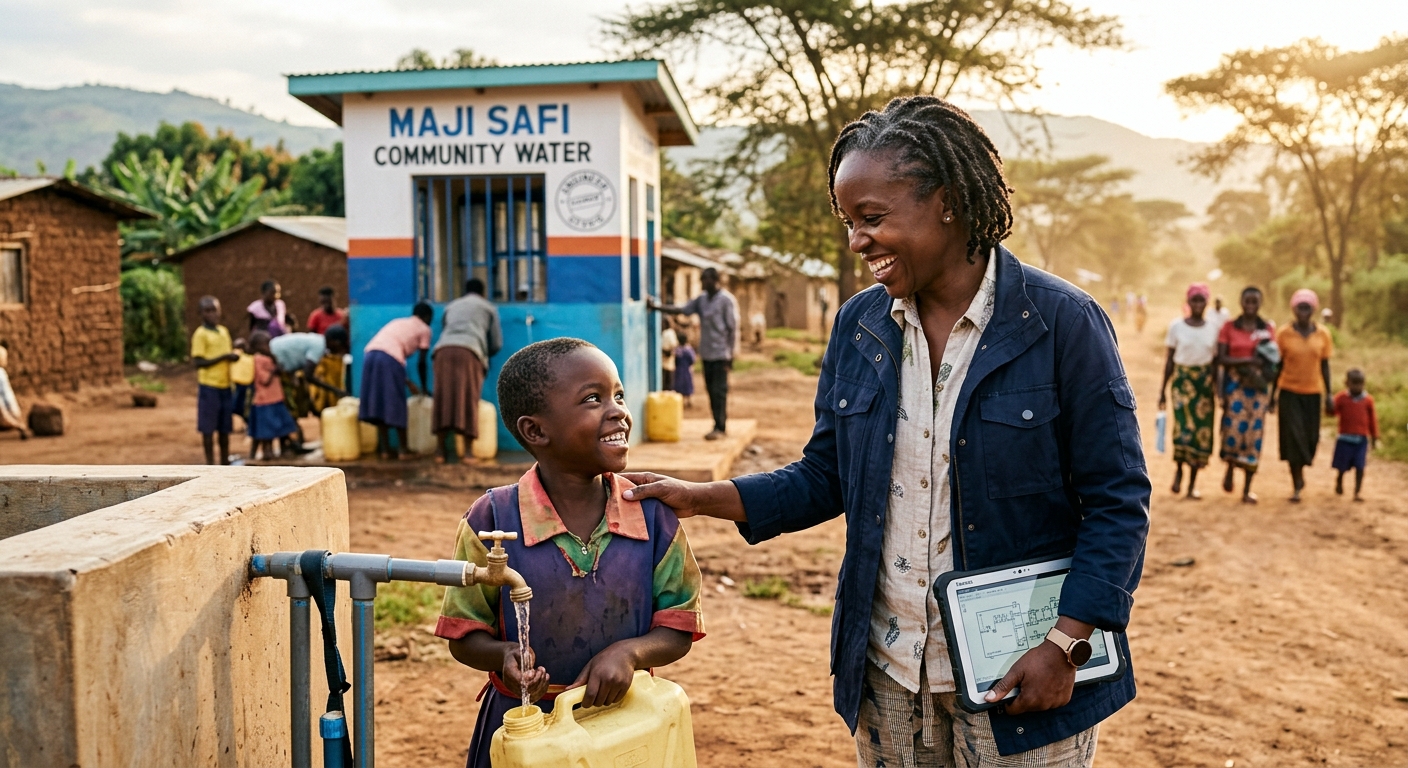
When the system was switched on and water flowed from the newly installed standpipes, a group of children ran toward it laughing. A woman filled a container in seconds, something that would have taken her an hour and a half on foot. Maya did not make a speech. She stood to the side and watched.
“I wasn’t crying because I was proud of myself,” she says quietly. “I was crying because I was thinking about all the versions of me that never got the chance to ask why. All the girls who are still walking.”
What Maya Wants People to Understand
When she speaks at universities and conferences now, Maya is careful to push back against narratives that frame her story as purely inspirational. She is not interested in being a symbol. She is interested in being useful.
“People want to say I overcame my circumstances,” she says, “but I think that gets it backwards. My circumstances gave me something most engineers don’t have. They gave me the reason. The need was never abstract for me. I didn’t learn about water scarcity in a textbook. I lived it. That changes how you solve problems.”
She advocates loudly for engineering programs to actively recruit students from underserved communities, arguing that lived experience is a form of expertise that no classroom can fully replicate.
Her Advice for Young People Facing Impossible Odds
- Find the question underneath your frustration. Anger can be data if you let it be.
- Look for the person who treats your curiosity as valuable, not naive.
- Understand that proximity to a problem is not a weakness in your field. It is a qualification.
- Build things that serve the people closest to the problem, not the people furthest from it.
- Let your reason be bigger than your resume.
The Work Continues
Today, Maya leads a team of eighteen engineers across offices in Lagos, London, and Nairobi. Her organization has expanded its work into rural communities in Ethiopia and Bangladesh, and she is currently collaborating with a university research team to develop filtration technology that can be manufactured entirely from recycled plastic waste, addressing two environmental crises at once.
She still keeps a photograph on her desk. It is not an award or a certificate. It is a picture her mother took of her as a child, standing next to the communal well, squinting into the sun, holding a bucket with both hands.
“That girl is why I do this,” she says. “Not just for her, but for everyone who still is her. The work isn’t done until turning on a tap is not a privilege. It’s just Tuesday.”
And somewhere in a village not far from where she grew up, a child who used to wake before dawn to walk for water is sleeping in a little longer this morning. Because someone who once walked that same road decided to build a different one.