
🎧 Listen to this story
Narrated by Sadachbia · 9,461 characters
The Report Card That Changed Everything
Every year, Maria Castillo hands out a short survey to her fifth-grade students. One question always stands out: “What is one thing about your teacher that makes you feel safe in this classroom?” The answers vary, but a theme emerges almost every time. Students write things like, “She never makes me feel dumb,” and “She explains things a different way when I don’t get it,” and perhaps most powerfully, “She told us she used to struggle too, and that made me believe I could do it.”
Maria Castillo, a 38-year-old elementary school teacher in Tucson, Arizona, was diagnosed with dyslexia at the age of nine. For a child who loved stories and desperately wanted to read them on her own, that diagnosis felt like a door slamming shut. What she couldn’t have known then was that the very thing making school so painful would one day make her one of the most effective, empathetic educators in her district.
Her story is not just about overcoming a challenge. It is about how that challenge quietly, persistently, became her greatest professional gift.
What It Felt Like to Be the Kid Who Couldn’t Keep Up
Maria grew up in a tight-knit family in South Tucson. Her mother worked double shifts at a local laundry facility, and her father drove a school bus. Neither had gone to college, but both believed fiercely in education. Books lined the shelves at home. Reading was treated as something sacred.
So when Maria came home with notes from teachers saying she was “not performing at grade level” and “struggling with phonics and comprehension,” her parents were confused and worried. Maria was sharp. She was creative. She could tell elaborate stories from memory and solve problems intuitively. But the words on the page seemed to rearrange themselves when she tried to read them. Letters flipped. Sentences blurred. What took her classmates minutes took her an exhausting hour.
“I remember sitting in reading groups and praying the teacher wouldn’t call on me,” Maria recalls. “When she did, and I stumbled, I could feel the other kids waiting. That waiting felt like the longest silence in the world.”
By third grade, she had internalized a story about herself: she was not smart. She was slow. She was broken in some way that other kids were not. No one told her that directly, but the system communicated it clearly enough through test scores, reading levels, and the subtle geography of a classroom, where struggling students are quietly moved to the back or pulled out of the room in small groups while everyone else moves on.
The Diagnosis That Reframed Everything
In fourth grade, a school psychologist named Dr. Anita Reyes administered a battery of assessments. The result was a formal diagnosis of dyslexia, a learning difference that affects how the brain processes written language. It has nothing to do with intelligence. It affects people across every IQ range, every background, every walk of life. But knowing that fact intellectually and feeling it emotionally are two different things.
What made the difference for Maria was not just the diagnosis. It was what Dr. Reyes said after delivering it. She leaned across the table, looked Maria in the eye, and said: “Your brain is not broken. Your brain is just reading a different map. We are going to teach you to read that map.”
That single reframe, from deficit to difference, from broken to different, altered the trajectory of Maria’s life. She began working with a reading specialist who used multisensory techniques. She learned to trace letters in sand, to use colored overlays on text, to break words into sounds using rhythmic clapping. Progress was slow but real. By the time she entered middle school, she was reading at grade level. By high school, she was in honors English.
Choosing to Go Back Into the Room That Once Scared Her
Maria did not set out to become a teacher. She studied communications in college and imagined a career in journalism. But during her junior year, she volunteered at an after-school tutoring center and was assigned to work with a second-grader named Dominic who was struggling with reading. She recognized everything about him, the slumped shoulders, the quick subject change when reading came up, the look of quiet shame dressed up as boredom.
She sat with him for an hour. She did not use the workbook provided. Instead, she asked him what he loved. He said dinosaurs. She drew pictures of dinosaurs and wrote their names in big letters. She had him trace the letters with his finger. She made up silly songs about the sounds. By the end of the session, Dominic had successfully sounded out four new words, and he was laughing.
“I drove home and cried,” Maria says. “Not sad crying. The kind of crying that happens when something clicks into place and you realize you have been waiting for that moment your whole life.”
She changed her major to education the following semester.
How Her Dyslexia Shapes Her Teaching, Every Single Day
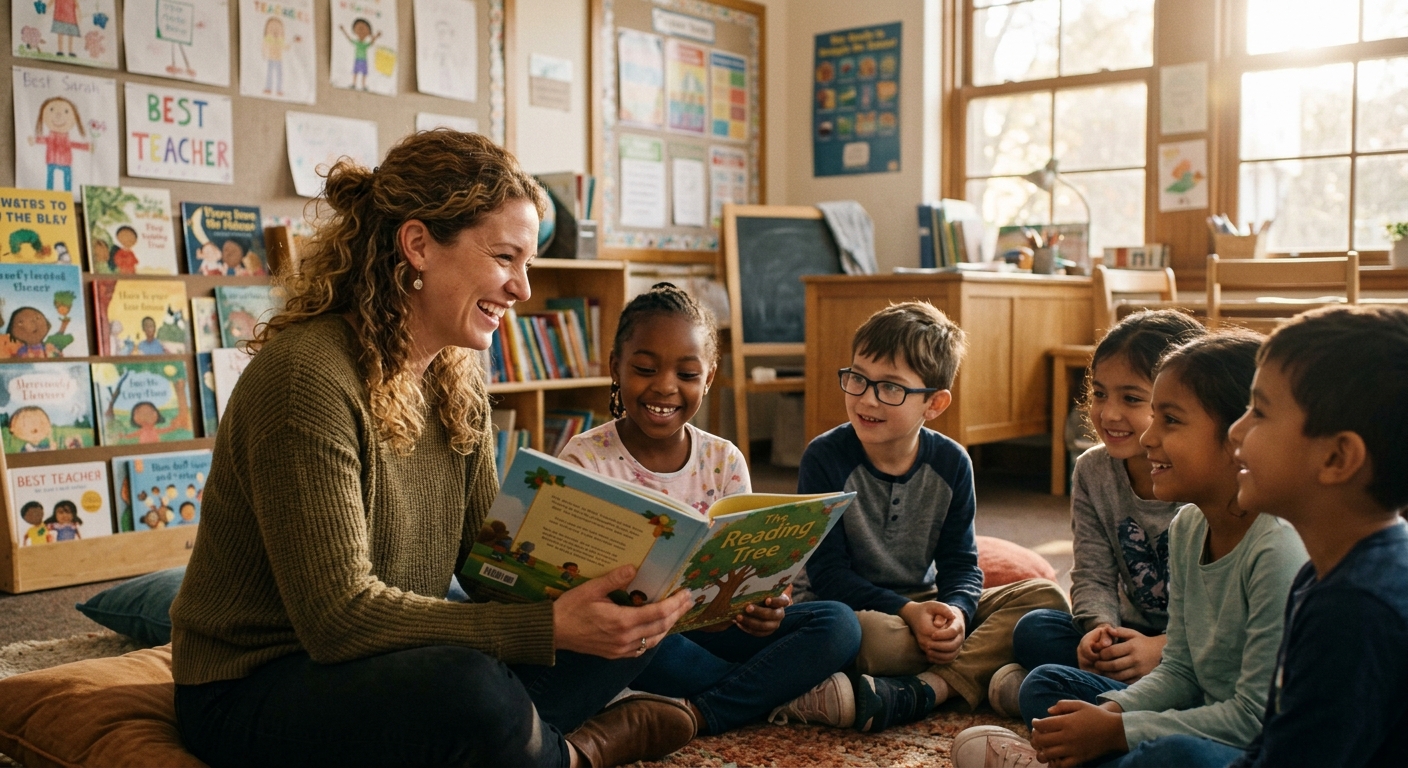
Maria now leads a fifth-grade classroom at a Title I school, where a significant portion of students come from low-income households and many have identified learning differences. She has become one of the most sought-after teachers in her building, not because of any special credential, but because of a quality that no certification program can manufacture: she genuinely understands what it feels like to sit in that chair and not understand.
Here is how her lived experience with dyslexia actively makes her a better teacher:
1. She Never Has Just One Way of Explaining Something
Students with dyslexia often need information presented in multiple formats before it sticks. Maria learned this through her own experience, and she now applies it universally. Concepts are taught verbally, visually, kinesthetically, and creatively. If one approach does not land, she does not repeat it louder. She finds another door.
2. She Reads the Room, Not Just the Lesson Plan
Years of hyperawareness in her own school years made Maria acutely attuned to student body language. She can spot a child who is confused but too afraid to say so from across the room. She has built specific rituals into her classroom culture, including anonymous question cards and a private check-in system, to make it safe for students to admit when they are lost.
3. She Separates Performance from Intelligence
Maria is careful never to equate test scores or reading fluency with a student’s worth or potential. She celebrates effort, creative thinking, and persistence as loudly as she celebrates academic achievement. Her classroom walls are filled with student work that reflects process, not just polish.
4. She Tells Her Story
At the start of every school year, Maria tells her students that she has dyslexia. She tells them what it felt like. She tells them about Dr. Reyes and the map metaphor. She watches something shift in certain students when she does this, a visible softening, a small exhale. For a child who believes they are uniquely broken, hearing that their teacher carries the same difference and built a life around it anyway is not a small thing. It is enormous.
5. She Advocates Loudly for Students Who Cannot Yet Advocate for Themselves
Maria has become an informal resource for parents who suspect their children may have learning differences. She helps them navigate the evaluation process, understand their child’s rights, and push for accommodations when schools are slow to provide them. She does this on her own time, without extra pay, because she remembers what it felt like when no one was fighting for her.
What the Research Says About Teachers Who Have Lived It
Maria’s experience aligns with a growing body of research on what educators call “lived experience pedagogy,” the idea that teachers who have personally navigated a challenge relevant to their students are uniquely equipped to support those students. A 2021 study published in the Journal of Learning Disabilities found that students with dyslexia showed significantly higher engagement and self-efficacy when their teachers had received training that included experiential or empathy-based components. Researchers noted that teacher empathy, not just instructional technique, was a strong predictor of student outcomes.
Maria’s colleagues have noticed too. Her principal, Dr. James Okafor, describes her classroom as “a place where kids who have been told they are behind come in and start to believe they can catch up.” He has invited her to lead professional development workshops for the rest of the staff, training teachers how to recognize signs of learning differences and respond with curiosity rather than frustration.
The Lesson That Outlasts the Classroom
There is a particular kind of strength that only grows in hard soil. Maria Castillo did not become a great teacher despite her dyslexia. She became a great teacher because of it, because she sat in confusion long enough to understand it deeply, because she experienced shame long enough to know how corrosive it is, and because she found her way through, with the help of one adult who chose a different kind of language.
Now she is that adult for dozens of children every year. The map metaphor has been passed forward. And somewhere in that classroom in Tucson, a child who arrived in September believing they were broken is leaving in June with an entirely different story about who they are.
That is not a small thing. That is everything.