🎧 Listen to this story
Narrated by Sadachbia · 11,102 characters
The Horse That Almost Didn’t Make It
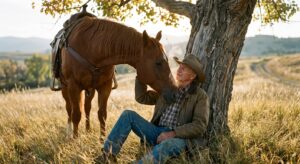
His name was Copper, and by every measurable standard, he was a lost cause. Pulled from a neglect case in rural Tennessee in the spring of 2019, the chestnut Quarter Horse arrived at Riverbend Rescue with open sores, severe malnutrition, and a trauma response so intense that experienced handlers could barely get within six feet of him. He flinched at sudden movements. He trembled at loud voices. He had learned, over years of mistreatment, that humans were not to be trusted.
Founder of Riverbend, a former veterinary technician named Dana Holloway, remembers the day he arrived with painful clarity. “Every single person on my team looked at me and said, ‘Dana, this one might be too far gone.’ And honestly, there were moments I agreed with them.” She paused during our conversation, glancing out the window toward the paddock where Copper now stands calmly. “But something made me hold on. I just couldn’t give up on him.”
Over eighteen months, Dana and her team worked with Copper using patient, trauma-informed methods. Slow introductions. Quiet voices. Boundaries respected on his terms, not theirs. Gradually, almost imperceptibly, Copper began to soften. He stopped trembling. He started approaching the fence on his own. And then one afternoon, something happened that would change the entire direction of Riverbend Rescue forever.
An Accidental Discovery That Changed Everything
It was a Saturday in August 2020 when a local family arrived for a scheduled farm tour. Among them was a seven-year-old boy named Marcus, who had been diagnosed with autism spectrum disorder at age three. Marcus rarely spoke and often became overwhelmed in new environments, pulling away from physical contact and retreating inward when overstimulated. His mother, Tanya, had almost cancelled the visit twice, worried it would be too much for him.
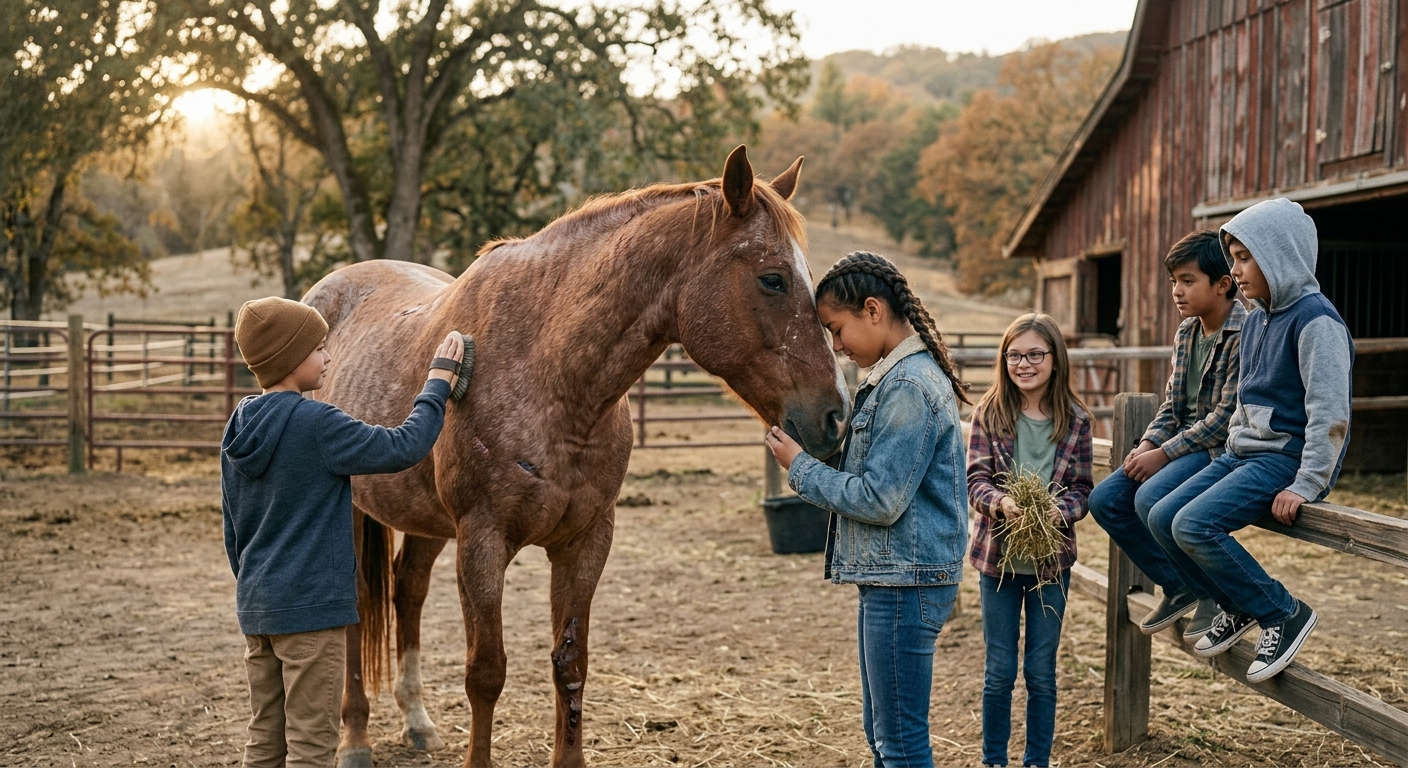
While the group gathered near the main barn, Marcus slipped away quietly and walked directly to Copper’s paddock. By the time anyone noticed, the boy and the horse were standing face to face at the fence, separated by nothing but a wooden rail. Copper, who still spooked around most adults, had not moved. He stood perfectly still, his large dark eyes fixed on Marcus, his breathing slow and even.
“Marcus reached out his hand,” Tanya recalled, her voice barely above a whisper. “And Copper just… lowered his head into it. Like he recognized something in my son. Like they already knew each other somehow.”
Marcus looked back at his mother and said three words he had never said about any animal before: “He is safe.”
What the Research Actually Says About Horses and Autism
What unfolded between Marcus and Copper that afternoon is not entirely a mystery to science. Equine-assisted therapy, sometimes called hippotherapy in its clinical form, has been the subject of growing research over the past two decades. Studies published in journals including the Journal of Autism and Developmental Disorders have found that interaction with horses can produce measurable improvements in social communication, sensory regulation, and emotional responsiveness in children on the autism spectrum.
There are several reasons researchers believe horses have this effect:
- Rhythmic movement: The three-dimensional gait of a walking horse closely mimics the human walking pattern, stimulating neural pathways related to balance and body awareness.
- Non-verbal communication: Horses respond entirely to body language, energy, and intention rather than words. This levels the playing field for children who struggle with verbal communication.
- Sensory input: The warmth, texture, and smell of a horse provide rich, calming sensory experiences that many autistic children find grounding rather than overwhelming.
- Emotional mirroring: Horses are highly sensitive to emotional states and respond visibly to stress or calm, giving children immediate, honest feedback about their own energy.
- No social performance required: Unlike human interaction, horses make no demands for eye contact, conversation, or social reciprocity. The relationship is built entirely on presence and trust.
Dr. Lisa Freund, a developmental psychologist who has studied equine-assisted interventions, describes this last point as perhaps the most underappreciated aspect of the work. “For a child who has spent their entire life being corrected for doing social interaction ‘wrong,’ a horse is profoundly liberating. The horse doesn’t judge. It just responds. And that honesty is incredibly therapeutic.”
Building a Program From the Ground Up
After the afternoon with Marcus, Dana couldn’t stop thinking. She reached out to a certified equine-assisted psychotherapist named Joel Merritt, who agreed to visit Riverbend and observe Copper’s behavior around children. What he saw in Copper, he told Dana, was rare: a horse whose own trauma had made him exquisitely attuned to emotional distress in others.
“Trauma does something to some horses,” Joel explained. “It makes them hyper-sensitive to emotional energy. In most cases, that’s a liability. But in the right environment, with the right support, it becomes a gift. Copper had learned to read humans at a very deep level just to survive. Now that he felt safe, he was using that skill to connect.”
Together, Dana and Joel spent six months developing a structured program, consulting with pediatric occupational therapists, autism specialists, and the families of potential participants. They named it the Copper Connection Program. The first cohort launched in the spring of 2021 with six children, all between the ages of five and twelve, all diagnosed with autism spectrum disorder at varying support levels.
The results in that first season were modest but meaningful. Children who had previously refused to engage in group activities began standing within proximity of their peers during sessions. Two children who rarely initiated communication began directing simple commands to Copper during grooming. One nonverbal participant began using a picture communication device with greater frequency after sessions, her occupational therapist noted, as if the interaction with Copper had loosened something in her.
The Families Speak
Marcus, now ten years old, has been part of the Copper Connection Program for three years. His mother Tanya describes the changes with careful precision, unwilling to overstate but unable to deny what she has witnessed.
“He started asking to go back the very next week. Marcus almost never asks for things. He just accepts or refuses. But he asked. Every single week, he would tell me: ‘Copper day.’ That became our phrase for Thursdays.”
She describes incremental shifts that built over months: Marcus making eye contact with Dana during sessions. Marcus tolerating brushing Copper alongside another child without withdrawing. And eventually, most remarkably to his mother, Marcus beginning to talk about Copper to his grandmother on the phone, unprompted, describing the horse’s behavior and what it meant.
“For a child who struggled to narrate his own experience,” Tanya said, “explaining Copper to someone else was extraordinary. The horse gave him a story worth telling.”
Another parent, a father named Dwayne whose daughter Priya joined the program at age nine, put it differently. “My daughter has always been brilliant, just wired differently than most people expect. What Copper gave her was confidence. She could read that horse better than any of the adults could. She knew when he was anxious before the handlers did. For the first time in her life, she was the expert in the room. You could see what that did for her.”
What Copper Gets Out of It
It would be incomplete to tell this story without asking what the work means for Copper himself. This is a question Dana takes seriously, and it shapes how the program is run.
“We watch him constantly. His body language. His willingness to engage. If he’s showing signs of stress or withdrawal, sessions stop, full stop. His wellbeing is not negotiable.” Dana emphasizes that Copper participates by choice, not compulsion. Horses cannot advocate for themselves verbally, she points out, which means humans must learn to listen differently.
What is notable, according to Joel, is that Copper’s behavior since the program began has not deteriorated but flourished. He has become more confident, more socially curious, more willing to engage with new people. “Working with these children seems to be good for him,” Joel said. “There’s a mutuality there that I find genuinely moving. He needed to be needed. And these kids give him exactly that.”
7 Things This Story Teaches Us About Healing
- Healing is rarely linear. Copper’s recovery took over a year of patient, quiet work before anyone saw results. So does human healing.
- Shared trauma can create profound empathy. Copper’s sensitivity to the children’s distress grew directly from his own experience of being misunderstood and afraid.
- Connection doesn’t require words. Some of the most meaningful relationships in this program have been entirely nonverbal.
- Being needed is itself therapeutic. For Copper and for the children, purpose accelerated healing in ways that passive care alone could not.
- The “too damaged” label is almost always premature. Nearly every person who met Copper in 2019 believed he was too broken to help. He has since helped dozens of children.
- Children often perceive what adults miss. It was Marcus, not a handler, who first recognized that Copper was safe. Trust the instincts of the people we too often underestimate.
- Programs built with genuine humility succeed. Dana and Joel spent months consulting specialists and families before launching. That listening shaped everything that followed.
The Bigger Picture
The Copper Connection Program now serves over thirty children per season and has a waiting list that stretches into the following year. Dana has begun training other rescue facilities in the model, with the goal of identifying horses with similar profiles and connecting them with therapeutic programs nationwide. She is careful to stress that not every rescue horse is a candidate, and that rigorous welfare screening must always come first.
But the underlying premise, she believes, is replicable: that animals who have experienced and survived trauma carry within them a capacity for empathetic connection that, when carefully cultivated, can become something extraordinary.
“I think about what both Copper and these kids have in common,” Dana said as our conversation drew to a close. “They’ve both been told, in one way or another, that they’re too different. Too difficult. That the world wasn’t built for them.” She smiled. “And then they find each other. And suddenly, all that difference becomes the whole point.”
Copper was standing at the paddock fence as I left, the afternoon sun catching the deep copper of his coat. A child I hadn’t met was walking slowly toward him, head slightly bowed, hand extended. The horse lowered his head. Neither of them made a sound. And somehow, that was the loudest thing I heard all day.