🎧 Listen to this story
Narrated by Gacrux · 7,876 characters
A Standing Appointment That Outlasted Everything
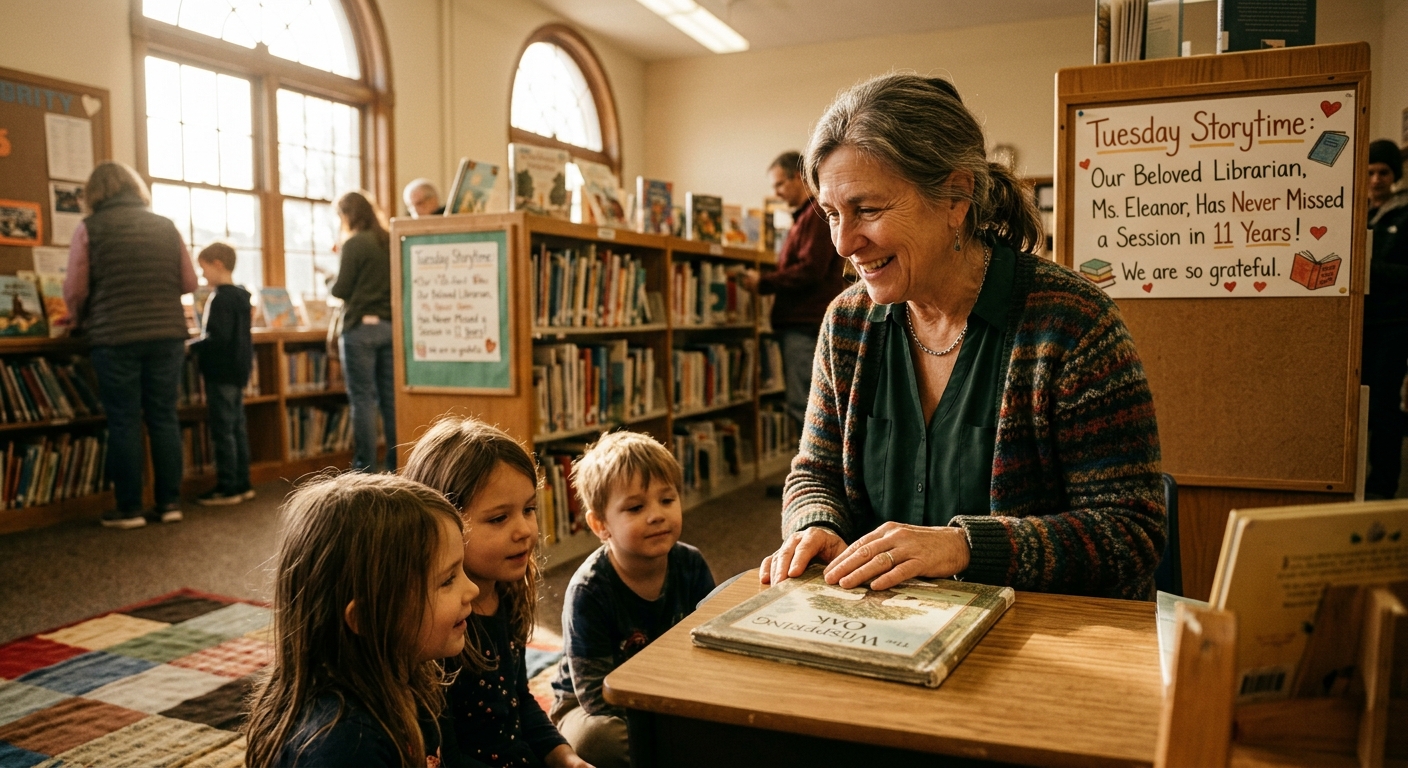
Rain, snow, a broken furnace in January, a global pandemic that shut down nearly everything else. None of it stopped Margaret Osei from showing up to the Millbrook Public Library every Tuesday at 10 a.m. And none of it stopped librarian Don Caufield from being there waiting, book already open, voice already warm.
What began in the winter of 2013 as a simple accommodation request has grown into something that defies easy categorization. It is not quite a friendship, though it is certainly that. It is not quite a professional service, though it is that too. It is, by most honest accounts, one of the most quietly remarkable acts of sustained human kindness that the people of Millbrook have ever witnessed, even if most of them have never heard of it.
How It Started: A Small Ask That Became a Big Commitment
Margaret lost most of her functional vision to glaucoma in her early sixties. A retired schoolteacher and lifelong reader, she described the experience of losing her sight as “losing a language I had spoken my entire life.” Audiobooks helped, but they were never quite the same. The voices felt impersonal. The pacing was rarely what she wanted. And the selection, particularly for the literary fiction and narrative nonfiction she loved most, was limited.
A neighbor suggested she speak to the librarians at Millbrook. She was skeptical. She expected to be handed a brochure and pointed toward a digital catalog. Instead, she met Don.
“He asked me what I liked to read,” Margaret recalled in a conversation last spring. “Not what formats were available. Not what the library carried. He asked me what I liked. I think I talked for forty minutes. He took notes.”
Don, who had worked at Millbrook for nearly two decades by that point, proposed something straightforward. He would set aside one hour every Tuesday morning, before the library opened to the public, and read to her. They would choose books together. They would go at whatever pace felt right. There was no form to fill out, no program to enroll in. It was simply an offer from one person to another.
Margaret said yes. She has not missed a Tuesday since.
What 11 Years of Weekly Reading Actually Looks Like
Over the course of their sessions, Don and Margaret have worked through a remarkable range of literature. A partial list from memory includes the complete works of Marilynne Robinson, several novels by Colm Toibin, two substantial biographies of Abraham Lincoln, the entirety of The Power Broker by Robert Caro (which, for reference, is over 1,300 pages and took them the better part of two years), a collection of Chekhov short stories, and more recently, a popular history of the Silk Road that Margaret had seen reviewed in a magazine her granddaughter read to her.
Don reads without performance, he says, though those who have overheard him disagree. “He does voices,” Margaret says, smiling. “He claims he doesn’t, but he absolutely does.”
They take breaks. They argue about characters. Don sometimes stops mid-paragraph to look something up because Margaret has asked a question he cannot answer off the top of his head. They have disagreed about books, sometimes sharply. Don found one critically acclaimed novel tedious. Margaret loved it. They finished it anyway, because that is what you do when you have made a commitment.
Why He Does It: Don’s Own Answer
When asked directly why he has kept this going for eleven years, Don Caufield takes a moment before answering. He is not a man who speaks in soundbites, which is perhaps fitting for someone who has spent a career in libraries.
“People talk about libraries like they’re about books,” he said. “And they are, of course. But they’re really about access. About making sure that the things that matter, the stories, the ideas, the sense that the world is larger than your own experience, that those things aren’t gated off from people who hit a barrier. Margaret hit a barrier. Reading aloud is not a complicated solution. It’s just time.”
He paused. “And honestly, she has better taste than most people I know. I’ve read things because of her that I never would have picked up. That’s not nothing.”
What Margaret Says It Has Meant
Margaret Osei is 76 years old. She lives with her daughter’s family three blocks from the library. She is sharp, funny, and not particularly interested in being described as inspirational, a word she finds “a little sticky.”
But when pressed about what the Tuesday sessions have meant to her over the years, she allows herself a longer answer.
“When you lose something like sight, people treat you differently. They speak more slowly. They assume more. They mean well, almost all of them, but there is a kind of distance that opens up. Don never had that distance. From the first Tuesday, he just talked to me like I was a person who wanted to read a book. That sounds small. It was not small.”
She folded her hands in her lap. “He gave me back something I thought was gone. You don’t forget that. You just keep showing up.”
The Ripple Effect: What the Library Noticed
Library director Priya Holloway was not aware of the arrangement for nearly its first two years. Don had not asked for permission, exactly, because he had not technically needed it. The sessions happened before opening hours, on his own time, in a building he had a key to.
When Holloway found out, her reaction was not bureaucratic concern. It was something closer to quiet awe. “Don didn’t frame it as a program or an initiative,” she said. “He never asked for recognition. He just kept a standing appointment. That is actually very rare in any profession.”
Since learning about it, the library has quietly expanded its accessibility offerings, including a small volunteer reading program inspired in part by what Don and Margaret built. Three other patron-volunteer pairs now meet weekly. None of them, Holloway notes, have quite matched eleven years yet. But every one of them started because someone heard about a librarian who showed up every Tuesday and thought: I could do something like that.
7 Things This Story Quietly Teaches Us
- Consistency is its own form of love. Showing up reliably, week after week, communicates something that grand gestures often cannot.
- Accessibility doesn’t always require technology. Sometimes the most powerful accommodation is a human voice and an hour of time.
- Ask what people like, not what they need. Don’s first question to Margaret was about her taste in books, not her limitations. That framing changed everything.
- Small commitments compound. One hour a week for eleven years is over 570 hours of reading, connection, and shared experience. It started as one Tuesday.
- You don’t need a program to start something meaningful. Don did not wait for a budget line or an official initiative. He just asked if she would like to try.
- Disagreement is part of real connection. The fact that Don and Margaret argue about books is a feature, not a bug. It means they are two people in genuine conversation, not a service provider and a recipient.
- Being seen as a whole person is the foundation of dignity. Margaret’s most moving reflection was not about the books. It was about the absence of distance.
Still Going
This past Tuesday, at 10 a.m., Don Caufield unlocked the side door of the Millbrook Public Library. Margaret Osei arrived four minutes later, as she almost always does. He had already made tea. They are currently seventy pages into a new biography, one Margaret had heard about from a podcast her granddaughter plays during their Sunday calls.
He opened to page seventy-one. She settled into her usual chair. And for the next hour, the library, not yet open, not yet busy, held the sound of one person reading to another, which is one of the oldest sounds in the world and, on the right Tuesday morning, one of the most important.