🎧 Listen to this story
Narrated by Rasalgethi · 7,265 characters
Something Was Off, But Nobody Could Say What
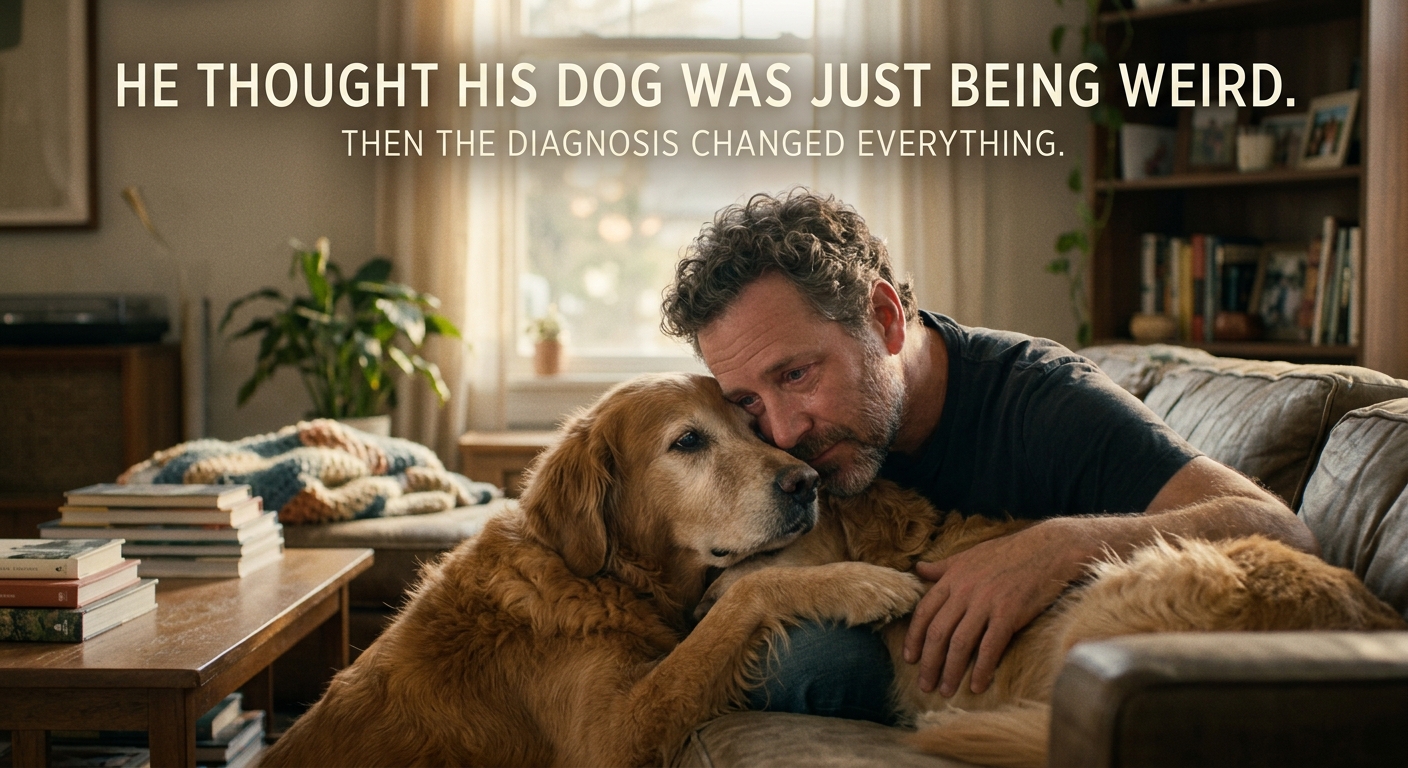
Brian Hanley had owned dogs his entire life. He knew their quirks, their routines, their silly habits. So when his seven-year-old Labrador, Scout, started behaving strangely in late 2019, Brian noticed immediately. Scout had always been easygoing, a tail-wagging, food-motivated, sleep-on-the-couch kind of dog. But suddenly, he was different.
Scout would press his nose obsessively into Brian’s left side, just beneath his ribcage. He would whimper softly, circling Brian’s feet and refusing to leave the room. At night, instead of sprawling across the foot of the bed as usual, Scout would curl tightly against Brian’s torso, nose buried near the same spot. Every single night.
“I thought maybe he smelled something I’d eaten,” Brian recalled. “Or maybe he was just getting more affectionate as he got older. I honestly laughed it off at first.”
He would not be laughing for long.
When a Dog’s Instinct Outpaces Modern Medicine
Brian was 47, healthy by every visible measure. He exercised regularly, ate well, and had no family history of serious illness. He had no symptoms, no pain, no warning signs that anything was wrong. His last checkup had come back clean. By all conventional logic, there was nothing to worry about.
But Scout would not let it go.
After nearly three weeks of the same behavior, Brian’s wife, Donna, put her foot down. “She said, ‘I’ve read about this. Dogs can smell cancer. You’re going to the doctor, and you’re going to tell them exactly what Scout has been doing,'” Brian said. “I thought she was being dramatic. I went anyway, mostly to get some peace at home.”
He went to his general practitioner, described Scout’s behavior, and asked, somewhat sheepishly, for additional screening. His doctor, to her credit, took the concern seriously. She ordered an abdominal ultrasound and a series of blood panels that went beyond the standard annual checkup scope.
The ultrasound flagged a small mass on Brian’s kidney, less than two centimeters. A follow-up CT scan confirmed it. The diagnosis was renal cell carcinoma, caught at Stage 1, entirely localized, and, crucially, completely treatable.
What Science Says About Dogs and Cancer Detection
Brian’s story is remarkable, but it is far from unique. Researchers and medical professionals have been studying canine cancer detection for decades, and the findings are consistently astonishing.
Dogs possess up to 300 million olfactory receptors in their noses, compared to roughly six million in humans. Their sense of smell is estimated to be between 10,000 and 100,000 times more sensitive than ours. This extraordinary biological capability allows them to detect chemical compounds, called volatile organic compounds, or VOCs, that are released by cancerous cells at concentrations as low as a few parts per trillion.
Here is a quick breakdown of what the research has shown so far:
- A 2011 study published in the journal Gut found that a trained Labrador could detect colorectal cancer from breath and stool samples with accuracy rates above 95 percent.
- The Pine Street Foundation conducted research showing dogs could identify lung and breast cancer from breath samples with sensitivity between 88 and 97 percent.
- Medical Detection Dogs, a UK-based charity, has trained dogs to detect prostate cancer, Parkinson’s disease, and even malaria with startling precision.
- Multiple anecdotal cases across the world involve pet dogs persistently investigating areas of their owners’ bodies that later turned out to harbor tumors.
Dr. Claire Guest, CEO of Medical Detection Dogs and a researcher who has dedicated her career to this field, has said publicly that she believes dogs could one day serve as a first-line screening tool for certain cancers, particularly in regions where diagnostic equipment is limited or expensive.
Scout Did Not Know What He Was Doing. Or Did He?
There is something both humbling and profound about this part of the story. Scout was not trained. He had no certification, no handler, no lab protocol. He was just a dog who loved his person, and something in that love, combined with his biology, drove him to communicate what he could not say in words.
Brian’s surgeon, Dr. Meredith Calloway, was candid during a post-surgery consultation. “She told me that if we had found this tumor a year or two later, the conversation we were having would have been very different,” Brian said quietly. “Scout found something that wasn’t causing me any pain, wasn’t showing up in routine bloodwork, and wasn’t something I ever would have gone looking for on my own.”
The tumor was removed laparoscopically. Brian’s recovery took six weeks. As of the time of this writing, he is cancer-free.
The Reunion That Needed No Words
When Brian came home from the hospital, still sore and moving carefully, Scout met him at the door as always. He sniffed Brian’s side once, then twice. Then he wagged his tail, turned a small circle, and lay down at Brian’s feet with a long, slow exhale.
“Donna and I both cried,” Brian said. “It sounds crazy, but it felt like he knew it was gone. Like he was finally satisfied.”
Scout never pressed his nose into that spot again.
What This Story Teaches Us About Listening
There are several layers to what Brian’s experience reveals, and they reach well beyond the science of canine olfaction.
1. Pay attention to behavioral changes in your pets
Animals communicate constantly. They do not have the language to say “something is wrong,” but they have behavior, persistence, and instinct. If a normally calm pet becomes fixated on a specific part of your body, that is worth noting, and worth mentioning to a doctor.
2. Advocate for yourself, even when you feel fine
Brian had no symptoms. He felt perfectly healthy. In many cancer cases, particularly in early stages, people do feel fine. Screening and early detection save lives, and sometimes the push to seek that screening comes from an unexpected place.
3. Trust the people (and animals) who know you best
Donna pushed Brian to go. Scout pushed Brian to go. Between a devoted wife and a devoted dog, Brian had more advocates than he realized. The people and animals in our lives often perceive things about us that we cannot perceive about ourselves.
4. Science and intuition are not opposites
It is tempting to dismiss a dog’s behavior as coincidence, as cuteness, as something easily explained away. But the science is real. The chemistry is real. Scout was not acting on emotion alone. He was responding to a biological signal that no machine in Brian’s doctor’s office had yet been pointed at the right place to find.
A Final Note on Scout
Scout is now nine years old. He still sleeps on the bed, still begs for table scraps, and still greets every visitor at the door with the enthusiasm of someone who has never once been disappointed by a human being. He received, in the words of Brian’s entire extended family, a very large steak dinner shortly after Brian’s surgery was confirmed a success.
He seemed to feel this was appropriate.
Brian keeps a framed photo on his desk now. It is Scout, mid-yawn, looking entirely unbothered and faintly pleased with himself. Underneath it, Brian wrote four words in black marker: “He knew first. Always.”