🎧 Listen to this story
Narrated by Sulafat · 7,556 characters
The Night Everything Changed
It started with a smell. That acrid, unmistakable scent of smoke that pulls you from the deepest sleep and plants a cold spike of panic straight into your chest. For the Mercer family of rural Tennessee, the night of October 14th began like any other and ended like something out of a movie they never wanted to watch.
By 2:17 a.m., the kitchen was fully engulfed. The fire had started near the stove, crept silently along the wooden cabinets, and by the time the smoke alarm finally screamed to life, the hallway was already thick with black haze. Sandra Mercer grabbed her two children, her husband Tom grabbed the go-bag they kept by the door, and they tumbled out into the cold Tennessee night in bare feet and pajamas.
It was only when they reached the end of the driveway that Sandra turned around and noticed two things missing: their tabby cat, Biscuit, and their four-year-old golden retriever, Duke.
Duke Goes Back
Tom saw it happen in real time. He had assumed Duke followed them out. But as the family stood frozen on the lawn watching orange light pour through the windows of their home, they heard barking from inside. Duke had not followed them out. Duke had gone back in.
“I screamed,” Sandra recalled. “I screamed his name and tried to go after him and Tom held me back. We didn’t know if he was trapped. We didn’t know if he was alive.”
The volunteer fire department arrived within six minutes. It felt like six years.
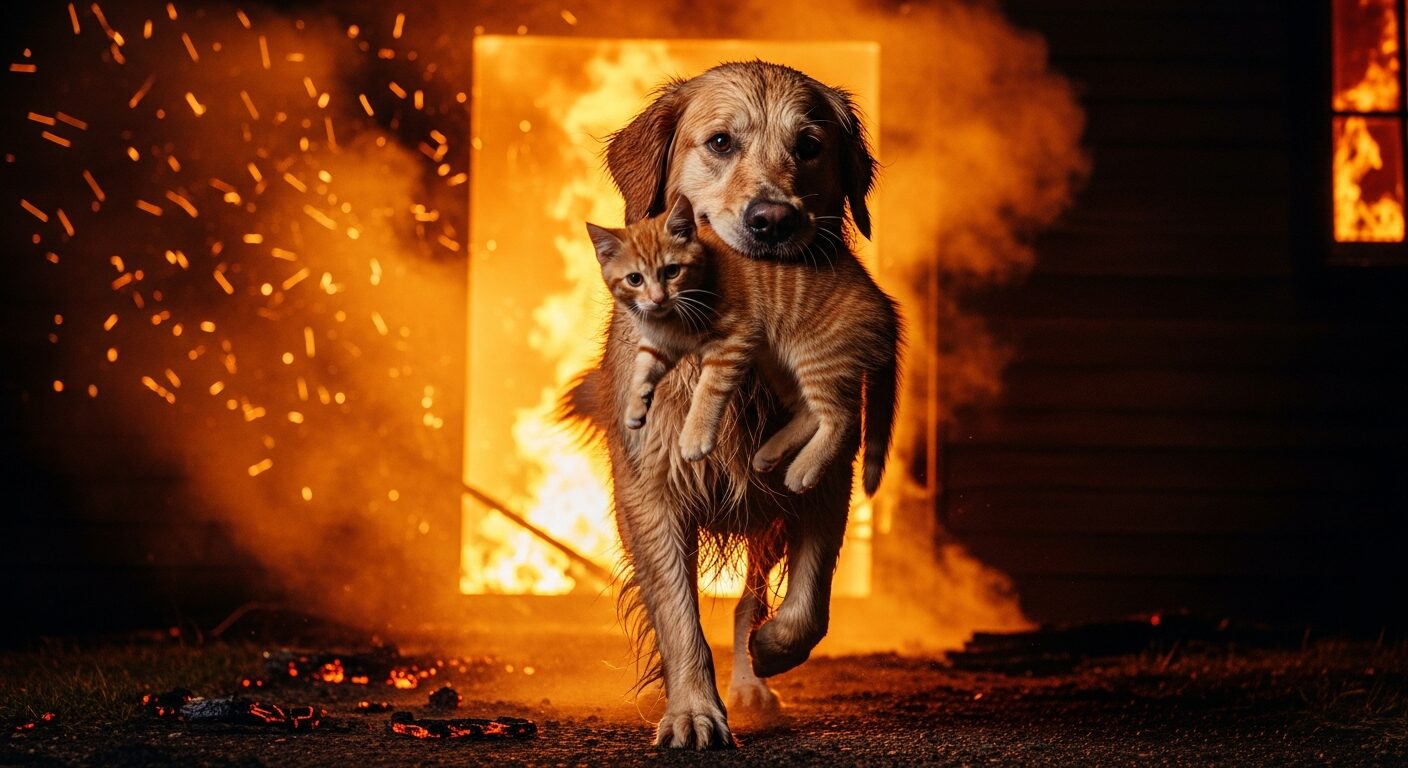
And then, just before the first firefighter reached the porch, Duke emerged from the front door. Coughing. Low to the ground. Fur singed along his left shoulder and one ear. And carrying, gently in his mouth, a very stunned, very alive orange tabby cat named Biscuit.
Duke dropped Biscuit at Sandra’s feet, looked up at her, wagged once, and sat down.
What the Firefighters Said
Captain Lyle Hutchins has been a volunteer firefighter for nineteen years. He has seen things that most people never will. But he says the sight of that golden retriever walking out of a burning structure with a cat in his mouth stopped him cold.
“In nearly two decades, I’ve pulled people out, I’ve pulled pets out, I’ve seen a lot,” Captain Hutchins said. “But I’ve never seen an animal make what looked like a conscious decision to go back into a dangerous situation for another animal. It’s not something you forget.”
Duke was treated on scene by a volunteer EMT who happened to also work part-time at a local veterinary clinic. He had smoke inhalation, minor burns on his shoulder, and a slightly singed ear. He was transported to an emergency animal hospital, treated overnight, and was home within 48 hours. Biscuit had a few singed whiskers and a lot of opinions about the whole experience, according to Sandra.
The Bond Nobody Knew Was That Deep
Here is the part of this story that makes it even more remarkable: Duke and Biscuit had not always been friends. When the Mercers adopted Duke as a puppy, Biscuit made her displeasure abundantly clear. There were hisses. There were swatted noses. There was a period of approximately eight months where Biscuit would only enter a room after Duke had been relocated to another one.
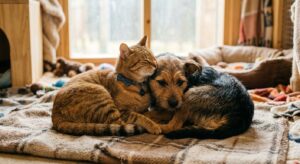
But somewhere between year one and year two, something shifted. The family started finding them asleep near each other. Then near became together. Then together became a pile. Tom would joke that Duke thought he was a cat and Biscuit thought she was a dog and they had simply met in the middle.
“We always knew they were close,” Sandra said. “We just didn’t know how close until that night.”
7 Things Duke’s Story Teaches Us About Love and Loyalty
- Love is not always loud. Duke and Biscuit’s bond developed quietly over years of small moments. The deepest connections often do.
- Loyalty does not require a shared species. Duke did not calculate risk. He simply could not leave without the one he loved.
- Instinct and intention can coexist. Scientists may debate whether Duke “understood” what he was doing. But the family who watched it happen has no doubt.
- Relationships that start rocky can become the most profound. The hissing, swatting early days of Duke and Biscuit’s relationship make their bond even more beautiful in hindsight.
- Courage is not the absence of fear. Duke was coughing when he came out. He was afraid. He went anyway.
- Animals feel more than we give them credit for. Ethologists have long argued that animal emotional lives are richer and more complex than popular culture acknowledges. Duke is Exhibit A.
- Sometimes the most important thing you can do is show up. Duke did not have a plan. He had a person, or in this case a cat, who needed him. That was enough.
The Aftermath: A Community Rallies
The Mercer home was a total loss. The fire consumed the structure, the memories inside it, the handmade quilt Sandra’s grandmother left her, Tom’s workshop, the kids’ artwork pinned to the refrigerator door. These are the losses that don’t show up on insurance forms and don’t have dollar amounts attached to them.
But the community of Harlan Creek, Tennessee showed up in a way the Mercers did not expect. Within 72 hours of the fire, a local Facebook group had organized a fundraiser that raised over $40,000. Neighbors they had never formally met dropped off meals, clothing, and gift cards. A local church offered their family housing for three months while they rebuilt.
And Duke? Duke became something of a local legend. The volunteer fire station put up a hand-painted sign outside their building that read: “In Honor of Duke, the Bravest Good Boy in Harlan Creek.”
He visits the station occasionally now. They keep treats behind the front desk specifically for him.
What Science Says About Animal Heroism
Dr. Patricia Greenwald, an animal behaviorist at the University of Tennessee, was asked to weigh in on Duke’s actions after the story was picked up by local news. Her response was careful but clear.
“We have documented evidence of dogs exhibiting what we call prosocial behavior toward other animals, including animals of different species,” Dr. Greenwald explained. “Whether we label it heroism or advanced social bonding, the behavior is real, it is documented, and it challenges some of our oldest assumptions about what animals are capable of feeling and doing.”
She noted that golden retrievers in particular are bred for strong social attunement, but added that the specific nature of Duke’s action, returning to a dangerous environment for a non-human companion, was notable even by the standards of documented animal behavior research.
A Family Rebuilt, A Story That Stays
The Mercers are back in Harlan Creek now, in a new home a half mile from where the old one stood. The kids have new artwork on the refrigerator. Tom has a new workshop, smaller than the last but filled with the same sawdust smell he loves. Sandra found a quilt at a local antique shop that she says is not her grandmother’s but carries the same kind of weight.
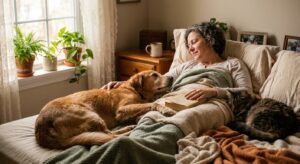
Duke sleeps at the foot of their bed. Biscuit sleeps on top of Duke.
Some nights, Sandra says, she lies awake and thinks about the sequence of events that led to everyone she loves being safe under one roof. She thinks about the six minutes that felt like years. She thinks about a dog who did not calculate the odds, did not weigh the risk, did not hesitate at the door.
“He just went back,” she says. “Because that’s what you do for the ones you love. You just go back.”
Maybe that’s the lesson Duke was always going to teach them. They just needed one terrible, smoke-filled night to finally learn it.