
🎧 Listen to this story
Narrated by Rasalgethi · 7,726 characters
The Man Most Students Walk Past Without Noticing
Every school has one. The person who arrives before the buses pull in, who leaves long after the last locker slams shut, who keeps the whole place running without ever standing in front of a chalkboard. At Jefferson Middle School in Columbus, Ohio, that person is Raymond Tillis, a 58-year-old custodian who has quietly worked the same hallways for over a decade.
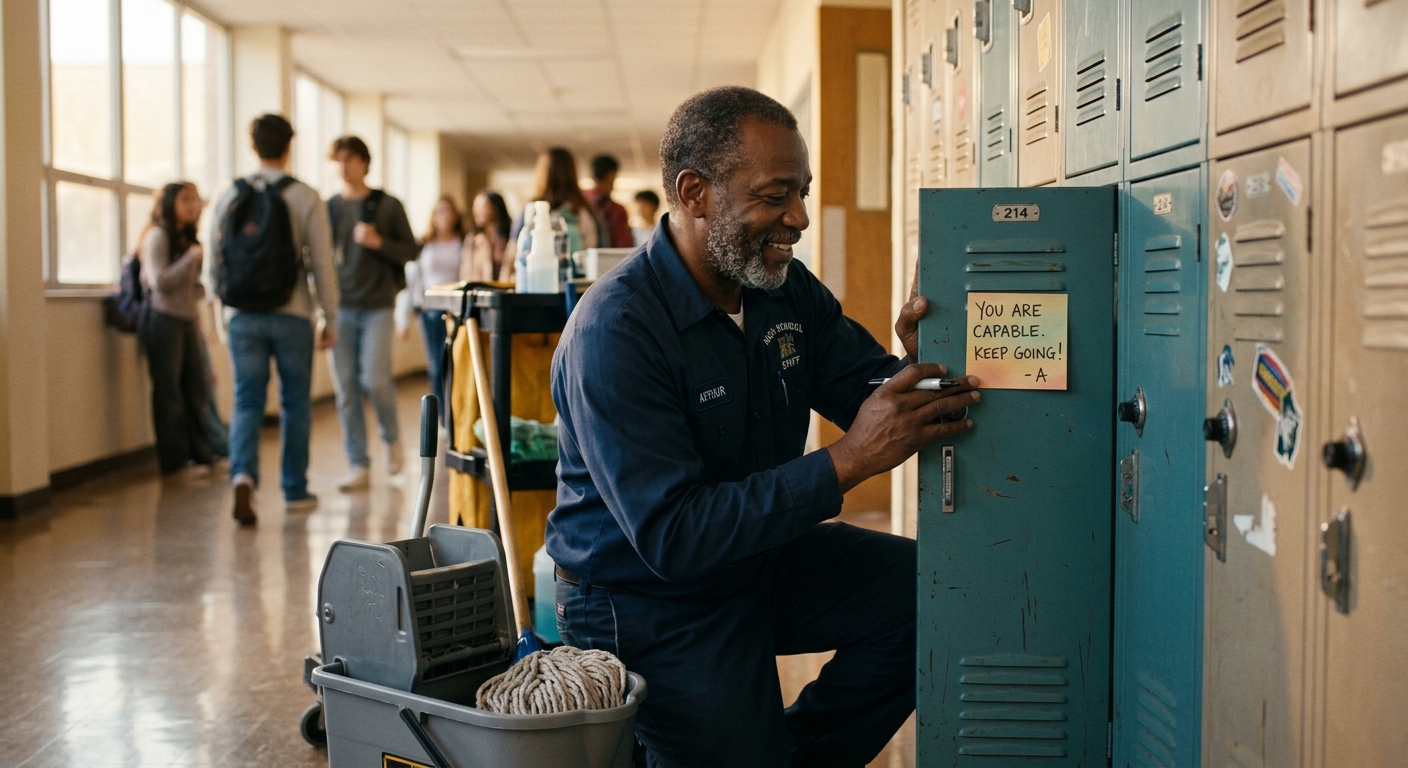
Most students barely registered his presence at first. He was background noise, part of the scenery, the man with the mop and the cart full of cleaning supplies. But somewhere around his second year on the job, Raymond started doing something that nobody asked him to do, something that cost him nothing but a few minutes each morning, and something that would change the lives of more students than any lesson plan ever could.
He started writing notes.
Where It All Started
Raymond is not a man of many words in conversation. He is soft-spoken, deliberate, and quick to deflect praise. But ask him why he started leaving notes, and something opens up in him.
‘I kept seeing these kids come in looking like the weight of the world was on them,’ he said during a recent interview outside the school’s boiler room. ‘Twelve, thirteen years old, and they already looked defeated. I thought, someone should say something to them. And then I realized, why not me?’
The first note was scrawled on a torn piece of paper towel and left on a locker belonging to a seventh grader named Marcus, who Raymond had noticed crying alone in the hallway three mornings in a row. It read: ‘You showed up today. That takes more courage than people know. Keep going.’
Marcus, now 23 and studying to become a social worker, still has that note. He keeps it folded in his wallet.
A Decade of Small Gestures, Enormous Impact
Over the past ten years, Raymond estimates he has written somewhere between 2,000 and 3,000 notes. He buys his own sticky pads and index cards, cycling through colors depending on his mood, yellow for energy, blue for calm, orange for celebration. Each note is handwritten. Each one is personal.
He pays close attention. He notices which students shuffle in with their eyes down. He sees who sits alone at lunch. He overhears snippets of worry before big tests, detects the slumped shoulders of a kid who just found out their parents are splitting up, and registers the trembling lip of a student who got cut from the basketball team.
And then, quietly, he leaves a note.
What the Notes Actually Say
Raymond’s notes are not generic motivational slogans. They are specific, warm, and human. A sampling from students and staff who saved them over the years includes:
- ‘I saw how hard you studied for that test. Win or lose today, I’m proud of how you prepared.’
- ‘You made three people smile this week without even realizing it. That matters more than you know.’
- ‘Being new is hard. You are doing better than you think.’
- ‘Failing a test does not make you a failure. Come back swinging.’
- ‘You are someone’s favorite person. Don’t forget that on your hard days.’
These are not the words of a guidance counselor following a protocol. They are the words of a man who genuinely sees the children around him and refuses to look away.
The Teachers Took Notice Too
It was not long before faculty started finding notes of their own. Raymond does not discriminate by age or title. Teachers who came in looking exhausted after a brutal week would find a sticky note on their classroom door. The principal once found a card on her desk the morning after a particularly difficult school board meeting.
‘He sees everyone,’ said eighth-grade English teacher Dana Morales. ‘I had a terrible week one October. My mother was sick, I had a class that was really struggling, and I was questioning everything. I walked in Monday morning and there was a note on my keyboard that said, Good teachers carry more than they let on. You are doing holy work. Rest when you can. I burst into tears at my desk. In the best way.’
What Raymond Says He Gets Out of It
Here is where Raymond’s story takes a turn that many might not expect. When asked what motivates him to keep going year after year, his answer is not about the students at all. At least, not entirely.
‘I went through something real hard in my forties,’ he said, pausing to choose his words carefully. ‘Lost my brother. Lost my footing for a while. When I came out the other side, I kept thinking about all the moments someone could have said something to me and didn’t. All the times a kind word might have kept me from going so dark.’
He straightened his collar and looked at the floor for a moment.
‘Writing these notes is my way of paying that forward. But honestly? It keeps me going too. Every time I write one, I’m also talking to myself. To the version of me that needed it most.’
The Ripple Effect Nobody Planned For
Word eventually spread. A parent posted a photo of a note her daughter received to the school’s Facebook group. It went modestly viral in the way that genuinely good things sometimes do, not millions of shares, but enough. Local news picked it up. Raymond was briefly, uncomfortably famous.
But the more meaningful ripple effect happened inside the school itself. Students started leaving notes for each other. A small group of sixth graders launched what they called the ‘Tillis Challenge,’ leaving kind messages on random lockers every Friday morning. A teacher incorporated note-writing into her weekly class routine.
Raymond had not intended to start a movement. He had just intended to make one child feel less alone on one hard morning. But kindness, it turns out, is contagious in the best possible way.
7 Things Raymond’s Story Teaches Us About Kindness
- You do not need a title to make a difference. Raymond has no credentials in counseling or education. He has eyes, a heart, and a pack of index cards.
- Specificity is more powerful than generality. His notes work because they reflect real observation. ‘You are great’ is forgettable. ‘I noticed you helped that new kid find his locker today’ is not.
- Consistency builds trust. One note is a nice gesture. Ten years of notes is a legacy.
- The giver benefits too. Kindness is not a one-way transaction. Raymond openly admits these notes have sustained him through his own struggles.
- Small things are not small. A sticky note costs pennies and takes two minutes. Marcus still carries his in his wallet after eleven years.
- You never know who is watching. Raymond saw children that others walked past. That act of seeing, before a single word was written, was itself a profound gift.
- One person can shift a culture. Raymond did not set out to change Jefferson Middle School. He set out to help one sad kid in a hallway. The culture changed anyway.
A Note for Raymond
Last spring, on the tenth anniversary of Raymond’s first note, the school organized a small surprise. Students, teachers, parents, and even a few graduates filled the gymnasium. They had collected notes, not written by Raymond this time, but written for him. Hundreds of them, stuffed into a handmade box decorated by the art class.
Raymond stood at the front of that gymnasium and read every single one. It took a long time. He did not rush.
When he finally looked up, his eyes were red but his smile was wide. He cleared his throat, looked out at the crowd of kids who had grown up partly because of him, and said exactly what you would expect from a man like Raymond Tillis:
‘Now get to class.’
And everyone laughed, and nobody moved, and for a moment the whole school just sat together in the warmth of what one quiet, attentive, generous man had built over ten years of showing up with a mop and a heart full of words worth sharing.