🎧 Listen to this story
Narrated by Sulafat · 7,017 characters
A Childhood Measured in Moving Boxes
By the time Maya Caldwell turned eighteen, she had lived in eleven different homes, attended nine different schools, and said goodbye to more people than most adults do in a lifetime. She had slept in rooms that were never quite hers, eaten at tables where she was always a guest, and learned early that the only constant in her life was change itself.
What she did not know, standing outside a group home with a garbage bag holding everything she owned, was that every single one of those goodbyes was quietly building something inside her. Something that would one day reach 10,000 people who felt exactly the way she once did: invisible, unmoored, and desperate for someone to say, “I see you. I was you. You are not alone.”
The Night Everything Shifted
Maya was twenty-three when she hit what she describes as her “breaking point and turning point, all in the same moment.” She had aged out of the foster care system at eighteen with a bus pass, a small stipend, and almost no support network to speak of. For five years, she had been piecing her life together on her own, working double shifts at a diner, couch surfing, and quietly struggling with anxiety and a deep sense of disconnection.
“I remember sitting in my car one night, just crying,” she recalls. “Not because anything specific happened. Just because I was so tired of feeling like I started the race of life ten miles behind everyone else, with no shoes.”
That night, she scrolled through a social media group for foster care alumni and started reading posts from others who were going through the same thing. Some were in their twenties, some in their thirties, some decades removed from the system but still carrying its weight. She read post after post and realized something profound: these people were not broken. They were brilliant, resilient, and desperate for community. And no one was building that community for them.
So she decided she would.
Building Bridges Out of Broken Pieces
What started as a simple Facebook group grew, with astonishing speed, into something far larger than Maya ever anticipated. She called it Rooted, a name she chose deliberately.
“Foster kids are always told we have no roots,” she explains. “I wanted to flip that. I wanted us to be the roots for each other.”
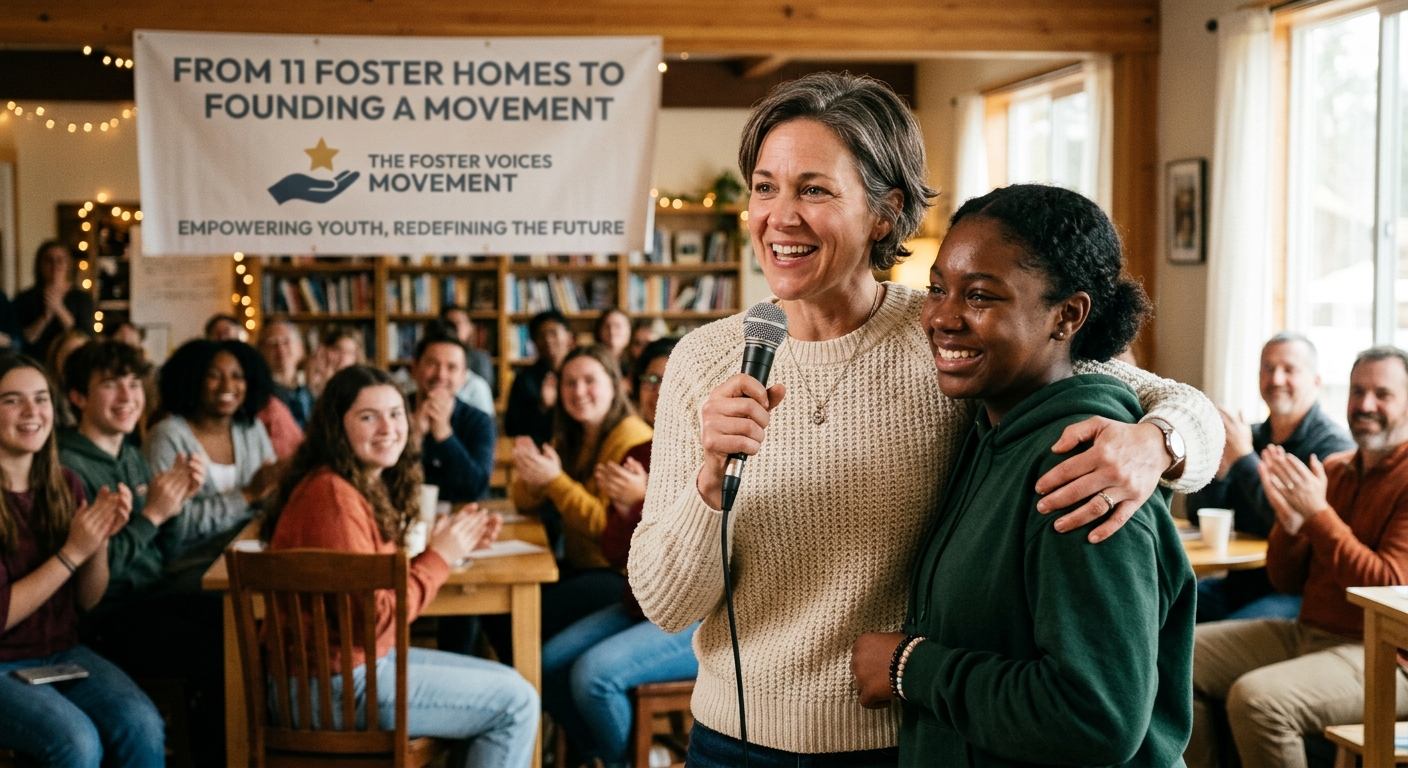
Within six months, the online community had over 1,000 members. Within two years, it crossed 10,000. Today, Rooted operates as a registered nonprofit with peer mentorship programs, emergency financial assistance, housing navigation support, and monthly meetups in fourteen cities across the country.
What Rooted Actually Does: A Closer Look
It would be easy to reduce Rooted to a feel-good story, but the work it does is deeply practical. Here is a breakdown of the core programs Maya and her team have built:
- Peer Mentorship Matching: Foster care alumni who have achieved stability in housing, employment, or education are matched with those who are newly aged out or struggling. The relationships are structured but warm, goal-oriented but flexible.
- The Emergency Fund: A small but mighty fund that provides one-time grants of up to $500 for members facing sudden crises, such as an eviction notice, a broken-down car, or a medical bill. “Sometimes $200 is the difference between someone keeping their apartment or losing everything,” Maya says.
- Career Navigation Workshops: Monthly sessions on resume writing, interview skills, and professional networking, taught by volunteers who are themselves system-impacted individuals who have “made it” in various fields.
- The Rooted Circle: Virtual and in-person support groups facilitated by licensed therapists who specialize in trauma and attachment. These sessions are free to all members.
- Holiday and Birthday Initiatives: Because many foster youth spend holidays alone, Rooted coordinates care packages, virtual gatherings, and local meetups during major holidays. No one spends their birthday without a card.
The Philosophy Behind the Work
What separates Rooted from other social service organizations is its foundational belief that foster care alumni are not charity cases. They are experts in their own experience. Every program is designed with input from members, every hire is prioritized from within the community, and every decision is filtered through one core question: “Does this give people power, or does it take it away?”
“The system treated us like problems to be managed,” Maya says. “We treat each other like people with wisdom and potential. That shift changes everything.”
A Community That Speaks Its Own Language
There is something that happens when you are in a room full of people who understand, without explanation, what it means to age out of foster care. You do not have to justify why you flinch at certain words, why you hold onto objects too tightly, or why trust feels like a foreign language. You are simply understood.
That shared language is, perhaps, Rooted’s most powerful offering. It cannot be quantified in a grant report or measured in a metric, but member after member describes it the same way: “For the first time, I felt like I belonged somewhere.”
What the Numbers Cannot Capture
10,000 members is an extraordinary number. But the story of Rooted lives in the individual moments within that number. It lives in the twenty-four-year-old who found her first mentor through the program and is now, three years later, mentoring someone else. It lives in the man who received an emergency grant and used that breathing room to land a stable job. It lives in the teenager who aged out of care on a Tuesday and found the Rooted online group by Wednesday, and cried with relief because someone answered her post within minutes.
These are not statistics. They are lives, redirected.
What Maya Wants You to Know
When asked what she would say to someone outside the foster care experience who wants to help, Maya does not hesitate:
“Learn before you lead. Listen more than you speak. And understand that the people who have been through hard things are not waiting to be saved. They are waiting for resources, for community, and for someone to get out of the way so they can save themselves.”
And for those who are still in the thick of it, those who are sleeping in unfamiliar beds and wondering if it gets better, she has a different message:
“It does. And you do not have to wait until you are on the other side to start building something. Start now. Even if it is just one post, one conversation, one hand extended. That is how Rooted started. That is how everything starts.”
How to Get Involved
If you are a foster care alumnus or know someone who is, Rooted’s online community is free to join. If you are a professional, volunteer, or donor who wants to support the work, Maya’s team is always looking for therapists, career coaches, housing advocates, and people who simply want to show up. Sometimes, she says, just showing up is enough.
Because that is all any of them ever needed. Someone who showed up and stayed.