🎧 Listen to this story
Narrated by Leda · 8,321 characters
The Diagnosis That Felt Like a Sentence
Robert Callahan was 51 years old when his cardiologist slid a piece of paper across the desk and said, quietly but directly, “Your arteries look like your father’s did at your age. And you remember what happened to him.”
He did remember. His father, Gerald, had survived his first heart attack at 53. His grandfather, Thomas, had not survived his second one at 61. And now Robert, with slightly elevated cholesterol, early arterial stiffness, and a stress test that raised eyebrows, was sitting in a fluorescent-lit office wondering if he was simply next in line.
“It felt like a verdict,” Robert said, recounting the moment during a conversation at his kitchen table in Columbus, Ohio. “Like the family had a contract with this disease, and nobody had ever thought to read the fine print.”
That was six years ago. Today, Robert’s most recent cardiac workup showed arterial health that his cardiologist described as “remarkable for his age.” His son, Daniel, 27, just received a clean bill of heart health. And his daughter, 24-year-old Mara, has become a registered dietitian who now helps other families rewrite their own health stories.
The change that started it all? It was not a drug. It was not surgery. It was not even a complicated wellness protocol. It was, by Robert’s own description, almost embarrassingly simple on the surface. But the commitment behind it ran deep.
When “Genetic” Becomes an Excuse
For decades, the Callahan family operated under a quiet but powerful assumption: heart disease was simply what happened to the men in their line. It was spoken about the way people speak about eye color or height, as something passed down, inherited, inevitable.
This kind of thinking, while understandable, is also one of the most dangerous health myths in modern life. Researchers at institutions including Harvard Medical School and the Mayo Clinic have increasingly documented that while genetic predisposition to heart disease is real, lifestyle factors can dramatically alter whether those genes ever “express” in dangerous ways. This is the field of epigenetics, and its implications are profound.
Dr. Anita Sharma, a preventive cardiologist not affiliated with the Callahan family but familiar with their type of case, explains it this way: “Having a genetic predisposition is like loading a gun. Lifestyle is the trigger. We cannot always change the gun, but we have far more control over the trigger than most people believe.”
The Callahans had never heard anything like that. Their family story had always skipped straight to the inevitable conclusion.
The One Change That Changed Everything
After his appointment, Robert did not immediately overhaul his life. He went home, sat with his wife Linda, and had a long conversation. Then another. Then several more. What emerged over the following weeks was not a resolution to “be healthier” in some vague, motivational-poster sense. It was something far more specific and, ultimately, more powerful.
The family decided to change how they ate together.
Not perfectly. Not overnight. But deliberately, consistently, and as a unit.
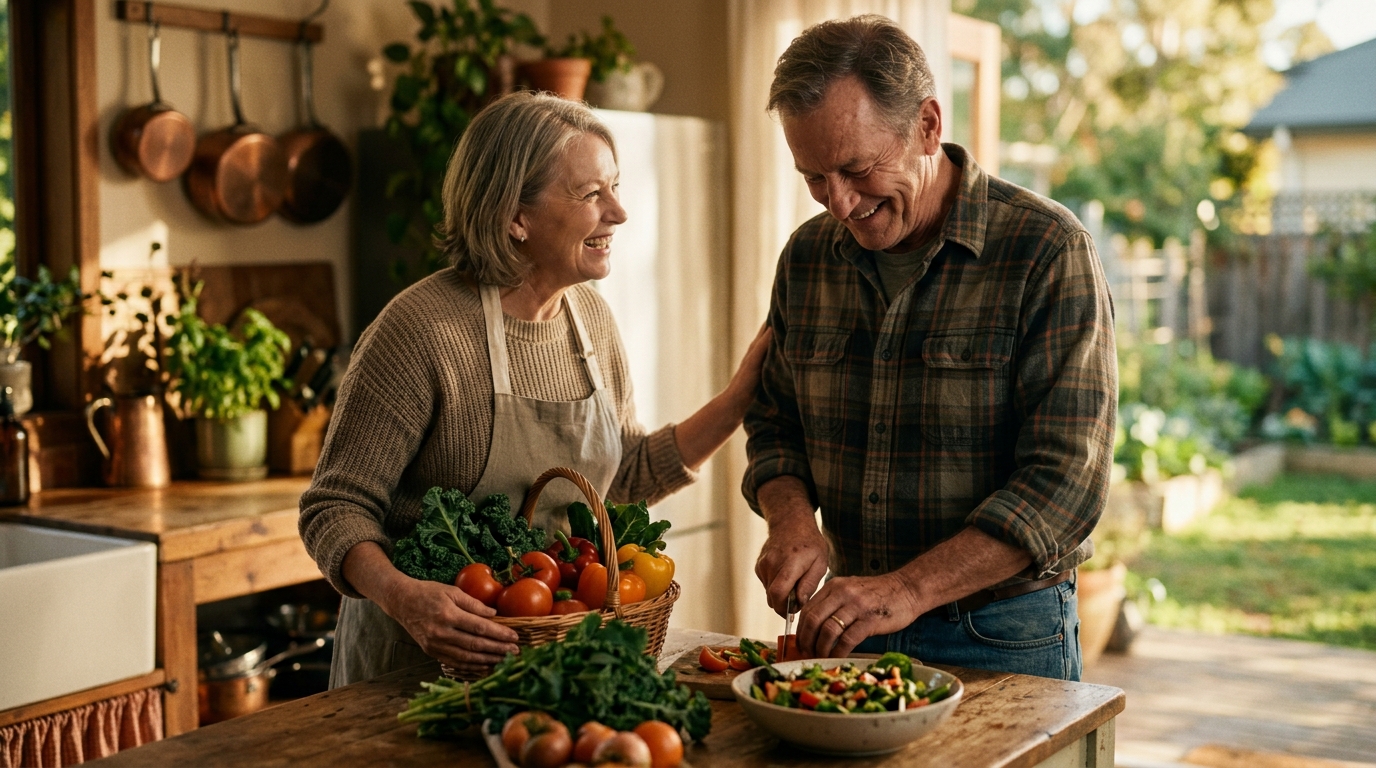
They shifted toward a whole-food, predominantly plant-based diet, not eliminating all meat, but dramatically reducing it. They cut out processed foods, refined sugars, and the kind of heavy, sodium-laden meals that had anchored family gatherings for generations. They started cooking more at home. They made Sunday dinners an event, not a habit, with fresh ingredients, new recipes, and conversations about why the changes mattered.
“We did not go vegan overnight and pretend it was easy,” Linda said, laughing. “There were arguments about sausage. There were many arguments about sausage.”
But the arguments gave way to curiosity. The curiosity gave way to habit. And habit, over months and then years, gave way to transformation.
What the Numbers Said
Within eighteen months of the dietary shift, Robert’s LDL cholesterol had dropped by 34 points without medication. His inflammatory markers, specifically his C-reactive protein levels, fell into a range his cardiologist had not expected to see. His blood pressure, previously creeping upward, normalized.
His doctor was not dismissive of the results. She was, by Robert’s account, visibly moved.
“She told me that she sees people make small changes and get small results all the time,” Robert recalled. “But she said this was different. She said, ‘You changed the environment inside your body.'”
Daniel, who had watched his father’s journey from young adulthood and grown up with the new family food culture, had his first cardiac screening at 25 and showed none of the early markers that had appeared in the men before him. Mara, inspired by the family’s experience, pursued her nutrition credentials and now works with at-risk cardiac patients.
7 Things the Callahan Family Learned Along the Way
- Food is information, not just fuel. Every meal sends signals to your body. A diet full of processed food sends different signals than one full of vegetables, legumes, and whole grains.
- Collective change is easier than solo willpower. Robert credits the family doing it together as the single biggest factor in sustainability. “Willpower runs out. Culture does not,” he said.
- You do not have to be perfect to make progress. The Callahans still eat meat occasionally. They still have birthday cake. The goal was not purity; it was direction.
- Cooking together is its own medicine. The act of preparing food as a family rebuilt connection and conversation in ways none of them had anticipated.
- The emotional side of food is real and must be respected. Letting go of generational recipes and food traditions felt like grief for a while. Acknowledging that made the transition gentler.
- Children absorb more than parents realize. Mara and Daniel watched every choice Robert made. His commitment quietly became their compass.
- Genetics is not destiny. This may be the most important lesson. A family history is a warning, not a sentence. It is information to act on, not a fate to accept.
A New Kind of Inheritance
The Callahans still talk about Gerald and Thomas, Robert’s father and grandfather. Their photographs sit on a shelf in the living room. They are remembered with love and without the silence that once surrounded the subject of how they died.
“We used to not talk about it,” Robert said. “It was like if we talked about it, we were inviting it in. Now we talk about it all the time. Because talking about it is how we fight it.”
There is something quietly revolutionary about a family that looks at a pattern spanning three generations and decides, not with fanfare or certainty but with simple, sustained effort, that the pattern ends here.
Robert Callahan is 57 now. He takes a walk every morning. He cooks dinner most nights. He argues sometimes about whether lentils are a real substitute for ground beef. (He has come around on this. Mostly.)
And when his grandchildren are born, if they are born with the same genetic tendencies, they will also be born into a family that already knows what to do about it. They will inherit, alongside whatever the DNA carries, a table set with intention, a kitchen full of knowledge, and the living proof that the story can be rewritten.
Sometimes the most powerful act of love a parent can offer is not the life they build for their children, but the habits they pass down without even trying.
Where to Start If This Resonates With You
If you have a family history of heart disease and feel the weight of that inheritance, consider these first steps recommended by preventive health professionals:
- Talk to your doctor about a full lipid panel and inflammatory markers, not just total cholesterol.
- Consult a registered dietitian who specializes in cardiovascular health before making dramatic dietary changes.
- Start with one meal a day that is plant-forward rather than attempting a full overhaul immediately.
- Involve your family. Change anchored in community outlasts change anchored in individual motivation.
- Learn about epigenetics. Understanding that genes can be influenced is genuinely empowering.
The Callahan story is not a medical miracle. It is something more available than that. It is a decision, made at a kitchen table, by a family that decided to read the fine print.