🎧 Listen to this story
Narrated by Callirrhoe · 7,694 characters
A Simple Idea That Became a Decade-Long Mission
When Bob Lanning retired from his job as a civil engineer in 2013, his wife handed him a list of hobbies he might enjoy: woodworking, gardening, maybe a little golf. He tried all three. None of them stuck. What did stick was a flyer he spotted on a bulletin board at his local hospital in Dayton, Ohio, asking for volunteer drivers to transport cancer patients to and from their treatment appointments.
“I figured I’d do it a few times a week,” Bob, now 74, recalls with a chuckle. “That was eleven years ago. I don’t think I’ve taken a full week off since.”
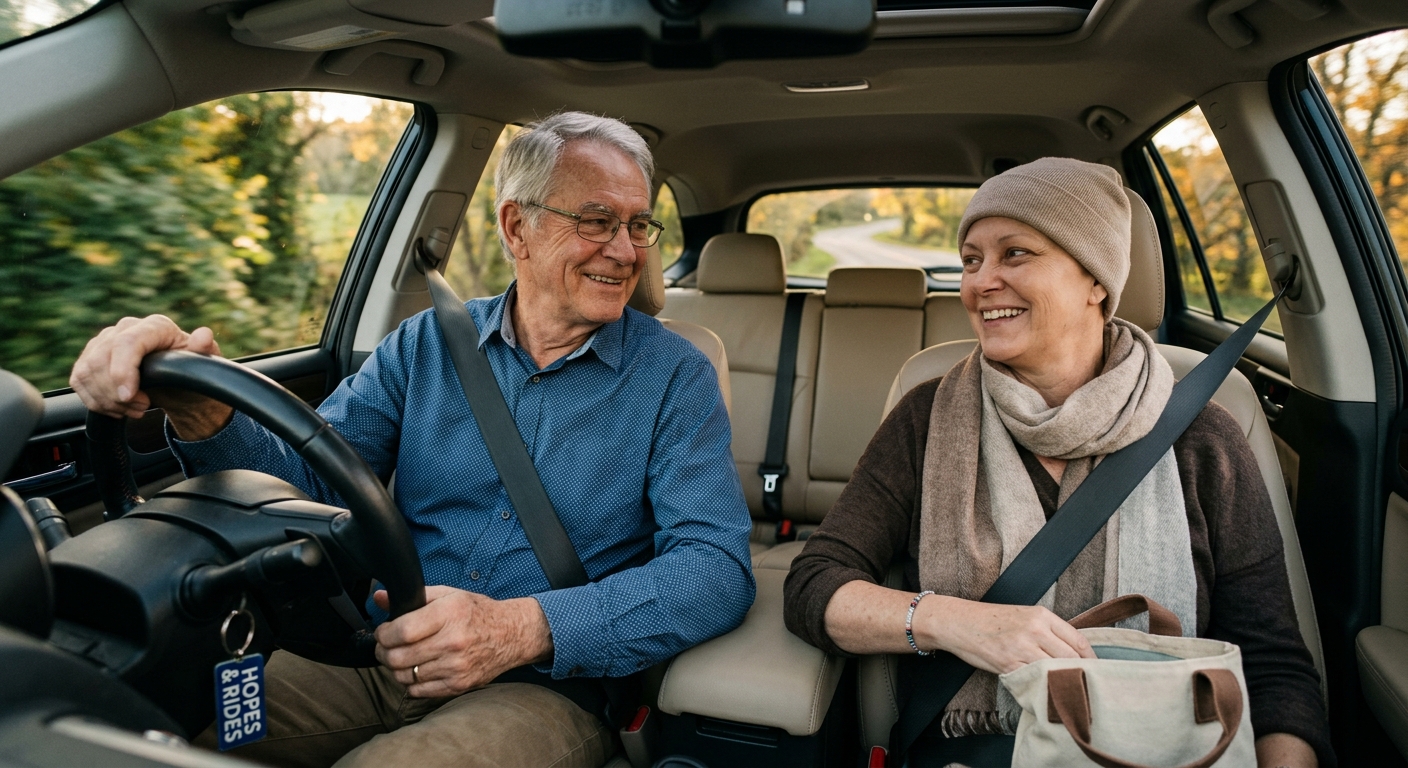
To date, Bob has completed more than 10,000 individual rides for cancer patients, clocking somewhere in the neighborhood of 180,000 miles behind the wheel of his trusty silver minivan. He does not accept tips. He does not ask for fuel reimbursement beyond what the volunteer program provides. What he does accept, freely and with genuine warmth, are the stories his passengers share during those quiet miles between home and hospital.
What the Numbers Don’t Tell You
Ten thousand rides is a staggering figure, but it risks flattening something profound into a mere statistic. Behind each number is a person: a mother of three who couldn’t afford a taxi during her chemo weeks. A veteran who had no family nearby. A retired schoolteacher who was terrified of her first radiation appointment and needed someone to walk her inside and wait.
Bob remembers nearly all of them.
“There was a gentleman named Harold,” Bob says, leaning forward. “Seventy-one years old, proud as anything, did not want help from anybody. First ride, he barely spoke. By the third ride, he was telling me about his time in Vietnam, his grandkids, his garden. By the end of his treatment, we were friends. Real friends.”
Harold passed away fourteen months after completing treatment, not from cancer but from a heart attack. Bob attended his funeral. He was the only non-family member there.
Why Transportation Is a Hidden Crisis in Cancer Care
Most people, when they think about the challenges of a cancer diagnosis, think about the disease itself: the fear, the treatment, the financial strain. Far fewer people consider the logistical nightmare that quietly unfolds around it.
Consider the numbers:
- The American Cancer Society estimates that nearly 1 in 4 cancer patients misses or delays treatment due to transportation barriers.
- A single course of radiation therapy can require daily appointments for five to seven weeks.
- Many chemotherapy patients are advised not to drive themselves home due to medication side effects and fatigue.
- Rural patients sometimes travel two to three hours each way for specialized care.
For patients without a car, without family nearby, or without the financial means to afford repeated rideshares or taxis, these logistical gaps can be the difference between completing a treatment course and abandoning it entirely. Volunteer drivers like Bob are not a luxury in the cancer care system. For many patients, they are a lifeline.
A Typical Tuesday With Bob
Bob’s phone alarm goes off at 5:45 a.m. He checks his schedule for the day, usually two to four rides, sometimes more. He prints out each patient’s pickup address, destination, and any notes the program coordinator has flagged. Does the patient use a walker? Do they get motion-sick? Do they prefer silence or conversation?
He keeps his minivan immaculate. There is always a small cooler in the back with bottled water and individually wrapped crackers, because some patients arrive for early-morning appointments having fasted, and the crackers help with nausea after treatment. There is a box of tissues tucked discreetly into the seat-back pocket. There is a phone charger with three different cable types, because people always need to call someone on the way home.
These are not official program requirements. These are just Bob.
“I think about what I would want if it were me in that seat,” he says simply. “I’d want someone who showed up on time, kept the car clean, didn’t make me feel like a burden. That’s not hard. That’s just basic human decency.”
The Emotional Weight of the Work
It would be dishonest to paint this story as purely joyful. Bob has lost patients he cared about. He has driven people to appointments they were afraid to attend and dropped them off at doors they weren’t sure they’d walk out of again. He has received phone calls from family members telling him that a passenger he drove last week passed away over the weekend.
“Does it hurt? Yes,” he says quietly. “But I think about it this way: I got to be part of their journey. I got to show them that a stranger cared enough to show up. That matters, even when the ending is hard.”
He pauses for a moment, then adds: “Especially then.”
Bob credits his late wife, Marlene, who passed away from breast cancer in 2019, with deepening his commitment rather than diminishing it. “She was one of the lucky ones. She had me, our kids, our neighbors. She was never alone for a single appointment. Not everyone has that. I keep driving because I know what it meant to her to have someone there.”
What Other Volunteers Say About Programs Like This
Bob is remarkable, but he is not alone. Across the country, volunteer driver programs affiliated with hospitals, cancer centers, and nonprofits like the American Cancer Society’s Road to Recovery program quietly shuttle thousands of patients each year. The volunteers who participate describe strikingly similar motivations:
- Personal connection to cancer: Many volunteers have lost a loved one or are survivors themselves.
- A desire for meaningful retirement: Former professionals who want their time to count for something tangible.
- The unexpected gift of connection: Nearly every volunteer interviewed described the rides as something they receive as much as they give.
“I came in thinking I was helping them,” says Karen, a retired nurse who volunteers with a similar program in Portland, Oregon. “Six years later, I realize they’ve been helping me process grief, stay connected to people, and feel useful. It goes both ways, always.”
How to Get Involved or Get Help
If you or someone you know needs transportation assistance for cancer treatment, or if you are considering becoming a volunteer driver yourself, here are some places to start:
- American Cancer Society Road to Recovery: cancer.org, search “Road to Recovery” for patient rides and volunteer opportunities.
- Local hospital volunteer coordinators: Most major cancer centers have internal volunteer driver programs.
- CancerCare: cancercare.org offers transportation assistance grants for eligible patients.
- Local nonprofits: Many communities have regional organizations specifically focused on medical transportation for low-income patients.
Volunteering does not require a special vehicle or medical training. It requires a valid license, a reliable car, a clean driving record, and the willingness to show up. The rest, as Bob will tell you, takes care of itself.
The Ride That Started It All
Asked about his very first ride back in 2013, Bob smiles wide. It was a woman in her late sixties named Gloria. She was nervous, chatty, and brought him homemade cookies wrapped in foil as a thank-you gift after her appointment. He still has the recipe she wrote out for him on a paper bag: snickerdoodles.
“I made them once,” he admits. “They weren’t as good as hers. But I still have the recipe.”
He pulls out his wallet and, sure enough, tucked behind his license, there is a small, folded square of paper bag with handwriting on it. He holds it up briefly, then tucks it back carefully, like it belongs there.
Because for Bob Lanning, it does.