🎧 Listen to this story
Narrated by Callirrhoe · 8,556 characters
The Forest Floor Has a Secret Language
Walk into an old-growth forest and you might notice something that is difficult to name. A kind of stillness that feels less like silence and more like listening. For centuries, poets and Indigenous storytellers have described forests as living, breathing communities with memory and feeling. For just as long, mainstream science dismissed these ideas as romanticism. But a growing body of research is quietly, and rather urgently, rewriting that dismissal.
Scientists studying forest ecosystems are now documenting something that looks, behaves, and functions remarkably like grief. Not in the way we experience loss, perhaps, but in a measurable, physiological, and deeply interconnected way that reveals forests as social organisms rather than collections of individual trees.
The Wood Wide Web: A Network Built on Relationship
To understand why forests respond to the death of old trees, you first need to understand how they communicate in the first place. Beneath every forest floor lies an intricate web of fungal threads called mycorrhizal networks. These networks connect the root systems of trees across enormous distances, allowing them to share nutrients, water, chemical signals, and even warning messages.
Suzanne Simard, a forest ecologist at the University of British Columbia and author of Finding the Mother Tree, spent decades mapping these underground networks. What she found fundamentally changed how scientists think about forests. Trees, she discovered, are not competing loners. They are cooperating communities, and at the center of each community stands what she calls a Mother Tree.
What Is a Mother Tree?
Mother Trees are the oldest, largest trees in a forest. They are the most deeply embedded in the mycorrhizal network, connected to hundreds of other trees simultaneously. Simard’s research showed that these anchor trees:
- Funnel carbon and nutrients to younger seedlings, including those of different species
- Send chemical defense signals when insects or pathogens attack neighboring trees
- Prioritize their own offspring with larger nutrient transfers, suggesting something like recognition
- Appear to increase these transfers as they age and near the end of their own lives
That last point is where things get particularly striking. When a Mother Tree is dying, it does not simply stop functioning. It accelerates. Simard documented cases in which dying trees flooded the surrounding network with a massive pulse of carbon and defense compounds, essentially redistributing their life’s resources to the community they had supported for decades or centuries.
What the Network Does After a Mother Tree Dies
Here is where the concept of grief becomes scientifically relevant, even if the word itself makes some researchers uncomfortable. When a Mother Tree is removed, either by logging, disease, or natural death, the surrounding forest does not simply carry on. Studies have documented the following responses in the network:
- Increased chemical signaling: Neighboring trees ramp up stress hormone production in the weeks and months following the loss of a major hub tree.
- Growth disruption: Seedlings and younger trees that were connected to the lost hub show measurable growth slowdowns, sometimes lasting years.
- Network restructuring: The mycorrhizal web physically reroutes itself, sometimes spending years reestablishing stable connections. During this period, the forest is measurably more vulnerable to disease and drought.
- Reduced diversity: Studies in logged areas where old-growth hub trees were removed found significant drops in the diversity of fungal and plant species, suggesting the network had lost a kind of biological intelligence that supported variety.
These are not metaphors. These are documented, peer-reviewed, measurable biological responses. Whether we choose to call them grief or simply systemic disruption depends largely on how comfortable we are with extending emotional language beyond the human.
Peter Wohlleben and the Case for Feeling
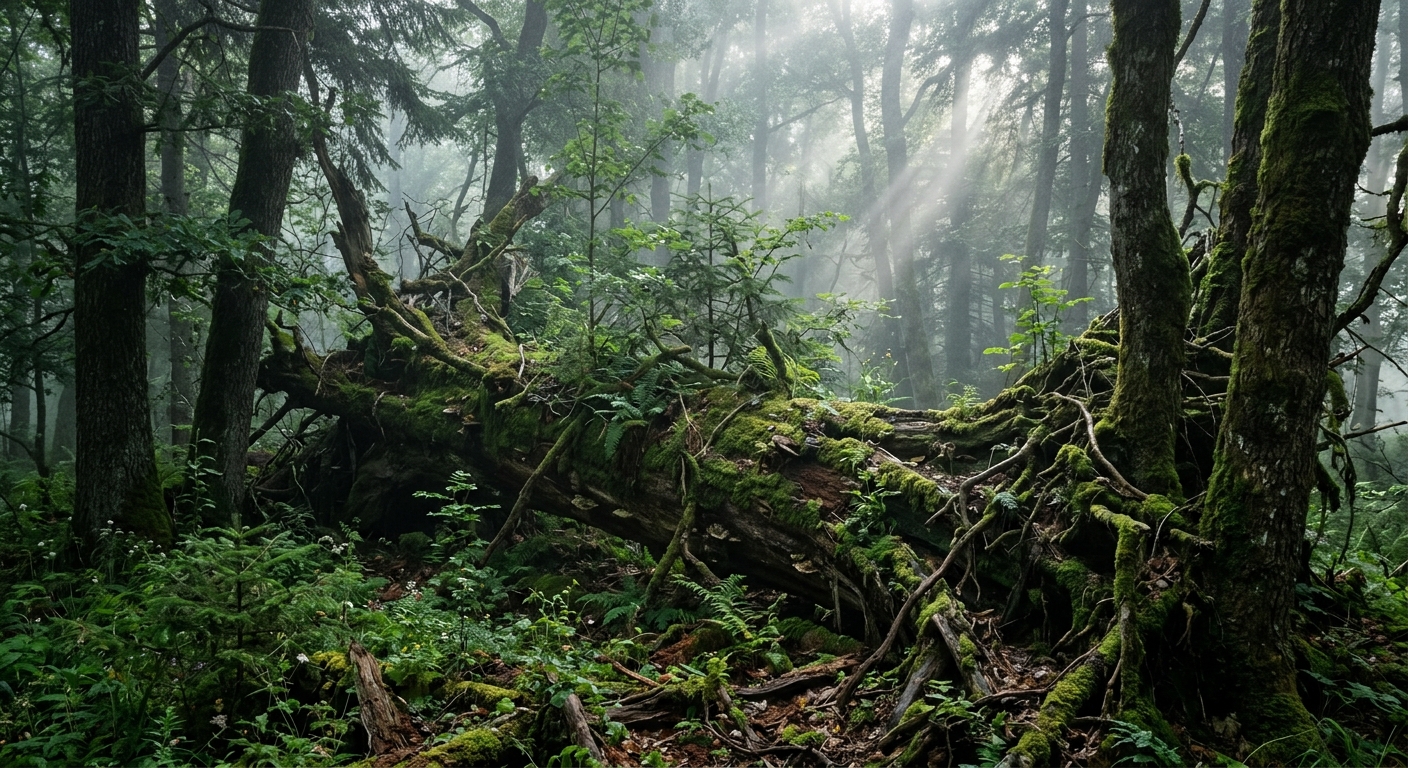
German forester and author Peter Wohlleben stirred international conversation with his bestselling book The Hidden Life of Trees. Drawing on decades of observation in managed forests, Wohlleben described witnessing what he believed was mourning behavior: trees growing slowly and carefully around a fallen companion’s stump, feeding it through root connections for years after its death, as if unwilling to let go.
His observations were sometimes criticized as anthropomorphism, but subsequent scientific studies have lent his anecdotal accounts more credibility. Researchers at the Technical University of Munich confirmed that trees in established communities do maintain nutrient flow to neighboring stumps, sometimes for decades. The reason, they suggest, may be practical: the stump’s root system still holds soil and retains moisture, making it a worthwhile investment for the network. But the behavior looks, from the outside, strikingly like loyalty.
The Question of Consciousness
Does any of this mean trees are conscious? That they feel sadness the way you or I feel sadness? Most scientists are cautious here, and rightly so. Monica Gagliano, a researcher who has published peer-reviewed work on plant cognition and learning, argues that the question itself may be too narrow. Consciousness, she suggests, may not be a binary quality that organisms either have or lack. It may exist on a continuum, and forests may occupy a place on that continuum we have not yet learned to recognize.
What is not in question is that forests are not passive. They are dynamic, responsive, communicative systems that change their behavior based on loss. Whether that constitutes grief in any meaningful sense is a philosophical question. But the biological evidence suggests that when an old tree falls, the forest around it is profoundly, measurably affected.
Why Old Trees Matter More Than We Realized
One of the most important practical implications of this research is the irreplaceable value of old trees, not just for carbon storage or biodiversity, but for the social infrastructure of the forest itself. Planting new trees, while valuable, cannot immediately replicate what an ancient hub tree provides. The mycorrhizal network that a 300-year-old tree has built over centuries cannot be recreated overnight.
Simard’s research found that forests with intact Mother Tree networks were significantly more resilient to climate stress than those where hub trees had been removed. They recovered faster from drought, resisted beetle infestations more effectively, and maintained healthier soil chemistry. The old trees were not just residents of the ecosystem; they were its memory, its immune system, and its connective tissue.
What This Means for How We Live
There is a life lesson folded inside this science, and it is not a subtle one. The oldest among us carry networks we cannot see. The connections built over decades, the quiet redistributions of resource and attention, the willingness to pass forward what has been gathered over a lifetime; these are not small things. They are the architecture of resilience.
Forests teach us that community is not decoration. It is survival. And the loss of those who have been at the center of a community the longest sends ripples through every connection they ever made.
The next time you stand in the shade of an old tree, consider what you are standing inside: a relationship that predates you, a network that will outlast you, and a living system that has been quietly practicing loyalty, generosity, and grief long before humans had words for any of them.
A Closing Thought From the Research
Suzanne Simard, in interviews about her life’s work, has described a moment of sitting beneath a dying fir tree in a forest she had studied for years. She said she felt, for the first time, that the forest knew she was there. Science, she acknowledged, cannot prove that. But science can prove that the forest was responding to everything around it, including her presence, through roots and fungi and chemical whispers too small and too slow for human senses to catch.
Maybe that is enough. Maybe the question is not whether forests grieve exactly the way we do. Maybe the question is whether we are paying enough attention to notice that they respond to loss at all, and whether that recognition might make us a little more careful, a little more grateful, and a little more humble about the ancient, breathing communities we walk through and too often take for granted.