
🎧 Listen to this story
Narrated by Kore · 8,590 characters
The World Got Quiet, and the Birds Started Singing Again
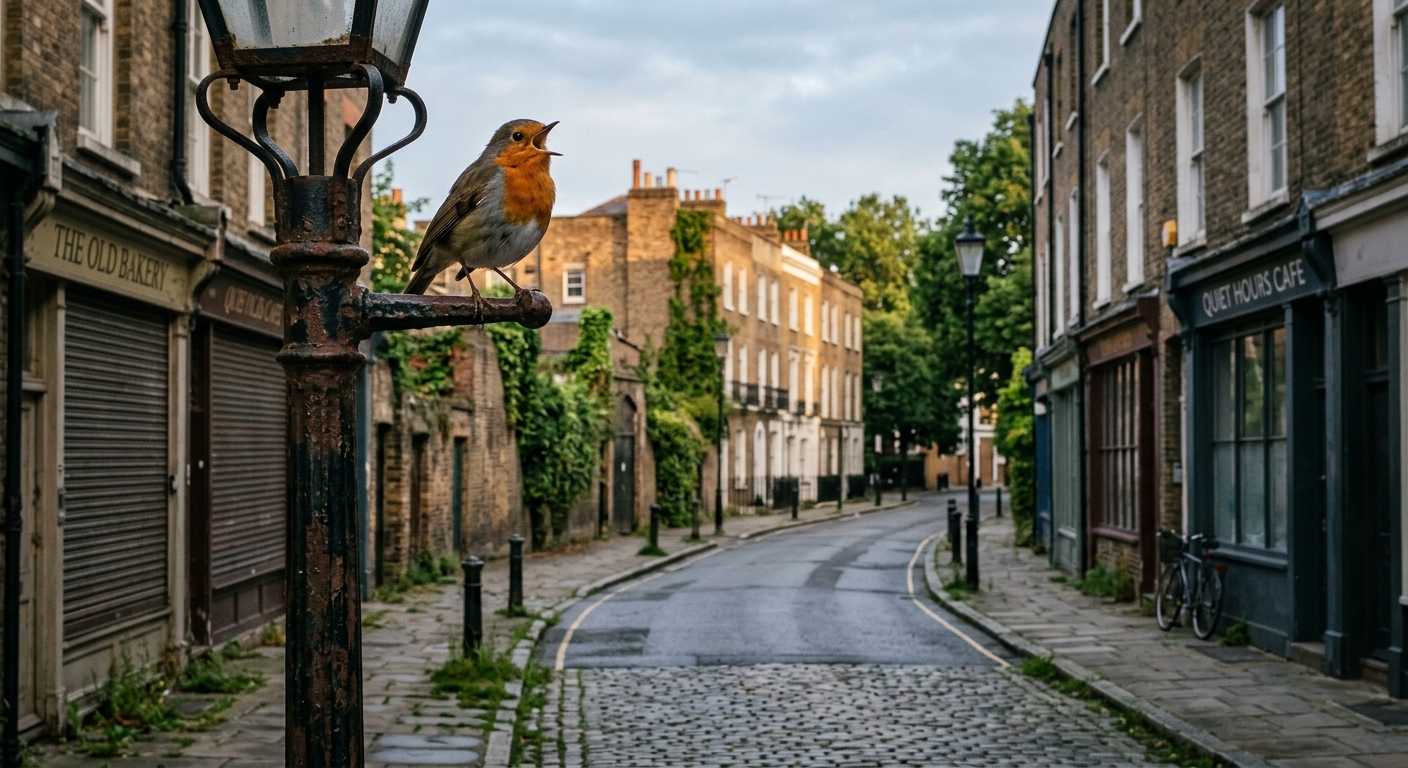
In the spring of 2020, something unusual happened in cities across the world. Streets that once hummed with the relentless roar of traffic fell silent. Engines stopped. Horns ceased. And into that rare, almost forgotten quiet, something extraordinary crept back in: birdsong.
People noticed it from their windows. They mentioned it in social media posts, in phone calls to family, in journal entries written during long, uncertain days indoors. The birds sounded different. Fuller. More present. More alive. It was not a hallucination born of stress or solitude. Scientists confirmed what millions of ears had already suspected: the birds were genuinely singing better, and the reason why tells us something profound about the world we have built around ourselves.
What the Research Actually Found
Researchers at San Francisco State University, led by ornithologist Elizabeth Derryberry, published a landmark study in Science magazine in September 2020. Using archived recordings of white-crowned sparrows from 1999 and comparing them to new recordings captured during the pandemic shutdown, they discovered something remarkable.
The sparrows were not just singing louder. They were singing better. Their songs had dropped in pitch, expanded in range, and increased in complexity. Without the low-frequency rumble of traffic drowning out the lower notes of their calls, the birds were free to use their full vocal range. They were, in the most literal sense, finally being heard.
The study noted that the quality of birdsong improved so dramatically during the lockdowns that it matched recordings from decades earlier, before urban noise pollution reached its current peak. In just a matter of weeks, birds reclaimed a vocal richness that had slowly been eroded over generations.
Why Traffic Noise Is So Damaging to Birds
To understand why quiet streets transform birdsong, it helps to understand what traffic noise actually does to the acoustic environment that birds depend on.
It Masks Their Communication
Birds sing for survival. They sing to attract mates, defend territory, warn of predators, and maintain social bonds. These are not casual performances. They are urgent biological messages. When low-frequency traffic noise fills the air, it overlaps with the frequency range many birds naturally use, effectively garbling their signals. Imagine trying to have an important conversation in the middle of a freeway. That is the daily reality for urban birds.
It Forces Behavioral Adaptation
Over time, birds living in noisy environments have had to adapt in ways that come at a cost. Many urban species have shifted their songs to higher pitches to avoid the traffic frequency range. Others sing louder, burning more energy. Some have changed the timing of their songs, singing earlier in the morning before traffic peaks. These adaptations require effort and compromise, and they are not always enough.
It Disrupts Mating and Reproduction
When a male bird cannot effectively communicate its fitness through song, it struggles to attract mates. Studies have shown that female birds in high-noise environments show reduced responses to male song, leading to lower breeding success. Noise pollution is not just an aesthetic inconvenience. It has real consequences for wildlife populations.
What We Lose When We Stop Listening
There is a concept in ecology called shifting baseline syndrome. It describes the way each generation accepts the natural world they are born into as the norm, without realizing how much has already been lost before they arrived. Most of us have grown up with traffic noise as a constant backdrop. We have never known our cities the way birds once knew them, or the way those same birds still remember in their genes.
When the lockdowns temporarily stripped away that noise and birdsong flooded back into city life, many people reported something they struggled to articulate. It felt like recovering something. Not just hearing something beautiful, but remembering something essential. A relationship between humans and the natural world that had been slowly muffled, year by year, decibel by decibel.
7 Things We Learned From the Silence
- Nature recovers faster than we think. Within weeks of reduced traffic, birds were already singing with significantly greater complexity and range. The environment can rebound with surprising speed when given the chance.
- Noise pollution is a form of habitat destruction. We often think of habitat loss in terms of physical space, but acoustic space is just as vital to wildlife. Filling it with noise is its own kind of erasure.
- Urban birds have been quietly struggling for decades. The shift in sparrow song quality was not recent. Scientists found that birds had been gradually simplifying their songs since at least the 1970s as traffic increased.
- Humans are also affected by constant noise. Research consistently links chronic traffic noise to elevated stress hormones, sleep disruption, cardiovascular issues, and reduced cognitive performance in children. The quiet that benefited birds also benefited the people who got to hear them.
- Birdsong has measurable mental health benefits. A 2022 study published in Scientific Reports found that listening to birdsong reduced anxiety and paranoia in participants. Every bird silenced by traffic noise is a small subtraction from our collective wellbeing.
- We have more influence over this than we realize. Urban planning decisions, vehicle emission standards, electric vehicle adoption, and even the placement of parks and green corridors all affect the acoustic environment. This is a solvable problem.
- Paying attention is itself a form of advocacy. The millions of people who noticed the birdsong in 2020 and mentioned it to others helped shift a conversation. Awareness precedes action. Listening is not passive.
Cities That Are Taking Noise Seriously
Some cities around the world have already begun treating noise pollution as a genuine environmental and public health priority, not an afterthought.
Amsterdam has invested heavily in cycling infrastructure, reducing the number of cars in residential neighborhoods and dramatically lowering ambient noise levels. Paris has designated zones de tranquillite, quiet zones in parks where noise-generating activities are restricted. New York City has launched noise complaint response programs and is gradually electrifying its bus fleet. Oslo has experimented with car-free city center zones, and reported increases in both pedestrian satisfaction and urban wildlife activity.
These are not radical or idealistic experiments. They are practical decisions with measurable outcomes, and birdsong is one of the indicators scientists are watching.
How to Hear What Has Been There All Along
You do not need a scientific study or a global shutdown to reconnect with birdsong. Here are a few practices that can help you tune back in.
Step Outside Before 8 a.m.
The dawn chorus, the burst of bird song that happens in the hour before and after sunrise, is the most acoustically rich period of the day. Even in urban areas, early morning brings a window of relative quiet. Set an alarm once. Just once. And go outside and listen.
Find Your Nearest Green Corridor
Parks, riversides, railway embankments, and cemetery gardens are often surprisingly rich in bird life and notably quieter than open streets. Many cities have more of these acoustic refuges than residents realize. Apps like Merlin Bird ID can help you identify what you are hearing and turn a walk into something that feels genuinely alive.
Sit Still for Five Minutes
Birds respond to human presence. If you sit quietly in one spot for five minutes rather than walking and talking, you will notice the soundscape around you shift and expand. Birds that had gone quiet will begin calling again. It is one of the simplest and most rewarding experiments in attention you can try.
A Song Worth Protecting
There is something quietly devastating about knowing that the birds singing outside your window are already performing a reduced version of their natural song, that they have learned to make themselves smaller, quieter, more compressed, just to survive in the world we built. And there is something quietly hopeful about knowing that the solution is not complicated or distant.
When we make space for quiet, birds fill it with something extraordinary. That is not metaphor. That is peer-reviewed science. And it is also, if you let it be, a reason to listen more carefully to everything you might be missing.