🎧 Listen to this story
Narrated by Sadachbia · 8,958 characters
Nobody Planned for This to Happen
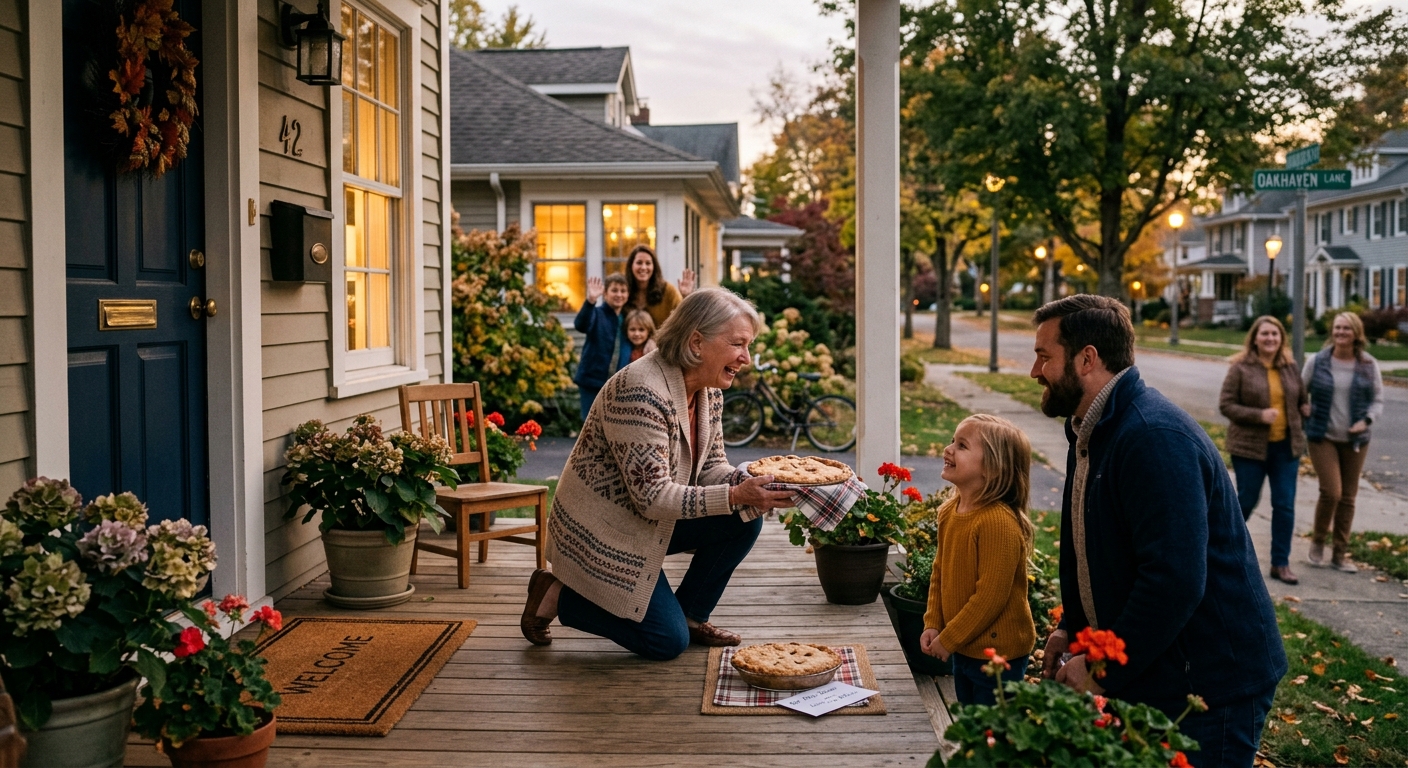
It started with a pie. A simple, slightly lopsided blueberry pie left on the porch of a house on Clover Street in a mid-sized Ohio town, with a handwritten note tucked under the tin: “Made too much. Enjoy. Your neighbor, Deb.”
Deb Harcastle, 67, a retired schoolteacher, had not set out to change anything. She had been baking to keep herself busy after her husband passed. She had extra pie. She had a neighbor she had never properly met in eleven years of living side by side. So she left the pie.
What followed over the next eight months was something that local sociologists, a regional newspaper, and eventually a national lifestyle magazine would describe as one of the most organic and surprising community revivals they had ever witnessed. Not a city program. Not a church initiative. Not a social media campaign. Just a pie, a porch, and a neighborhood that had quietly been starving for connection without realizing it.
The Loneliness Nobody Was Talking About
Before we get further into what happened on Clover Street, it is worth sitting with a statistic that stops most people cold when they hear it. According to the U.S. Surgeon General’s advisory released in 2023, roughly half of American adults report measurable levels of loneliness. Not occasional sadness. Not a bad week. Chronic, persistent loneliness that affects physical health, cognitive function, and life expectancy in ways comparable to smoking fifteen cigarettes a day.
And the cruel irony is that much of this loneliness exists not in remote rural areas but in dense suburban neighborhoods, in streets lined with houses, in places where dozens of people live within shouting distance and yet know almost nothing about each other.
Clover Street was not unusual. It was just average. People waved from driveways. They exchanged brief nods at mailboxes. They had formed an unspoken agreement, as most modern neighborhoods have, that proximity does not require relationship.
Until Deb and her pie broke that agreement wide open.
A Timeline of Accidental Community
Here is how things unfolded, pieced together from interviews with residents conducted by the Millfield Gazette in the spring of the following year:
- Week 1: Deb leaves a blueberry pie for her neighbor Marcus, 34, a remote software developer who admits he had spoken fewer than twenty words to any neighbor in two years. Marcus eats the pie. He feels something shift, though he cannot name it yet.
- Week 2: Marcus, inspired and a little embarrassed by his own isolation, buys a flat of tomato seedlings and leaves one on every porch within four houses. A small sticky note reads: “These need people who will actually pay attention to them. I am not that person.”
- Week 3: Three neighbors who received tomato plants happen to be watering them at the same time on a Tuesday evening. They end up talking for forty minutes about nothing important: the weather, a pothole, a good podcast. A retired nurse named Gloria calls it “the best conversation I’ve had in months.”
- Week 5: Gloria sets up a small folding table at the end of her driveway on Saturday mornings with coffee and store-bought donuts. She puts a sign on it that says: “Sit if you want. No obligation.”
- Week 8: Four people are regularly showing up for Saturday coffee. Then seven. Then eleven. A man named Pat, who had been quietly battling depression since losing his job, starts coming every week. He later says those Saturday mornings were the first thing he looked forward to in over a year.
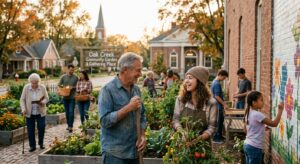
- Month 4: Someone suggests a neighborhood tool-sharing system. A shared spreadsheet is created listing who owns what: a pressure washer, an extension ladder, a tile saw, a sewing machine. Thirty-one households participate within two weeks.
- Month 6: A block party happens. Not an organized, permit-required, city-sponsored event. Just people dragging grills and lawn chairs into the street on a Friday evening. Eighty-three people attend. Several of them meet each other for the first time despite living on the same block for over a decade.
- Month 8: A local reporter shows up. The story goes regional. Then national. Then Deb gets a phone call from a producer at a morning talk show, which she politely declines because, as she tells Marcus, “I just made a pie. That is not a television story.”
What the Residents Actually Say About It
When asked to describe what changed, the residents of Clover Street do not use the word “community” very often. That word feels too formal for what they experienced. They use smaller words.
“I just feel seen,” says Gloria, 71. “I walk to my mailbox and someone waves and actually looks at me. That sounds like nothing. It is not nothing.”
Marcus, who once described himself as someone who had “optimized for isolation,” says the change crept up on him slowly. “I started leaving my front door open on warm evenings. Just open. I don’t know why. I think I wanted to hear people.”
Pat, who agreed to share his story with the hope it might help others, is the most direct about the stakes. “I was in a dark place. I did not reach out to anyone because I thought no one would notice. When Gloria started that coffee thing, I noticed. Someone was bothering. That mattered to me more than I can say.”
What This Teaches Us About Connection
Researchers who study social connection have a term for what happened on Clover Street: they call it a low-barrier entry point to community. The genius, if you can call it that, of Deb’s pie was not its filling. It was its complete lack of obligation. It asked nothing. It required no RSVP, no scheduled time, no shared belief system, no commitment. It was simply a gesture extended without strings.
And that, it turns out, is exactly what most lonely people need. Not a formal program. Not therapy (though therapy is wonderful and important). Not a neighborhood Facebook group with passive-aggressive threads about parking. Just a small, genuine, low-pressure signal that says: I notice you exist. I thought of you.
The Three Ingredients Behind Clover Street’s Transformation
Looking back at the timeline, three consistent elements appear in every step of the neighborhood’s evolution:
- Visibility without demand. Every gesture, from the pie to the coffee table to the open spreadsheet, was visible but never required participation. Nobody was guilted or organized into connection.
- Repetition over time. The Saturday coffee table worked because it kept showing up. Community is not built in a single event. It is built in the accumulation of small, recurring moments.
- One person going first. Every ripple traced back to Deb deciding to go first. She did not wait for a neighbor to reach out to her. She simply reached out. Someone always has to go first, and it is almost always uncomfortable, and it is almost always worth it.
Could This Happen on Your Street?
That is the question the Millfield Gazette ended its feature with, and it is the right one. The honest answer is: probably yes, and probably easier than you think.
You do not need a great idea. You do not need to be extroverted. You do not need resources or a plan. You need the same thing Deb had, which is a small surplus of something, time, food, plants, tools, attention, and the willingness to extend it outward without expecting anything back.
The cure for loneliness is not found in apps or algorithms or programs, though all of those things can help. It is found in the ancient, stubbornly human act of turning toward each other. Knocking on a door. Leaving something on a porch. Pulling up a folding chair and staying a little longer than is strictly necessary.
Deb Harcastle baked a pie because she had too many blueberries and a quiet house. She had no idea she was starting anything. That is, somehow, the most hopeful part of all.
Start Small. Start Today.
If you are sitting with this story and feeling both moved and slightly daunted, here is a list of genuinely small things that have been shown to spark neighborhood connection, drawn from community-building research and, yes, from what actually happened on Clover Street:
- Leave something on a neighbor’s porch with a note, food, seeds, a book, anything with a bit of warmth attached to it
- Sit on your front porch or stoop more often, even briefly, visible presence signals availability
- Introduce yourself to one neighbor you have never properly met
- Share something you have too much of, zucchini from a garden, a skill, a tool, a recommendation
- Wave and make eye contact, not just a head nod, a real acknowledgment
- Create a low-stakes recurring thing, a weekly walk, a morning coffee spot, even a simple sign
None of these are revolutionary. All of them have the potential to change something, for you, for someone else, for a whole street that does not yet know it is lonely but will one day look back and remember exactly when things turned around.
And maybe it will trace back to you. And a pie you almost did not bother making.