🎧 Listen to this story
Narrated by Kore · 7,081 characters
There is a particular kind of quiet that settles over a rural highway after nine at night. The trucks thin out. The radio stations drift into static. And somewhere along a stretch of road where the next town is forty miles away, a car sputters, coasts, and goes silent.
For the people who break down on that road, there is one thing they tend to see first: a small glowing sign, a single lit window, and a man named Walt who has no intention of letting anyone sit in the dark alone.
This is a story about that sign, that window, and the habit of kindness that has outlasted three decades, two renovations, and one very stubborn coffee machine.
A Station at the Edge of Nowhere
Walt Brenner bought the station in 1991, back when gas was a dollar and change and the highway saw twice the traffic it does now. It was never meant to be a landmark. It was a place to sell fuel, snacks, and the occasional road atlas to people who still used them.
But the location made it something else. The station sits at the middle of a long, empty stretch with no other services for miles in either direction. Cell reception is a rumor. When something goes wrong out here, there is nowhere else to turn.
Walt noticed this early. In his first winter, a family of four pulled in just as he was about to close, their engine steaming and their youngest child asleep in the back seat. The posted hours said the station closed at nine. It was ten past.
He turned the sign back to OPEN, put on a pot of coffee, and spent the next two hours helping a stranger figure out a cracked radiator hose. He never mentioned the hours.
“I figured the sign says when I’m allowed to go home,” he likes to say. “It doesn’t say when I’m allowed to help.”
The Unwritten Rules of the Late Shift
Over the years, Walt developed a quiet set of habits for the travelers who find him after dark. None of them are written down. None of them are advertised. They simply happen, night after night, for whoever needs them.
- The porch light stays on. Even on nights when he closes the register, the outdoor light burns until dawn, so anyone arriving after hours knows the place is not abandoned.
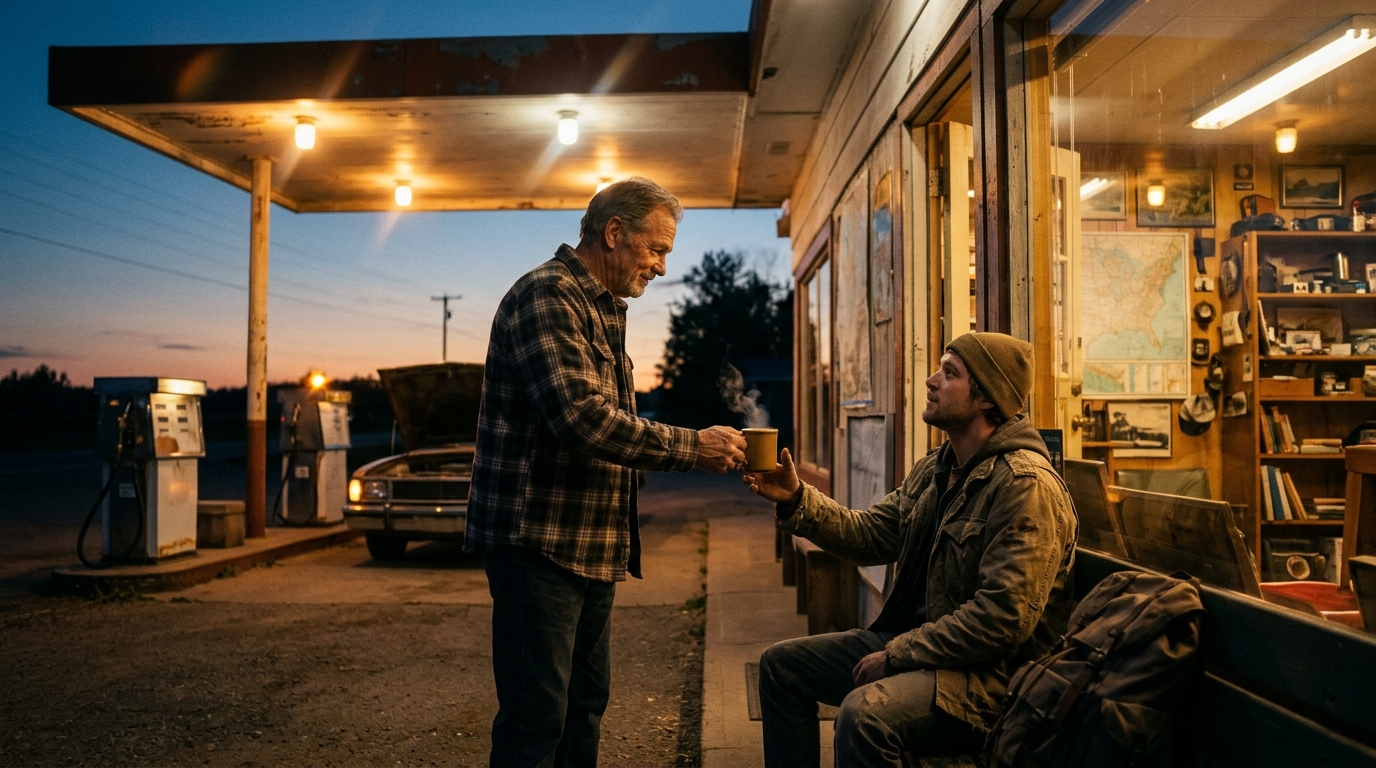
- The first question is always the same. Not “what’s wrong?” but “have you eaten?” A tired, frightened person thinks better with something warm in their hands.
- The phone is theirs to use. The landline behind the counter has connected stranded drivers to tow trucks, worried spouses, and one very relieved grandmother in another state.
- The back room has a cot. It is not fancy. It has a wool blanket and a small lamp. But more than a few travelers have slept there safely while a part was ordered or a storm blew through.
- Nobody is charged for the kindness. Parts and fuel cost what they cost. The coffee, the phone, the cot, and the conversation are free.
The Night Everything Slowed Down
Ask Walt about his favorite memory and he will take his time answering. He is not a man who rushes his stories. But the one he returns to most is about a night in late October, a few years back.
A young woman named Imogen had been driving cross-country to start a new job. Her car died a few miles short of his station, and she walked the rest of the way in a thin jacket, fighting a wind that came straight off the plains. When she pushed open the door, she was shaking, and she was trying very hard not to cry.
Walt did not ask her to explain. He handed her a mug, pulled a stool up to the heater, and let the quiet do its work. After a while, she began to talk. The job was her first real chance after a hard year. She had sold most of what she owned to make the move. If the car could not be fixed, she told him, she did not know what she would do.
He spent the night under her hood with a flashlight in his teeth. By the time the sky began to lighten, the engine turned over. Imogen stood in the cold blue dawn, holding a paper cup of coffee, and said she had never been so grateful for anything in her life.
Walt shrugged. “Somebody did it for me once,” he said.
What Evening Teaches Us About Kindness
There is something about the hours after dark that strips away our pretenses. During the day, we move fast, we stay busy, we keep our guard up. But in the evening, when the light goes soft and the world grows hushed, we become more honest about what we need.
A stranded traveler at night is not performing strength. They are tired, uncertain, and a little afraid. And that vulnerability is exactly what makes a small act of care land so deeply. A warm drink at ten o’clock at night is not a small thing. It is proof that the world still has people in it who will stay up for you.
Walt understands this better than most. He has watched the same transformation hundreds of times: the stiff shoulders loosening, the worried voice slowing down, the moment a stranger realizes they are not alone out here.
Three Lessons From a Lit Window
If there is wisdom in Walt’s decades behind that counter, it can be gathered into a few simple ideas:
- Availability is a form of love. Showing up, especially when it is inconvenient, tells people they matter more than your schedule.
- Comfort comes before solutions. A frightened person cannot solve a problem until they feel safe. Warmth first, repairs second.
- Kindness does not need an audience. Walt has never posted about any of this. The good he does is done quietly, then forgotten by him and remembered forever by them.
The Letters on the Wall
Behind the register, there is a corkboard that has grown crowded over the years. It is covered in postcards, photographs, and handwritten notes from people who passed through on their worst nights and never forgot it.
One card, from a man who had been driving to a funeral, reads simply: You gave me a place to breathe before the hardest day of my life. Another, from a family whose van broke down on a holiday weekend, includes a child’s drawing of a gas station with a big yellow sun over it.
Walt does not display them to boast. He keeps them where he can see them during the long, slow stretches of the night shift, a quiet reminder of why the light stays on.
Ending the Day Well
When the last customer has gone and the highway falls silent, Walt does the same thing every night. He wipes down the counter, refills the coffee for whoever might need it next, and steps outside for a minute. He looks at the road stretching into the dark in both directions, and he listens.
Sometimes there is nothing but wind. Sometimes, far off, there is the low hum of an engine and the sweep of headlights. He waits to see whether they will slow down.
Tonight, as you wind down your own day, perhaps there is a lesson in that small ritual. Somewhere in your life, there may be a person who is running on empty, coasting toward a dark stretch with no end in sight. You may not own a gas station. But you can leave a light on. You can put the kettle on. You can be the thing a tired stranger sees glowing in the distance and thinks, I am going to be okay.
That is all Walt has ever done. And somehow, it has been enough to change hundreds of lives, one dark night at a time.