🎧 Listen to this story
Narrated by Kore · 6,155 characters
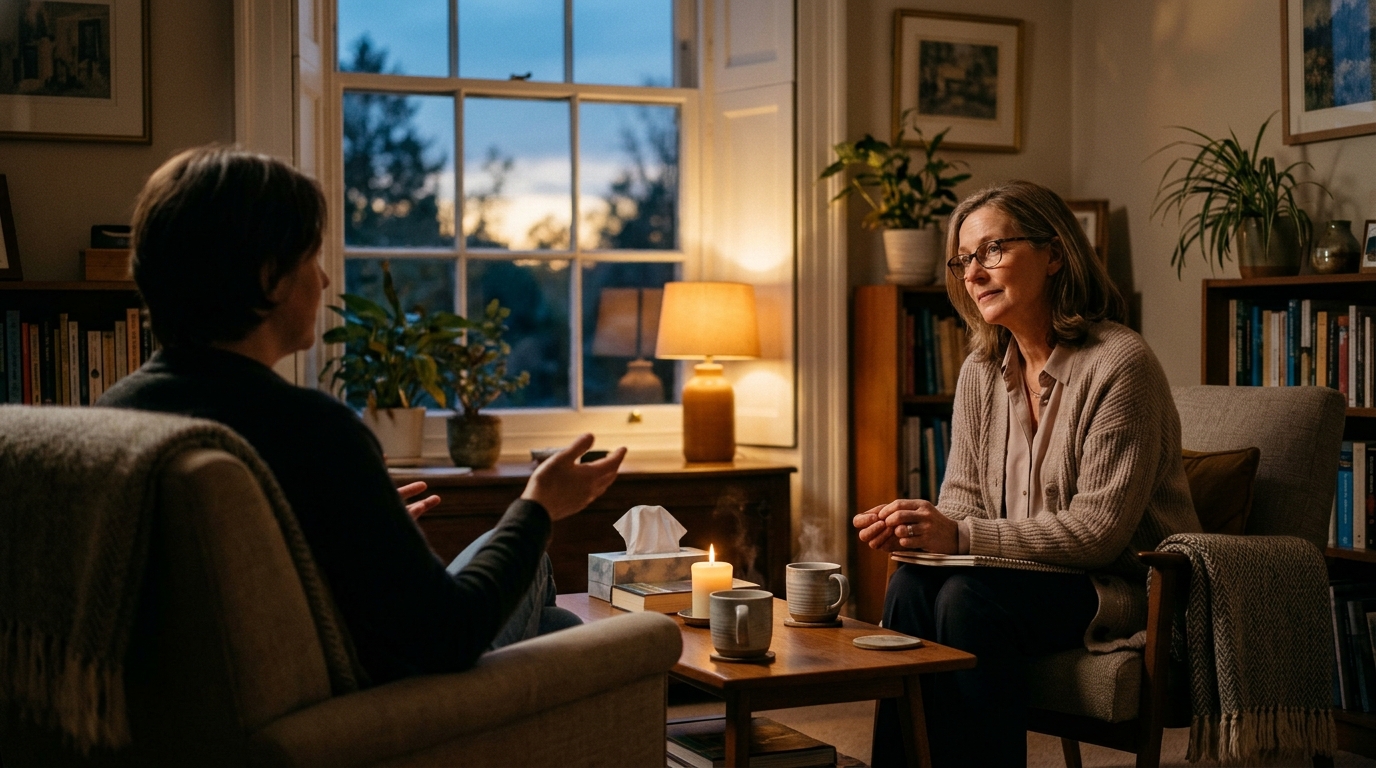
There is a particular hour on the palliative care ward when the overhead lights are dimmed, the visitors have gone for dinner, and the long amber light slides across the linoleum. Dr. Miriam Okafor-Hale has learned to clear her afternoon schedule for it. She calls it the hour before the lamps, and she says it is when the real conversations begin.
I spent an evening shadowing her at a small hospice-affiliated unit, and what I saw changed how I think about the end of a day, and perhaps the end of a life.
The Shift in the Room
During the day, a hospital room belongs to the machinery of care. There are rounds, medication schedules, physiotherapists, and relatives holding clipboards of questions. Patients perform a kind of bravery for all of it. They say they are fine. They ask about the weather.
But as the sun lowers, something loosens. Dr. Okafor-Hale describes it simply: the performance ends.
“People spend all day being brave for the people who love them. By dusk they are tired of it. And in that tiredness, there is room for the truth.”
She has been a palliative physician for nineteen years. Early in her career, she scheduled her difficult conversations for mid-morning, when she was fresh and the patient was rested. She thought that was the responsible thing to do. What she noticed, over time, was that the real questions rarely arrived on her schedule. They arrived when she lingered by a bedside at six in the evening, charting slowly, in no hurry to leave.
What Dusk Does to a Conversation
When I asked her why evening works, she did not give me a clinical answer. She gave me a list, the kind she has built up from thousands of bedsides.
- The noise falls away. Fewer footsteps, fewer interruptions, fewer people who might overhear.
- The light is forgiving. Soft light makes faces gentler and silences less awkward.
- Fatigue lowers defences. Exhaustion strips away the polite deflections we use all day.
- Endings are in the air. The day itself is finishing, and that makes it easier to speak about other finishings.
She is careful not to romanticise it. “It isn’t magic,” she told me. “It’s just that the day has stopped asking anything of them. Dusk is the first moment they are allowed to stop being a patient and start being a person.”
Mr. Alvarez and the Unsent Letter
I watched her sit with a man I will call Mr. Alvarez, a retired ferry engineer in his late seventies. All week, she told me, he had been cheerful and deflecting, a man who joked about the hospital food and waved away every gentle opening she offered.
At around a quarter to seven, with the window turning the colour of apricots, she pulled the chair a little closer and said nothing at all. She just sat. After a long while, he began to speak.
He told her about a daughter he had not spoken to in eleven years. He told her about a quarrel that had started over something small and calcified into something permanent. He told her he had written a letter three times and torn it up each time.
She did not fix it. She did not say that everything happens for a reason or that time heals. She asked one question: “What would you want her to know?”
He answered for nearly half an hour. The next morning, with his hands steadier than they had been all week, he dictated a letter, and she wrote it down word for word.
The Skill of Not Filling the Silence
What struck me most was how little she actually said. Her craft, I realised, is mostly restraint. When I asked her to teach it, she offered a few principles she returns to at the end of every long day.
Sit lower than the person you are with
She almost never stands at a bedside in the evening. A chair, pulled close, tells a person that you are not leaving soon.
Let the first silence pass
Most people rush to fill the quiet. She waits. “The second silence is where the true thing lives,” she said.
Ask what matters, not what is wrong
Questions about symptoms belong to the daytime. At dusk she asks about people, places, regrets, and small joys.
Never promise the outcome
She offers presence instead of reassurance. “I can promise I will stay for this conversation,” she says. “I can’t promise what comes after it.”
What She Carries Home
I asked whether the work wears her down, whether sitting with so much endings leaves her hollow by the time she drives home. She paused for a long moment, in the way she must pause with her patients.
“The opposite, mostly,” she said. “I leave knowing exactly what matters. Almost no one, at the end, talks about their career or their possessions. They talk about who they loved and whether they said so.”
She has a small ritual of her own. When the last evening round is finished, she steps outside and stands for a few minutes in whatever light is left. Sometimes it is gold and sometimes it is grey, and she says it does not matter which. She uses the moment to ask herself the same question she asks her patients: Is there anyone I have not told?
An Invitation for Your Own Evening
You do not need to work in a hospital to borrow her wisdom. The hour when the day loosens its grip is available to all of us, and it is often the best time for the conversations we keep postponing.
Consider trying one of these tonight, as the light fades:
- Put the phone in another room and sit somewhere with a window.
- Think of one person you have been meaning to reach out to, and write them a few honest lines, even if you never send them.
- Ask someone you love a question that has nothing to do with logistics: What has been on your mind lately?
- Then wait. Let the first silence pass.
The Lamps Come On
When I left the unit that night, the corridor lamps had just flickered on, and the ward had settled into its low evening hum. Through the open door of Mr. Alvarez’s room, I could see him asleep, the folded letter resting on the blanket beside his hand.
Dr. Okafor-Hale was already moving to the next room, unhurried, pulling up a chair. She had told me that the work is simply to be there when the light changes and the masks come off.
Tonight, when your own day begins to soften, perhaps you can do the same for someone. The truth tends to arrive quietly, right before the lamps come on.