🎧 Listen to this story
Narrated by Aoede · 8,784 characters
A Quiet Corner of the City, a Routine Nobody Expected
At 6:47 every weekday morning, before most people in the Riverside Heights neighborhood had poured their first cup of coffee, Marcus Webb was already standing at the corner of Elm and 4th. He wore the same navy blue jacket, carried the same small thermos of tea, and smiled at every person who passed. But Marcus was not waiting for a bus. He had not taken public transit in years. He was waiting for his neighbors.
This is not a story about grand gestures or viral moments. Nobody filmed Marcus for months. No news crews showed up. He simply showed up, day after day, to walk the elderly residents of his apartment complex safely to their medical appointments, grocery runs, and therapy sessions. He did it quietly, consistently, and without ever asking for a thing in return.
What started as a one-time favor snowballed into something that changed the entire social fabric of a small urban neighborhood, and the lessons buried inside this man’s simple routine are worth every minute of your time.
How It All Started: A Moment That Could Have Been Forgotten
Marcus, 41, a former logistics coordinator who now works part-time at a community center, traces the whole thing back to a Tuesday in February three years ago. He was heading out early when he noticed his neighbor, Dolores Pacheco, 78, struggling at the bottom of the apartment steps with a paper bag of medical paperwork, a folding cane, and boots that were clearly not meant for icy sidewalks.
“She looked so determined,” Marcus recalled in a conversation with neighbors at a block gathering last spring. “Like she had done this a thousand times and was going to do it a thousand more, even if it killed her. I just walked over and said, where are you headed? And she said the clinic on 9th. So I said, I’ll walk you.”
That walk took twenty-two minutes. They talked about her late husband, about Marcus’s daughter starting kindergarten, about the bakery that used to be on the corner before a chain pharmacy took its place. By the time they reached the clinic, Dolores had tears in her eyes. Not because she was sad, but because, as she told him, nobody had walked beside her like that in a long time.
Marcus went home thinking about that. He could not stop thinking about it.
From One Walk to a Morning Mission
Within two weeks, Marcus had quietly knocked on a few doors in his building, introducing himself properly to neighbors he had only ever nodded at in the hallway. He learned that four residents over the age of 70 had recurring medical appointments and no reliable way to get there safely on their own. Two had mild cognitive decline. One, a 83-year-old retired schoolteacher named Harold Birch, had fallen twice the previous winter on his way to his cardiologist.
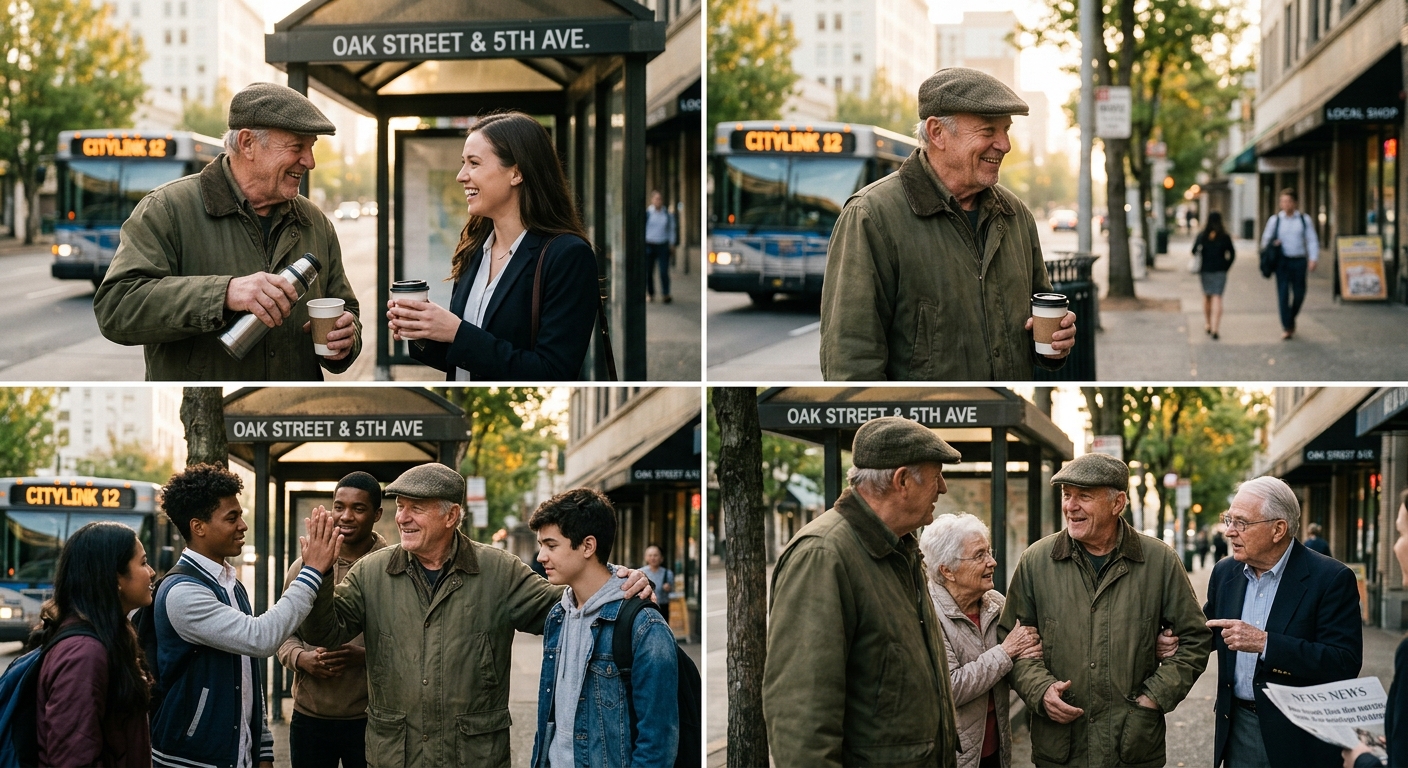
Marcus started showing up at the bus stop each morning not because it was convenient, but because it was the natural gathering point. Even residents who did not take the bus would pass by it on their way out. It became his signal: I am here. I am available. You do not have to do this alone.
By the third month, he was walking between two and five people per morning, staggering his schedule to accommodate different appointment times. He kept a small notebook in his jacket pocket with each neighbor’s name, their usual clinic or destination, and notes like “prefers the longer route, easier curbs” or “needs five extra minutes, moves slower on cold days.”
What the Neighbors Say
Ask anyone in the building about Marcus and the responses follow a similar pattern: disbelief first, then warmth, then something that sounds a lot like gratitude mixed with grief for how rare this kind of thing is.
Dolores Pacheco, who was the first person Marcus ever walked, puts it simply: “He makes you feel like you matter. Not like a burden, not like a charity case. Like a person who deserves company.”
Harold Birch, now 85 and still making his cardiology appointments every three weeks, laughs when asked about it. “I told him he doesn’t have to keep doing this. You know what he said? He said he learns something new every single morning. I think he actually means it.”
A younger resident, Priya Nair, 34, who began joining Marcus occasionally on weekends after hearing about what he was doing, describes the experience as “quietly radical.” “We talk so much about community,” she says, “but this man is actually building one, one block at a time, before breakfast.”
The Ripple Effect Nobody Planned For
What Marcus started has grown in ways he genuinely did not anticipate. Three other residents of the building now rotate morning walks on the days Marcus has early shifts at the community center. A local church two blocks away heard about the effort and began coordinating rides for residents who need to travel farther than walking distance allows. A neighborhood Facebook group that was mostly used for complaints about parking has become a scheduling board for volunteer walkers.
None of this was organized. None of it was funded. It grew because one person did something consistent and visible, and that visibility gave others permission to do the same.
Sociologists and community advocates have a term for this: social modeling. When people see a behavior practiced openly and without fanfare, they are far more likely to adopt it themselves. Marcus did not launch a campaign. He just showed up, which turned out to be the most powerful thing he could have done.
7 Things Marcus’s Story Teaches Us About Real Community
- Consistency matters more than scale. Marcus did not organize a massive volunteer event. He showed up every morning. The reliability of his presence was the foundation everything else was built on.
- Small conversations carry enormous weight. Those twenty-minute walks were not silent. They were filled with stories, memories, and laughter. Connection is built in those in-between moments.
- Loneliness among the elderly is a quiet crisis. Several of Marcus’s neighbors admitted they sometimes went entire weeks without a real conversation. His walks changed that rhythm fundamentally.
- You do not need permission to start something meaningful. Marcus did not wait for a community organization to launch a program. He just started doing the thing that needed to be done.
- Proximity is not the same as community. He had lived in that building for six years before he knew his neighbors’ names. Knowing someone is close is not the same as actually being present for them.
- Practical help is an act of love. Marcus did not send cards or post supportive messages. He showed up physically, at a specific time, to help with a specific need. That concreteness is what made it transformative.
- One act, done repeatedly, becomes a movement. The neighborhood walking network that now exists grew entirely from one man choosing not to look away from a woman struggling on icy steps.
What Marcus Says About All of It
When asked if he considers himself a community hero, Marcus looks genuinely uncomfortable with the word. “I just have a little extra time in the mornings,” he says, waving the question off. “And these folks have good stories. Honestly, they’re doing me a favor by letting me tag along.”
There is something instructive in that deflection. Marcus reframes the exchange not as charity flowing in one direction, but as a mutual arrangement where both parties gain something real. He insists that Harold’s stories about teaching high school in the 1970s have made him a better father. That Dolores’s resilience has made him less likely to complain about small inconveniences. That showing up for others has made him more grounded in his own life.
“I think we’ve convinced ourselves that being a good neighbor is complicated,” he said. “But it’s really just paying attention. Just noticing when someone needs company and not pretending you didn’t notice.”
A Challenge Worth Taking
You may not live near a bus stop. You may not have mornings free. But Marcus’s story is not really about walking or bus stops or even elderly neighbors specifically. It is about the gap between seeing a need and choosing to meet it, and how narrow that gap can be when we decide not to let it intimidate us.
Think about your own building, your street, your block. Who do you pass every day without really seeing? Who has been quietly struggling while the rest of the world rushed past? The next conversation you start, the next door you knock on, the next walk you offer could be the beginning of something neither of you can yet imagine.
Marcus Webb stood at a corner in a navy blue jacket with a thermos of tea, and a neighborhood grew up around him. Not because he was extraordinary, but because he was present. Consistently, gently, stubbornly present.
That is something every single one of us can do.