🎧 Listen to this story
Narrated by Kore · 7,559 characters
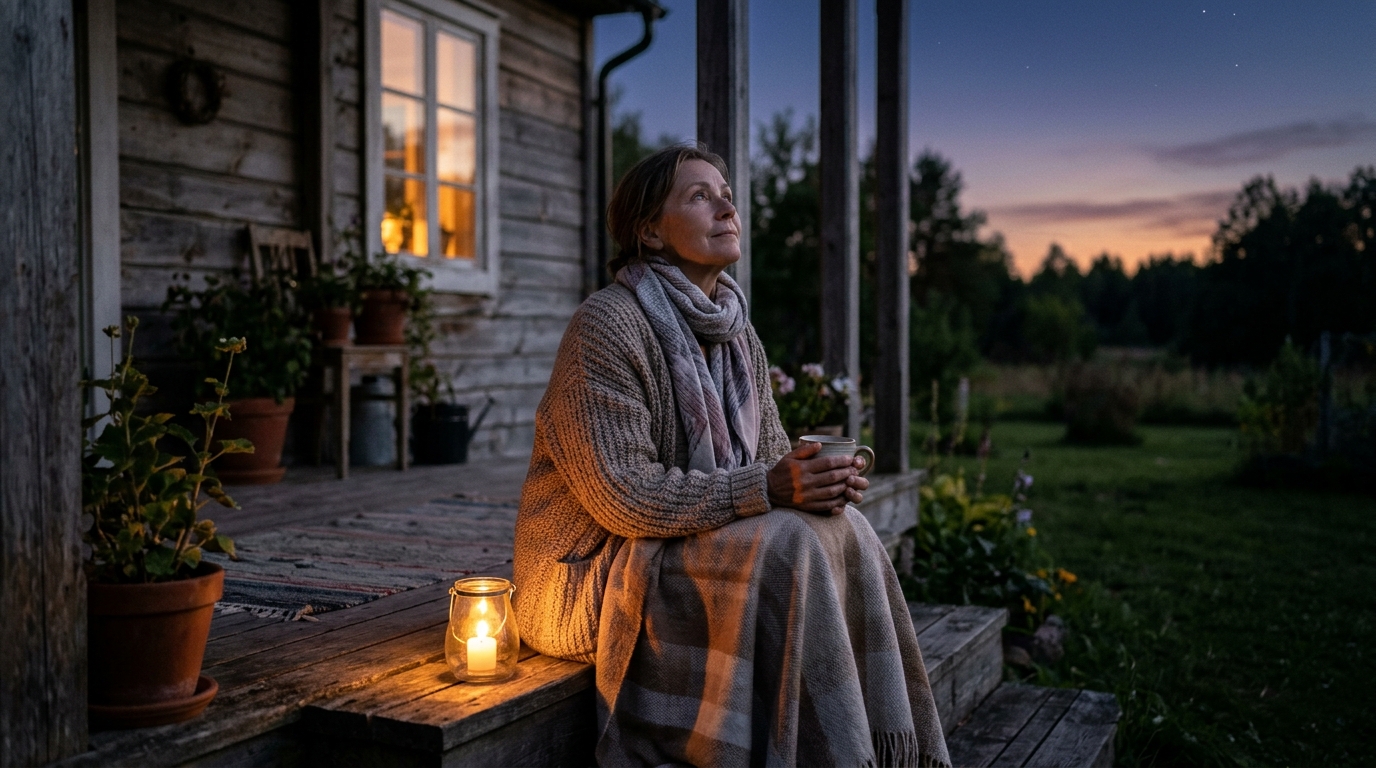
The porch light at the Hendricks house goes off at nine o’clock every night. It has done so for more than a year now, and the neighbors on Alder Lane have quietly learned what it means. When that light clicks off, Margaret Hendricks, seventy-one, is sitting on the third step with a cup of chamomile tea, looking up and talking to her late husband.
This is the story of how that ritual began, what it did to a grief that felt too heavy to carry, and what Margaret says she would tell anyone who is learning to live in the quiet after a great love ends.
The Silence After the Casseroles
Margaret’s husband, Walter, died in late February after forty-six years of marriage. The first weeks were a blur of kindness: casseroles, sympathy cards, a steady stream of visitors who sat on the sofa and said gentle things. Then, as always happens, the visitors thinned out and the casseroles stopped, and Margaret was left alone with a house that suddenly felt far too large.
“Nobody warns you about the evenings,” she told me over the phone, her voice warm and unhurried. “The days, I could fill. I had errands, phone calls, paperwork. There is so much paperwork when someone dies. But when the sun started going down, the whole house went quiet in a way I can’t describe. That was Walter’s time. We always sat together after supper. We never said much. We just sat.”
For months she avoided the evenings. She turned on the television for noise, fell asleep in her chair, and woke up stiff and sad in the dark. Her daughter worried. Her doctor mentioned, gently, that grief sometimes needs somewhere to go.
The Night She Finally Stepped Outside
The change came in October, on an unremarkable evening. Margaret had been standing at the kitchen sink washing a single plate, a habit she still couldn’t shake, when she noticed how clear the sky looked through the window over the faucet.
“Walter loved the stars,” she said. “He wasn’t a scientist or anything. He just liked to look. He’d point out the Big Dipper every summer like he was introducing me to an old friend, even though I’d seen it a thousand times. I thought, I haven’t looked up in months.”
She dried her hands, wrapped a blanket around her shoulders, and went out to the porch. She sat on the step, tipped her head back, and felt something loosen in her chest.
“I didn’t plan to talk,” she admitted. “It just came out. I said, ‘Well, Walter, the tomatoes did terribly this year.’ And then I laughed, because it was such a silly thing to say. And then I cried. And then I said more.”
What a Year of Evenings Looks Like
Margaret made a quiet promise to herself that night: she would come out to the step every evening and talk, for as long as she needed. She did not set a rule about how long or what to say. She simply showed up.
Over the following year, the ritual took on a gentle shape of its own.
- The early weeks: Mostly tears, and apologies. She told Walter she was angry at him for leaving, then felt guilty, then told him that too.
- The winter months: Report-card talk. She shared small news from the day, the way she once had across the dinner table. The cat had been sick. The neighbor’s boy shoveled her walk.
- Spring: The conversations stretched into memories. She found herself retelling the story of their first apartment, the leaky roof, the borrowed couch.
- Summer: Long, easy silences. Some nights she said nothing at all and simply watched the fireflies give way to starlight.
- Autumn: Gratitude. By the one-year mark, she was thanking him more than she was grieving him.
Why Evening Matters
There is something about the hour just after dusk that invites honesty. The day’s demands have settled. The phone stops ringing. The mind, finally released from the work of being busy, starts to turn toward what it has been avoiding.
“In the daytime I could hide,” Margaret said. “At night, under all those stars, there’s nowhere to hide, and somehow that was a comfort instead of a threat. The sky is so big that my sadness felt small enough to hold. Does that make sense?”
It does. Many grief counselors note that rituals, even simple ones, give mourning a container. A repeated act at a repeated time tells the heart that it is allowed to feel, and that it will be given a place to do so, every single day, without needing to be rushed.
The Quiet Science of Speaking Out Loud
While Margaret never set out to follow any therapeutic technique, what she stumbled on has a long history. Speaking to someone who has died, whether aloud, in a letter, or beneath the sky, is a gentle practice many people find helpful. It keeps a sense of connection alive while allowing the relationship to slowly change shape, from presence to memory. It is not about denial. It is about continuing a bond in a new way.
The Neighbors Notice
It did not take long for people on Alder Lane to realize what the porch light meant. A woman across the street, Dolores, began leaving her own porch light off in solidarity, as if to say, we see you, and we will not intrude. One evening a young father walking his dog slowed down as he passed, caught Margaret’s eye, and simply raised a hand in quiet greeting. She raised hers back.
“That’s what I never expected,” Margaret said. “I thought I was doing something private and a little foolish. But it turned out to be a way of staying connected to the living, too. People stopped bringing me pity. They started bringing me tea and company when I wanted it, and leaving me be when I didn’t.”
What She Wants Other Grieving People to Know
When I asked Margaret what she would say to someone just beginning their own journey through loss, she took a long moment before answering, and I could almost hear the stars in the pause.
- You do not have to wait until you feel ready. She started on an ordinary night, in a blanket, with no plan at all.
- Choose a small, repeatable ritual. It does not need to be grand. Consistency matters more than meaning.
- Let the feelings be messy. Anger, laughter, and tears often arrive in the same five minutes. All of them belong.
- Make room for the evening. If the quiet hours are the hardest, meet them on purpose instead of running from them.
- Let others in when you are ready. Grief shared is not grief diminished, but it is grief made bearable.
One Year Later
On the anniversary of that first night in October, Margaret sat on the step as usual. But this time she brought a second cup of tea, set it down beside her on the wood, and smiled at the empty space.
“I told him I was going to be all right,” she said. “Not today, maybe, and not every day. But I’m going to be all right. And I think he already knew.”
She still goes out most evenings. Some nights she talks. Some nights she just listens to the crickets and watches a satellite crawl across the dark. The porch light goes off at nine, a small signal to the whole street that a woman is keeping company with the sky.
A Gentle Thought Before Bed
If you are carrying a loss tonight, you do not need a year of evenings or a perfect ritual. You only need a moment, a window or a step or a patch of dark sky, and permission to say whatever is true.
The stars have been listening to people talk to them for as long as there have been people. They are patient. They do not interrupt. And for one widow on Alder Lane, they turned out to be exactly the right audience for a love that did not end, only changed its address.
Tonight, when the noise of the day finally fades, consider stepping outside. Look up. Say hello to whoever you are missing. You might be surprised by how much lighter the quiet feels.