🎧 Listen to this story
Narrated by Kore · 6,762 characters
The clinic closes at five, but Dr. Anita Rao’s most important work often happens afterward. Not in the exam room, but in the quiet hour when the sky softens, the streetlights flicker on, and her patients lace up their shoes and step outside.
It sounds almost too simple to be medicine. Yet across clinics, hospitals, and community health programs, a growing number of physicians are writing something unusual on their prescription pads: Walk for thirty minutes, preferably in the evening. Repeat daily. And the people receiving that prescription are, in many cases, finding that it works.
A Different Kind of Prescription
Depression is notoriously stubborn. Medication helps many people, therapy helps many more, but both can take weeks to show results, and some patients wait months for an appointment at all. Doctors have long known that physical activity can lift mood, but until recently it was often tacked on as an afterthought: and try to get some exercise, too.
That is changing. Clinicians are now treating movement as a genuine, structured part of care, with specific instructions, follow-up, and goals. Some programs, such as those built around the idea of green prescriptions or social prescribing, formally connect patients with walking groups and outdoor spaces. The evening walk has become a favorite recommendation for reasons that go beyond fitness.
Why Evening, of All Times?
Morning exercise gets most of the glory in wellness advice. But for people living with depression, the evening carries its own particular weight, and its own particular opportunity.
The Hardest Hour
For many people, the end of the workday is when the mind turns on itself. The distractions of the day fall away. The house is quiet. Rumination, that loop of heavy, repetitive thoughts, tends to creep in right as the light fades. Doctors who recommend evening walks are often meeting depression at exactly the hour it feels loudest.
A Natural Wind-Down
Many people with depression also struggle with sleep, whether that means lying awake for hours or waking before dawn. A gentle walk in the hours before bed can help the body shift gears. The slow decline of daylight signals the brain that the day is ending, and light physical activity may help ease the transition toward rest. Better sleep, in turn, often supports better mood the next day.
A Boundary Between Work and Rest
For those who work from home or carry stress home with them, a walk becomes a kind of doorway. You leave the day on one side of it. You return on the other, a little lighter. Several patients describe it as the moment their day finally ends, instead of just blurring into night.
What the Research Suggests
It is worth being careful here: an evening walk is not a cure, and it is not a replacement for professional treatment. But the evidence behind walking and mood is encouraging.
- Regular aerobic activity has been associated in many studies with reduced depressive symptoms, and some research suggests the effect can be meaningful even for people with moderate depression.
- Time in green space, such as parks, tree-lined streets, and trails, has been linked with lower stress and improved mood.
- Walking with others adds a social layer that can ease the isolation depression often brings.
- Consistency matters more than intensity. A steady, easy walk done daily often beats an ambitious routine that gets abandoned.
Researchers continue to study exactly why movement helps. Possible explanations include changes in brain chemistry, reduced inflammation, improved sleep, and the simple psychological boost of doing something good for yourself when everything feels impossible.
One Patient’s Story
Consider a composite of the kind of story clinicians describe again and again. A man in his fifties, recently widowed, stops going out. His appetite fades. His evenings are spent in a dim living room with the television murmuring. His doctor, after discussing treatment options, adds one small instruction: walk around the block after dinner, every night, and note how you feel.
The first week, he manages three nights. He walks slowly, eyes on the pavement. The second week, he notices the neighbor’s garden. By the end of the month, he has a route, a favorite bench, and a nod exchanged with a dog walker he passes at the same corner each evening. Nothing dramatic has happened. And yet something has shifted: the evening is no longer something to endure. It has become something to look forward to.
That is the quiet power of the practice. It does not demand a transformation. It asks only for the next small step, and then the next.
How to Begin: A Gentle Starter Guide
If you or someone you love is struggling, here is a soft place to start. Always talk with a doctor or mental health professional first, especially if symptoms feel heavy or persistent.
- Start small. Ten minutes is enough. The goal is to build the habit, not to prove anything.
- Pick a consistent time. After dinner or just before dusk works well for many people. Routine makes it easier to show up on hard days.
- Leave the screen behind. If you can, walk without headphones for at least part of the route. Let the evening sounds in.
- Choose a familiar path. Familiarity lowers the barrier to going out. You can always explore later.
- Invite someone, if it helps. A friend, a neighbor, or a pet can make the first steps easier.
- Notice, don’t judge. Pay attention to small things: the color of the sky, the smell of cut grass, the quiet. You do not need to feel better to begin.
- Forgive the missed days. Tomorrow evening is always there.
A Note of Honesty
Walking will not fix everything. For some people, depression is severe enough that getting out the door feels impossible, and that is not a failure of willpower. It is a sign that more support is needed. Evening walks work best as part of a broader plan that may include therapy, medication, social connection, and medical guidance. If you are having thoughts of harming yourself, please reach out to a crisis line or emergency services right away.
The Quiet Hour Worth Keeping
There is something fitting about the fact that this particular medicine is best taken at the end of the day. Evening is the hour of letting go: of the to-do list, of the mistakes made, of the version of the day that did not go as planned. A walk at dusk does not erase any of it. But it gives it somewhere to settle.
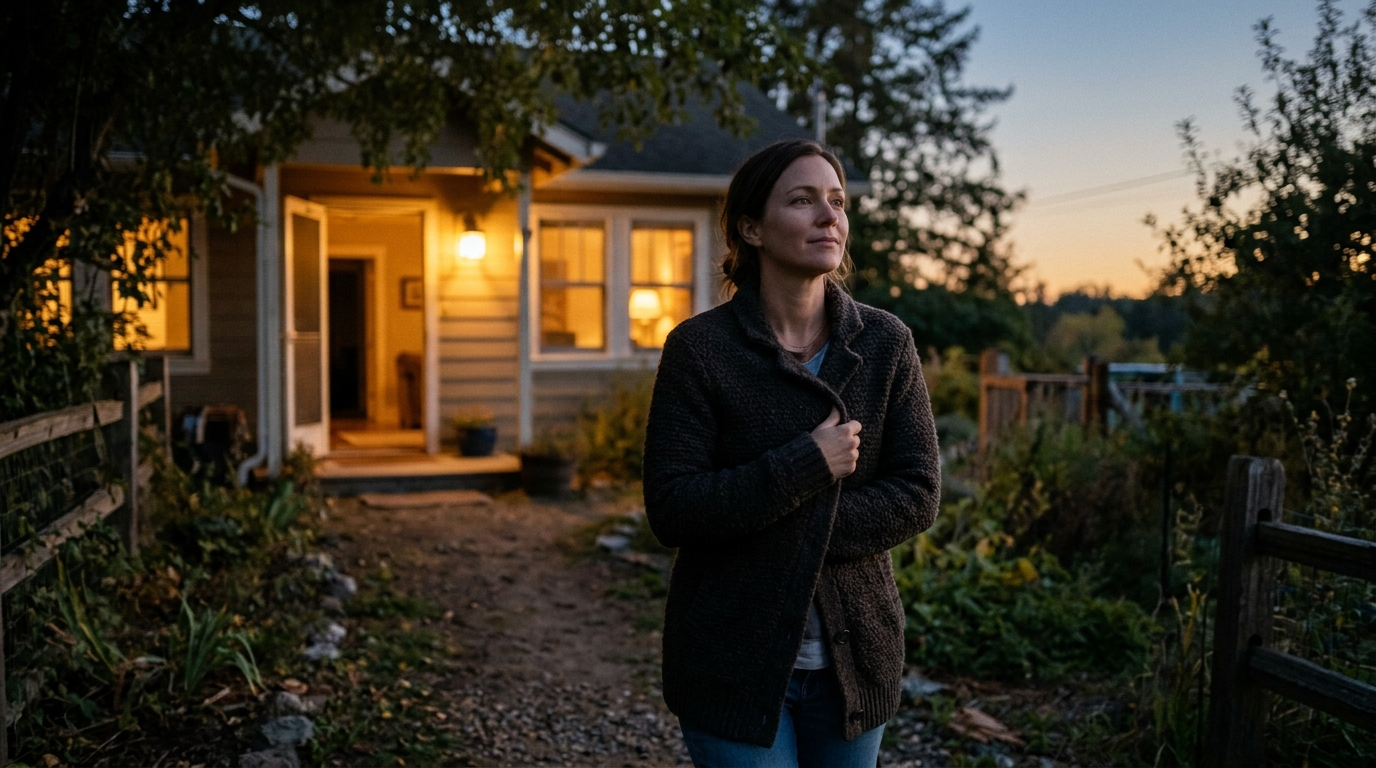
As the light turns gold and then violet, and the first windows glow warm in the houses you pass, you may find that the world feels a little less heavy than it did an hour ago. Not fixed. Not solved. Just a little more bearable, and a little more your own.
That is the prescription. No pharmacy required. Just a pair of shoes, a door, and the soft light at the end of the day.