🎧 Listen to this story
Narrated by Kore · 7,432 characters
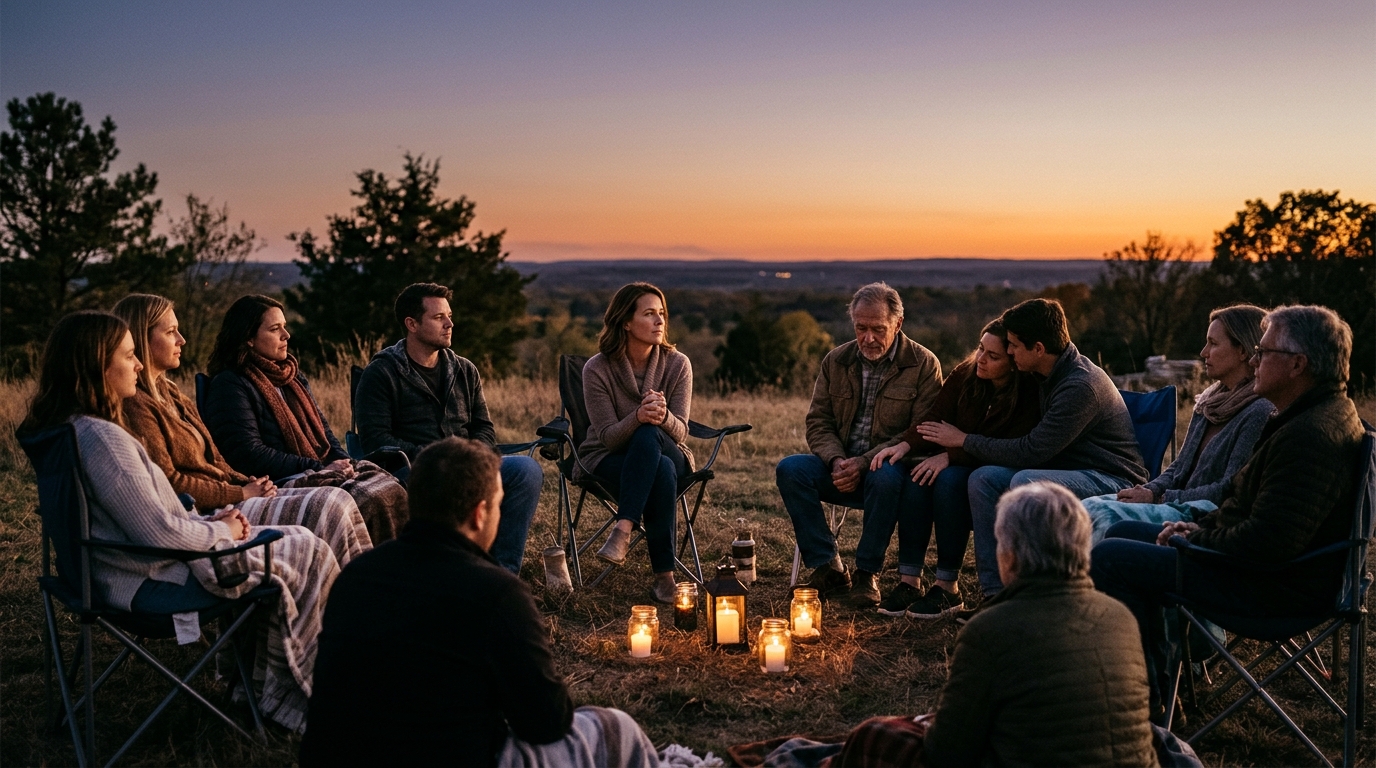
The folding chairs are set out at 6:40 on most evenings, give or take the season. Nobody turns on the overhead lights. In fact, the lights in the back room of the community garden pavilion do not get switched on at all until the very end, when someone needs to find a lost glove or a set of keys. For the next hour, the only illumination comes from the sky itself, and from a few small lanterns that Marguerite, the group’s founder, sets on the windowsills.
This is the sunset grief circle, and its one unbreakable rule is right there in the name: it begins when the light starts to fade.
A Rule Born From a Hard Evening
Marguerite did not set out to start a support group. Six years ago, her husband of thirty-one years died in the spring, and she found that the mornings were bearable but the late afternoons were not. There was something about the hour when the light turned amber and the neighborhood filled with the sounds of people coming home. Doors closing. Dinners starting. Her house stayed quiet, and the quiet had weight.
One evening she did what she had never done before. She walked to the edge of the community garden near her home, sat on a bench, and watched the sun go down without trying to fill the silence with anything. A neighbor she barely knew, a retired bus driver named Tomas, wandered over and sat on the other end of the bench. He had lost his daughter two winters earlier. Neither of them said much. They just watched the sky change color together.
“We sat there for forty minutes,” Marguerite remembers. “When it got dark, he said, ‘That was the first time today I did not feel like I was drowning.’ And I said, ‘Me too.’ That was the whole beginning.”
Why Fading Light Seems to Help
Over the years, the group has developed its own quiet theories about why twilight helps. Nobody here claims to be a scientist, and the group makes no medical promises. But the members have noticed patterns that ring true to them, and a few of them line up with what many counselors and grief educators describe.
- The pressure to perform lifts. In bright daylight, we are expected to be productive, cheerful, and capable. As the light softens, so does that expectation. People seem to exhale.
- Faces are easier to share. In dim light, tears feel less exposed. Members say they can speak more honestly when they are not being watched too closely.
- The sky models change. Watching a day end, gently and without fuss, offers a quiet picture of something letting go and still being beautiful.
- Evenings are the loneliest hours. Many grieving people say the dusk hours are the hardest, so meeting then means nobody has to face that stretch alone.
What Actually Happens in the Circle
The format is deliberately simple. People arrive, take a cup of tea from the thermos on the side table, and settle into the chairs, which are arranged in a loose half circle facing the west-facing windows. For the first ten minutes, there is no talking at all. Everyone simply watches the sky.
Then, when someone is ready, they speak. There is no required order and no requirement to speak at all. A few rules keep the space safe:
- No one offers advice unless it is asked for.
- No one says “at least” about anything. At least he lived a long life. At least she is not suffering anymore. Those sentences stay outside the door.
- Silence is allowed to be long.
- What is said in the circle stays in the circle.
When the last of the color drains from the sky, Marguerite switches off the lanterns and then, finally, turns on the overhead light. The room comes back to ordinary brightness. People gather their coats. They hug, or they do not. Several of them have said the moment of the light coming on feels like a gentle return to the world, a way of stepping back into the day’s ordinary demands without being thrown into them.
Three Voices From the Circle
Tomas, the bus driver
Tomas still comes every week. He says the hardest hour of his day used to be five o’clock, when his daughter would call after work. “I would sit by the phone,” he told me, “knowing it would not ring. Now at five o’clock I have somewhere to be. That is a bigger gift than I can explain.”
Priya, a young widow
Priya joined the group at thirty-four, the youngest member by a decade. She had felt out of place in other support groups, where the stories belonged to people who had lived long lives together. “Here,” she said, “nobody compares losses. We just sit in the same sky. Some evenings I do not say anything and no one minds.”
Walter, who lost his brother
Walter, a man in his seventies, admitted that he almost did not come the first time. “I thought a grief group would be a room full of crying,” he said. “But it was mostly quiet. Somebody mentioned how the clouds looked like folded laundry, and we all laughed. I did not know you could laugh in a place like that.”
The Evening Walk Home
One of the group’s quieter traditions has nothing to do with the meeting itself. When the circle ends, people tend to linger on the pavilion steps, and a few of them walk part of the way home together. The streetlights are just flickering on by then. Windows glow yellow in the houses along the road.
Marguerite says this walk is the part she cherishes most. “The evening is not empty anymore,” she said. “That is what changed for me. The hour that used to feel like an abyss became an hour that holds company. I still miss him. I will always miss him. But the dusk does not frighten me now.”
Bringing a Little of This Into Your Own Evenings
You do not need a pavilion or a group to borrow something from this idea. If you are grieving, or simply carrying a heavy season, these small practices might help when the day starts to wind down:
- Watch the light change. Spend ten minutes at a window or on a doorstep as the sun lowers. Resist the urge to reach for your phone.
- Dim the room on purpose. Skip the harsh overhead light and use a lamp or a candle. Let the room soften as the day does.
- Name one thing you carried today. Say it out loud or write it down, then set it down for the night.
- Invite someone to sit with you. You do not need conversation. Sometimes presence is the whole point.
- Make the dusk hour yours. If a certain time of day has become hard, fill it with a small ritual that belongs to you, like tea, a short walk, or a favorite song.
What the Light Teaches
There is a gentle truth tucked inside this group, and it does not require anyone to be an expert in loss. Grief does not follow the clock, but our days do. By placing the work of remembering inside the softest hour of the day, the circle lets people borrow some of the sky’s patience. The sun does not hurry to set. It does not apologize for leaving. It simply goes, and the colors it leaves behind are some of the most beautiful of the whole day.
Marguerite likes to say the group does not promise healing so much as company at the hour when company matters most. On the evenings when the sky turns especially gold, she catches a few members looking at one another across the room, and she knows that no one needs to say anything at all.
The lanterns stay lit until the last bit of color is gone. Then the light comes on, the chairs get stacked, and everyone steps out into the evening, a little less alone than when they came in.
Tonight, as the light fades where you are, you might pause for a minute and let it. Someone, somewhere, is doing the very same thing, and you are sitting in the same sky.