🎧 Listen to this story
Narrated by Kore · 6,727 characters
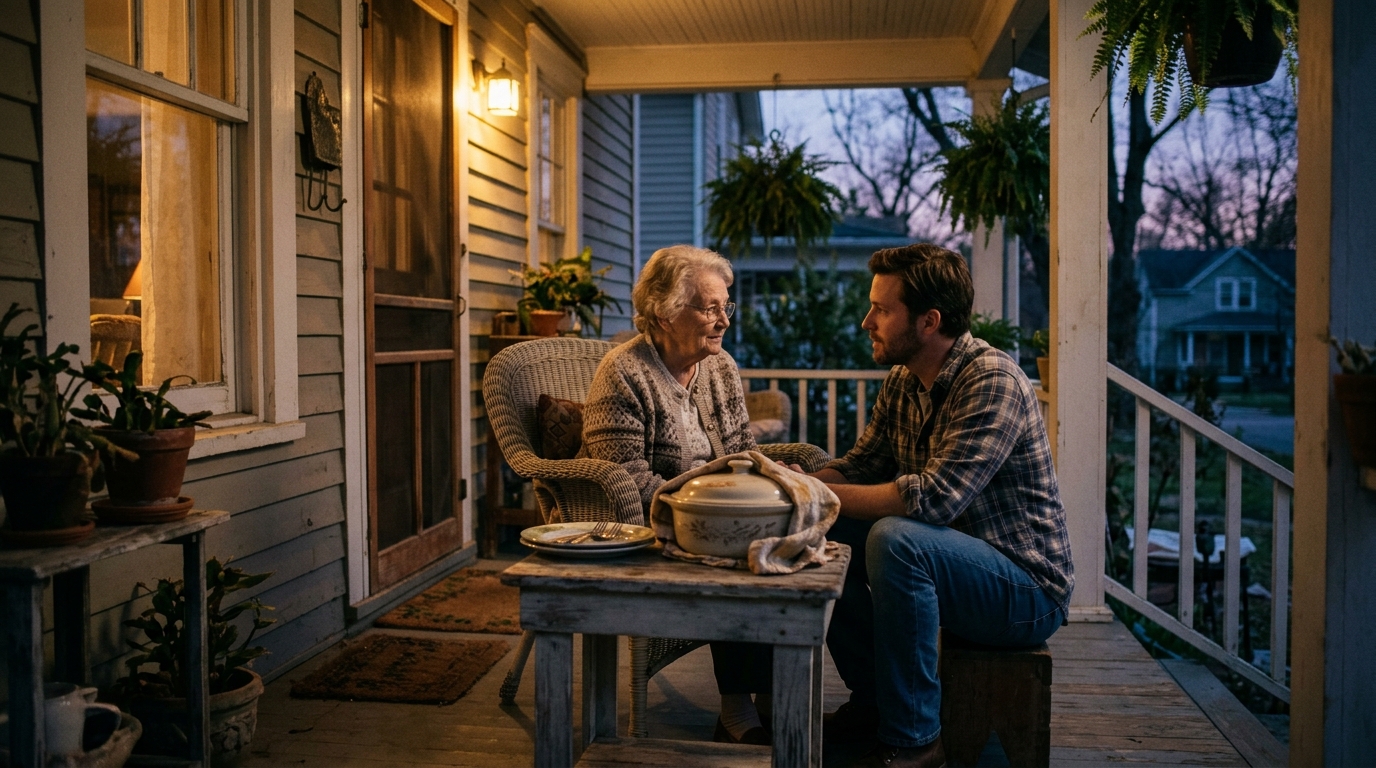
At six o’clock every evening, when the sky over Maple Hollow Lane starts to soften into peach and gray, a small ritual unfolds on a quiet porch. A screen door opens, a pair of hands sets down a covered dish, and a soft knock rings out twice. Then the neighbor walks back across the lawn, never waiting to be thanked.
Her name is Marisol Vega, and she has been doing this for three years. This is her story, told the way she told it to me: slowly, in the hush of an evening, with a cup of tea going cold between her hands.
It Started With an Empty Porch
Marisol is a dental hygienist, a mother of two teenagers, and, by her own cheerful admission, someone who burns toast on a regular basis. She did not set out to become the neighborhood’s evening angel. It began, as most good things do, with a small observation.
“I noticed the newspapers,” she said. “Mr. Abernathy used to bring them in every morning at seven, rain or shine. One week they just started stacking up.”
Walter Abernathy, then eighty-three, had lived in the yellow house next door for nearly fifty years. His wife Dorothea had passed the previous spring, and since then the house had grown very quiet. When Marisol finally knocked, he opened the door slowly, thinner than she remembered, wearing a cardigan buttoned one hole off.
“I asked if he’d eaten,” she said. “He said, ‘Oh, I had some crackers.’ It was four in the afternoon. I knew what that meant. Crackers was dinner.”
What the Evening Teaches
Marisol made a pot of chicken and rice soup that night, far too much for her own family. She ladled some into a dish, covered it with foil, and carried it next door. The next evening she brought a casserole. By the end of the week, six o’clock had become a fixed point in both of their lives.
What surprised her most was not Walter’s gratitude. It was what the ritual did to her own days.
“The mornings are chaos,” she told me. “School runs, work, emails, the dog throwing up on the rug. By evening I’m wrung out. But walking that dish across the lawn at six, I feel the whole day slow down. It’s like a bookmark. This is where I stop being busy and start being human.”
There is something about the evening that invites this kind of reflection. The noise of the day drains away, the light turns golden and forgiving, and the small things, a porch step, a warm dish, a lit window, begin to feel enormous. Marisol says her best thinking happens in the thirty seconds between setting down the plate and turning back toward her own front door.
The Small Details That Made It Work
Over three years, Marisol has refined her little tradition into something both practical and tender. If you are thinking about starting something similar, her habits are worth borrowing:
- She keeps it simple. Soups, stews, roasted chicken, mashed potatoes. Nothing fancy, nothing that requires explanation.
- She asks about preferences once, then listens. Walter dislikes cilantro and loves anything with dill. She never forgot.
- She never makes it a debt. There is no tally, no expectation of repayment, and she deflects every offer of money with a smile.
- She sticks to the same time. Six o’clock became something Walter could set his day by, a small anchor in a long afternoon.
- She returns the dishes without a fuss. Walter washes them and leaves them on the porch rail, usually with a folded note tucked underneath.
The Notes on the Porch Rail
That last detail is where the story turns from kind to quietly beautiful. Walter, who spent forty years as a high school shop teacher, began leaving notes. At first they were brief: Thank you. The pot roast was perfect. Then they grew longer.
One note described the way Dorothea used to hum while she cooked. Another recalled a camping trip in 1974 when they lost the tent in a thunderstorm and laughed until sunrise. Marisol keeps every one of them in a shoebox on her bookshelf.
“I think he needed somewhere to put his memories,” she said. “Food was just the excuse. What we were really passing back and forth was company.”
The Evening Everything Shifted
About a year in, Marisol was running late. A patient had gone long, traffic crawled, and she did not reach home until nearly seven. She rushed the dish over, apologizing before anyone could answer the door.
Walter was sitting in the porch swing in the dim light, waiting. He was not hungry, he told her. He had simply gotten used to the sound of her footsteps.
“That’s when I understood,” she said, her voice catching. “It was never really about dinner. It was about being expected. Everyone wants to be expected by someone.”
What Her Kids Learned Without Being Told
Marisol never gave her children a lecture on generosity. She did not have to. Her daughter Elena, now sixteen, started carrying the dish over on nights her mother worked late. Her son Mateo, fourteen, began shoveling Walter’s walkway in winter without being asked.
“Kids copy what they see,” Marisol said. “If they see you step toward someone’s loneliness instead of away from it, that becomes normal to them.”
Elena has since started a small weekly dinner club at her school for students who eat alone in the cafeteria. When her teacher asked where the idea came from, she said it came from a covered dish on a yellow porch.
A Quiet Ripple
Word of Marisol’s habit spread slowly across the street, the way real kindness tends to. A retired nurse two doors down began checking on Walter’s medications. A young couple started raking his leaves. Someone left a bag of tomatoes from their garden. Without any announcement, the whole lane tightened into a community.
Walter is eighty-six now. His cardigan buttons line up properly again. He walks to the mailbox every morning, and at six each evening he is on the porch swing, a folded blanket across his knees, watching the light fade and listening for a familiar pair of footsteps.
A Gentle Thought Before Sleep
When I asked Marisol what she hoped readers would take from her story, she thought for a long moment as the porch lights flickered on along her street.
“Don’t wait for a big moment,” she said. “Nobody needs a hero. They need someone who shows up at six o’clock. If you’re lying in bed tonight wondering whether you did anything that mattered today, think about who might be eating crackers for dinner.”
Tonight, as the day winds down and the house grows still, consider the neighbor you have not seen in a while. Consider the stack of newspapers, the dark window, the quiet that has lasted a little too long. A warm dish, a soft knock, and a few words at dusk may be the most ordinary and most extraordinary gift you ever give.
And tomorrow, at six o’clock, somewhere on a quiet street, a porch light will glow and a covered dish will arrive right on time.