🎧 Listen to this story
Narrated by Kore · 7,360 characters
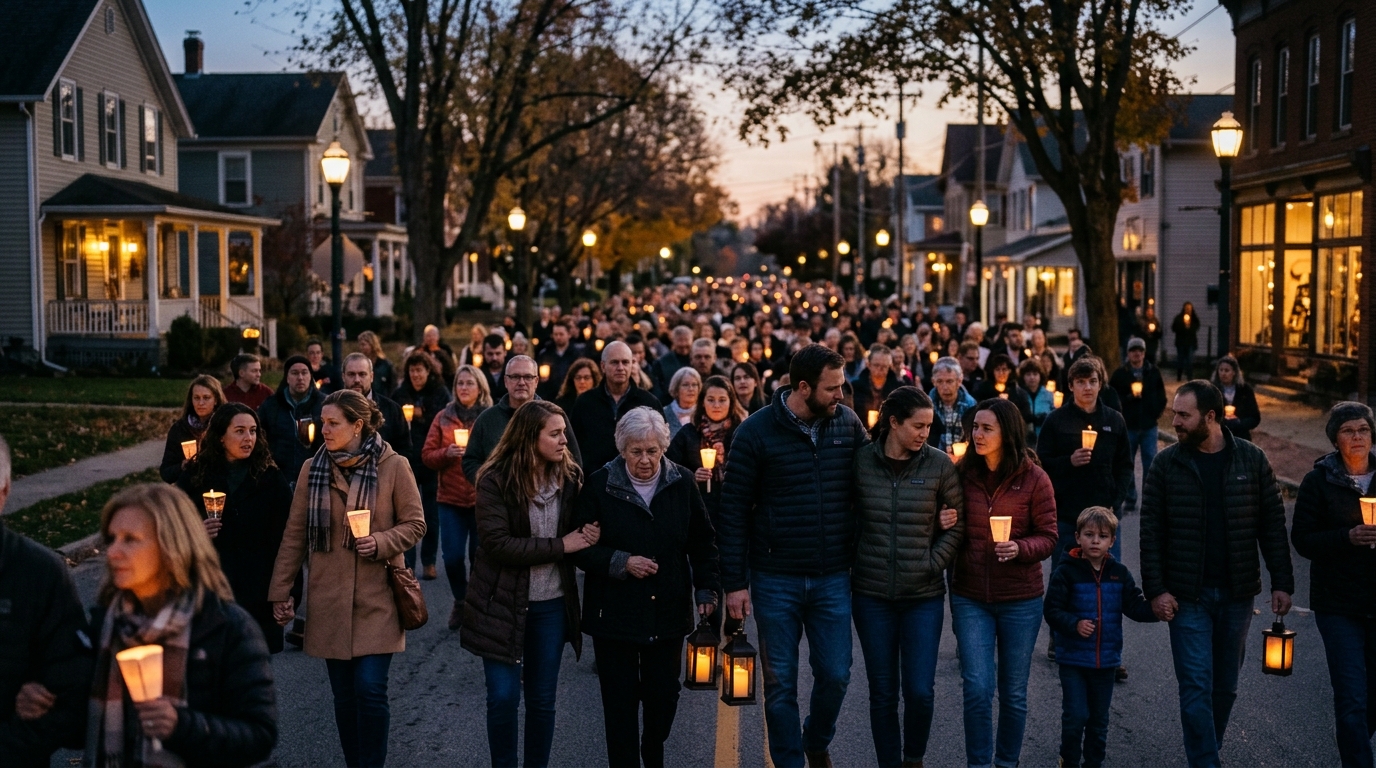
At 6:15 on Thursday evenings, the parking lot behind the Lindqvist Hardware store begins to fill. Nobody honks. Nobody rushes. People arrive in ones and twos, zipping jackets, tucking photographs into pockets, nodding hello without the usual small talk. By the time the sun starts sliding toward the ridge, there are often forty or fifty of them, and they begin to walk.
This is the Sunset Grief Walk, and it has become the most quietly important thing that happens in this small town each week. It has no stage, no speeches, and no sign-in sheet. It only asks one thing of you: show up as you are, carrying whatever you are carrying.
How It Started With One Empty Chair
The walk began three winters ago, and the way people tell it, it began with a chair.
Marguerite Dunleavy, a retired school librarian, lost her husband of forty-one years in the autumn. For weeks she kept setting two places at the table out of habit, then clearing one away in silence. What she found hardest was not the mornings, which were busy, or the nights, which she had learned to survive. It was the hour in between. The golden, slanting light of late afternoon, when he used to come in from the garden and ask what was for supper.
One evening she could not bear the kitchen, so she put on her coat and walked the old rail trail at the edge of town. She walked until the sky went orange, then rose, then violet. She cried a little, and then, somewhat to her surprise, she felt lighter.
She mentioned it to a neighbor, who mentioned it to someone else. The following Thursday, three people joined her. The Thursday after that, eleven.
Why Sunset, Of All Times
Ask the regulars why it works, and they tend to circle the same answer: the evening is when grief is loudest, and also when the world gives you permission to be quiet.
Daytime asks things of us. It asks us to answer emails, to smile at the cashier, to keep the machinery of life turning. But dusk has always been a threshold. The light softens, the birds settle, the day admits it is ending. For someone in mourning, that gentle surrender can feel like company.
Grief counselors who have visited the walk point to something else as well. Loss often feels heaviest at the transitions of the day, when the structure of work and errands falls away and the empty space where someone used to be becomes impossible to ignore. Walking through that exact window, alongside others, turns a lonely hour into a shared one.
What Walking Does That Talking Sometimes Cannot
Dr. Anselm Okafor, a local family physician who joins most weeks, says he has watched people open up in motion in ways they never do across an office desk.
“When you walk side by side, you are not staring at each other,” he told me. “You are both looking at the same horizon. That takes the pressure off. People say true things out loud because they do not feel watched while they say them.”
There is also the body to consider. Gentle movement, fresh air, and fading natural light all help settle a nervous system that has been running on alarm for weeks or months. Nobody on the walk calls it therapy. But quite a few of them sleep better on Thursday nights.
The Unwritten Rules
Over time, the walk has developed a few customs, none of them official, all of them understood:
- No one has to speak. Silence is fully welcome, and plenty of people walk the whole loop without saying a word.
- No fixing. If someone shares a memory, the response is a nod or a hand on the shoulder, never advice. Nobody is told that it gets easier or that their loved one is in a better place.
- Say their name. Some people carry a photograph. Others simply say the name aloud at the turnaround point, where the trail meets a wooden bench facing west.
- Grief of every kind belongs. A widow, a parent who lost a child, someone mourning a friendship, a man grieving the dog he buried last week. There is no hierarchy of loss.
- Leave when you need to. Some people walk the full mile and a half. Some turn back after ten minutes. Both are fine.
A Moment at the Bench
On the evening I joined them, the light was doing what it does in late October: pouring through the bare maples in long amber bars, gilding the grass, turning every breath into a small white cloud.
At the bench, the group paused, as they always do. A young man I will call Teodor, who had come for the first time that night, stood at the edge of the circle with his hands jammed in his pockets. He had lost his younger brother in the spring. He had not spoken about it to anyone, he told me later, not even his parents.
When the quiet stretched out, he said his brother’s name. Just the name, barely audible. And fifty strangers, without any prompting, said it back to him, softly, like a wave returning to shore.
He wept then, and nobody turned away or tried to stop it. Someone simply stood a little closer. The sun slipped behind the ridge, the sky went rose and then slate, and the whole group stayed there for a long, unhurried minute, letting the dusk hold him.
Why It Is Spreading
What began as one woman’s lonely evening stroll has now been picked up in at least a dozen other towns. A church in a neighboring county started its own walk after a member visited. A hospice volunteer carried the idea to a coastal village. A group of nurses began a version near their hospital, timed to the end of their shifts.
The model travels easily because it needs almost nothing: a safe path, a regular time, and a willingness to be present. No budget, no training, no building. Marguerite, who never intended to start a movement, has fielded calls from organizers in other states and gives them the same advice every time.
“Do not make it complicated,” she says. “Pick a day. Pick a trail. Show up at sunset. Let people come.”
What This Small Town Understands
Modern life is oddly bad at grief. We give it a few days of leave and a casserole, and then we expect people to rejoin the pace of things. But sorrow keeps its own calendar, and it often resurfaces long after the cards have stopped arriving.
The Thursday walk quietly corrects for that. It tells the bereaved that they do not have to be finished, that there is a place for them every single week, and that no one will ask them to hurry. It makes space for the long middle of grief, the part nobody schedules.
If You Want to Try It Yourself
- Choose a safe, familiar path that is easy to walk, ideally with a natural turnaround point.
- Pick a consistent weekly time near sunset, and keep it, even if only two people come at first.
- Share the invitation simply: through a church bulletin, a library board, a neighbor’s porch.
- Set the tone at the start: no pressure, no advice, silence is welcome.
- Close each walk with a pause, a moment to name those we miss.
The Light That Stays
As the group headed back toward the parking lot that night, the streetlamps flickered on one by one. People drifted toward their cars in the blue half-dark, some hugging, some simply lifting a hand. Teodor lingered for a moment by the trailhead, then asked Marguerite when the next walk was.
“Thursday,” she said, smiling. “Same time. We will be here.”
And that, in the end, may be the whole secret. Not a cure, not an answer, but a promise kept every week as the light goes gold and then gray: you do not have to carry this alone, and when the day grows quiet, someone will be walking beside you.