🎧 Listen to this story
Narrated by Kore · 7,700 characters
There is a particular kind of quiet that settles over a town when the power goes out at dusk. The hum of refrigerators stops. The streetlights stay dark. Suddenly everyone is standing in the same dim, uncertain light, wondering what to do with the hours that are usually filled by screens and appliances. On a cool October evening, in a small Ohio town, that quiet became the backdrop for one of the kindest things the people of Marlow’s Diner had ever witnessed.
A Storm, a Dark Street, and a Full Dining Room
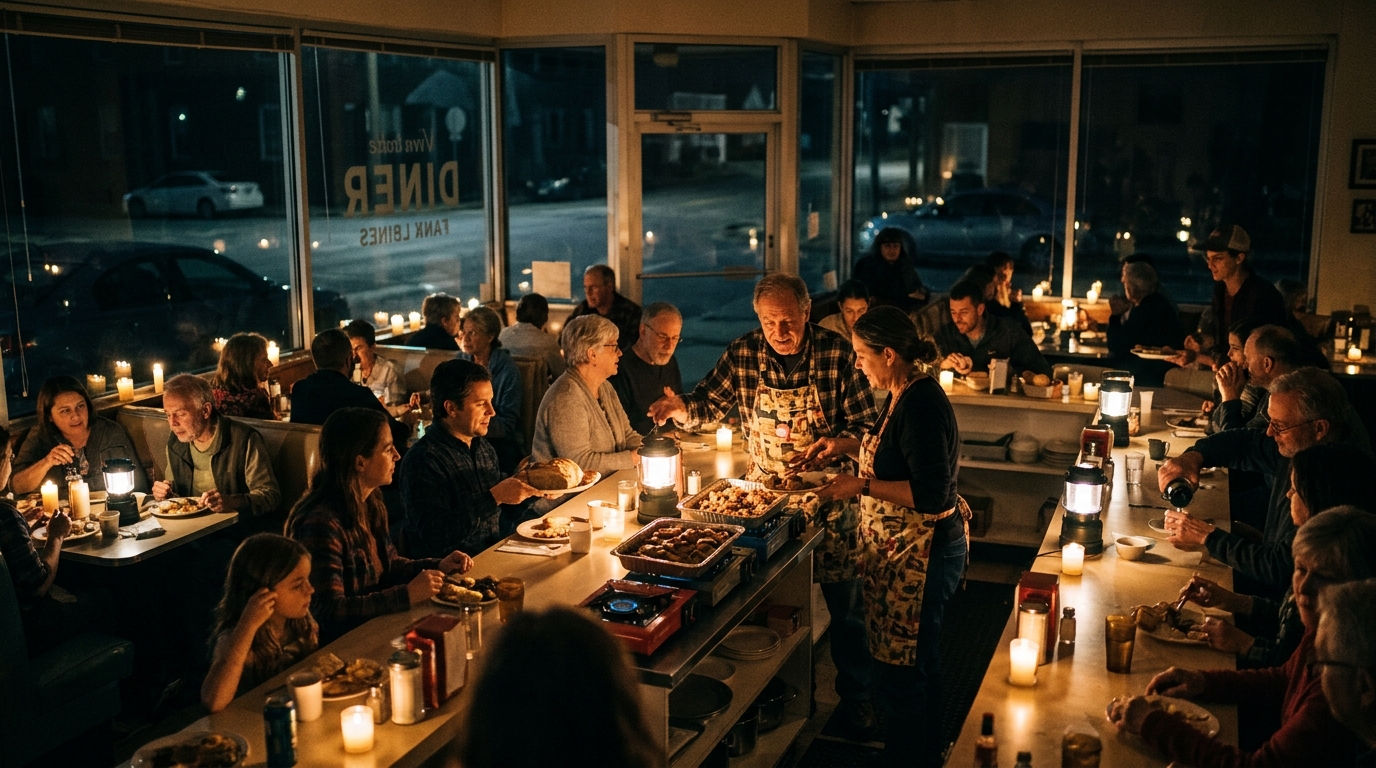
The storm had rolled through just after five o’clock. By the time the transformer on Cedar Street gave out, the sky had faded into that bruised blue-gray that comes right before true night. Inside Marlow’s Diner, a family-owned place that had served the same meatloaf special for thirty-one years, about forty customers were midway through their evening meals.
When the lights died, nobody panicked. Owner Dolores Marlow, a woman who had weathered plenty of storms both literal and otherwise, did what she always did. She pulled out the emergency candles from beneath the register, lit them one by one, and set them on the tables. Within minutes, the diner glowed like a lantern in the middle of a darkened street.
The gas stove still worked, so the kitchen kept going. Servers moved between tables with flashlights tucked under their arms. Families who had stopped in simply to wait out the storm ended up ordering plates of food, and strangers shared tables because there was no better place to be.
The Man at the Corner Booth
In the far corner sat a man in a worn canvas jacket, eating alone. He had come in about twenty minutes before the outage, ordered a bowl of soup and a slice of pie, and said very little. Dolores would later say he had the look of someone who was just passing through, tired in the way people are after a long drive.
As the evening wore on, he watched the room. He watched a young mother cutting her son’s chicken into small pieces by candlelight. He watched an elderly couple holding hands across a table, laughing at something neither of them would remember later. He watched a group of teenagers, home from a canceled football practice, pooling crumpled dollar bills to split a plate of fries.
Then he stood up, walked to the register, and asked Dolores a quiet question: how much would it cost to cover everyone’s dinner?
What Happened Next
Dolores thought he was joking. She told him the total would be well over six hundred dollars, and that there was no way to run a card with the power out anyway. The man nodded, reached into his jacket, and pulled out an envelope thick with cash.
“I’ve been carrying this around for a long time,” he told her. “Tonight feels like the right night to spend it.”
He asked her not to announce it. He asked her not to point him out. He simply wanted every table to find out the same way, when their servers came with the check and said there was nothing left to pay.
The Moment It Clicked
One by one, the tables learned the news. The young mother covered her mouth and cried. The elderly couple looked at each other, then around the room, trying to figure out who had done it. The teenagers, stunned, tried to leave their fry money on the table anyway, and Dolores gently pushed it back toward them.
By the time anyone thought to look for the man in the canvas jacket, his booth was empty. The only evidence he had been there was a folded napkin beneath his coffee cup. On it, in careful handwriting, were five words: Pass it on when you can.
The Evening Reflection: What the Dark Made Room For
Dolores told me later that she sat alone in the diner after closing that night, long after the last customer had gone, with just a single candle burning on the counter. The power was still out. The street was silent. She thought about how strange it was that a blackout, usually such an inconvenience, had cleared a space for something so bright.
There is something about the end of a day that softens us. When the noise fades and the lights go low, we start to notice things we missed in the rush of daylight: the faces around us, the small debts of gratitude we owe, the people who might be carrying more than they show. Evenings have always been the hour of reflection, the time when we take stock of what mattered and what did not.
That night, the whole diner got to do that together. No phones glowing, no television humming in the background. Just candlelight, warm food, and the odd, shared understanding that someone had looked at a room full of strangers and decided to take care of them.
The Ripple That Followed
The story did not end when the power came back on at nine-forty that night. Over the following weeks, small things began to happen around town:
- The young mother returned to the diner and paid for a stranger’s breakfast, leaving a note that read Pass it on when you can.
- The teenagers organized a canned-food drive at their school, saying they wanted to “do something with the feeling.”
- The elderly couple started leaving an extra twenty-dollar bill under their sugar dispenser every Sunday, to be used for whoever needed it most.
- Dolores herself began keeping a small jar by the register labeled Someone’s Dinner, which customers could add to whenever they chose.
None of it was organized. None of it was planned. It simply grew, the way kindness does when it is given room to breathe.
Lessons That Settle In at the End of the Day
When I think about this story late in the evening, with the house quiet and the day finally behind me, a few things rise to the surface.
1. Generosity does not need an audience
The man in the corner booth could have made a show of it. He could have stood up, announced his gift, and basked in the applause. Instead, he asked for anonymity. The kindness was entirely for the people receiving it, not for himself.
2. Disruption can be an invitation
A power outage is a nuisance. But it also strips away our usual distractions and forces us to look up. Some of the best human moments happen when our routines are interrupted and we are left with nothing but each other.
3. One act often wakes up a hundred others
The money itself was just six hundred dollars. But the example it set was worth far more. People left that diner feeling lighter, and they carried that lightness into their own homes, workplaces, and neighborhoods.
4. You never know who is carrying what
The man in the canvas jacket never explained the envelope of cash or what he meant by “a long time.” We may never know his story. But it reminds us that behind every quiet face is a history we cannot see, and that kindness sometimes flows from the most unexpected places.
A Small Practice for Tonight
As you wind down your own evening, consider this. Think back on your day and ask yourself where a small kindness might have fit, even one you missed. Then look ahead to tomorrow and choose one place where you could offer something quietly, without announcement or expectation.
It does not have to be six hundred dollars. It can be a coffee for the person behind you in line, a note left for a coworker, a phone call to someone who has been on your mind. The scale matters far less than the intention.
Dolores still has the folded napkin. She keeps it taped inside the cash drawer, where she sees it every morning when she opens up. Pass it on when you can. It is a simple instruction, and perhaps the only one any of us really needs.
The lights have long since come back on at Marlow’s Diner. But the people who were there that night will tell you the same thing: for a few hours, in the glow of candlelight and the warmth of a stranger’s generosity, that little dining room was the brightest place in town.