🎧 Listen to this story
Narrated by Kore · 7,256 characters
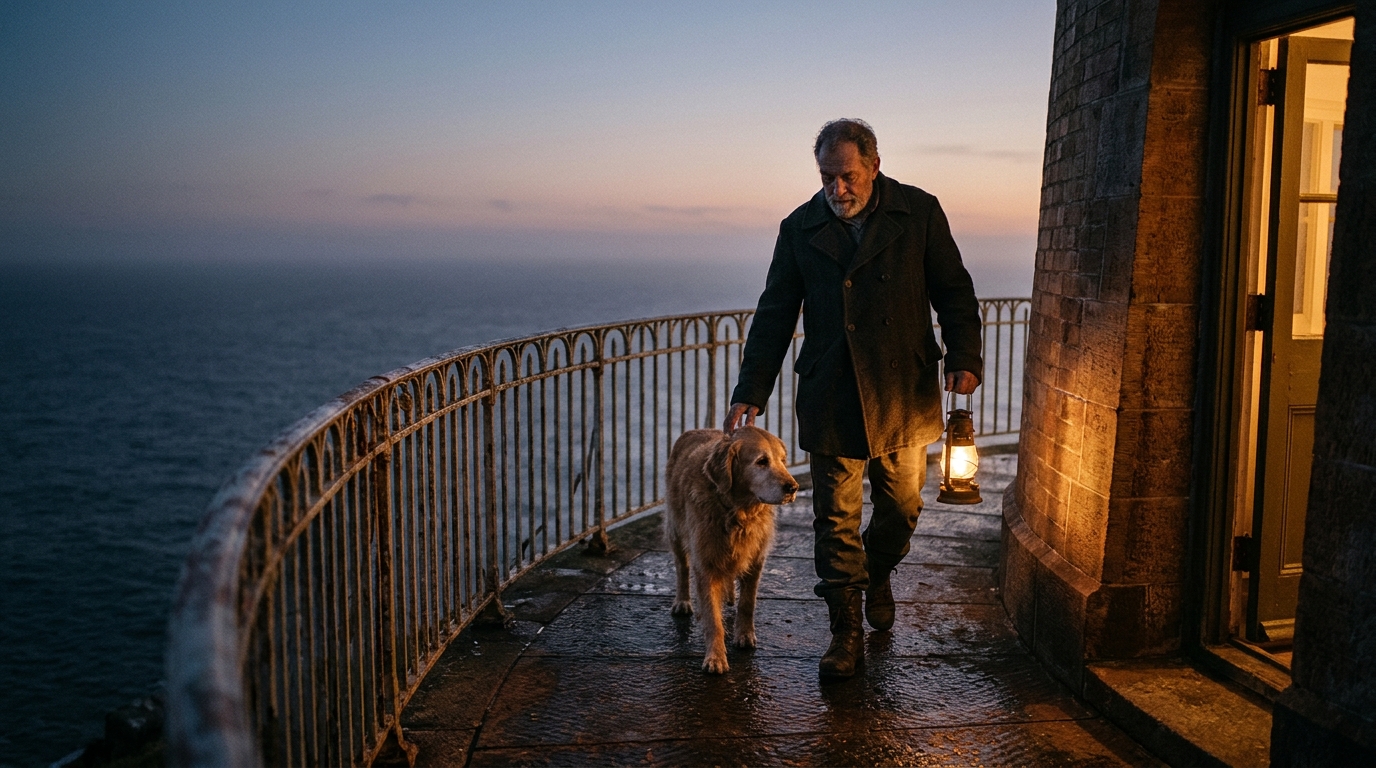
Every evening, just as the sun slips below the waterline and the sky turns the color of a ripe peach, a light comes on at the top of a tall white tower on a windswept point of coast. And every evening, a few minutes before it does, an old man and a scruffy brown dog step out of the keeper’s cottage and begin a walk that neither of them has missed in nearly six years.
This is the story of how that walk came to be, and why those who know them say it saved both of them from a loneliness that had quietly settled over their lives.
The Quiet Before the Dog
Walter had been a lighthouse keeper for most of his working life. Back when the station was fully staffed, there were three keepers, a shared kitchen, and the kind of easy chatter that fills a house when people depend on each other. Then came automation, and one by one the others moved on. Walter stayed on as a caretaker, tending the grounds, maintaining the old lens, and giving tours to the occasional summer visitor.
When his wife passed, the quiet grew heavier. He described it later as a particular kind of silence, not the peaceful kind of an empty beach, but the hollow kind of a house where a second coffee cup no longer gets taken down from the shelf.
“The days I could manage,” he once told a visiting volunteer. “There was always something to scrape or paint or polish. It was the evenings that got me. The light would fade, and I’d realize I hadn’t spoken a word out loud since morning.”
The Dog Nobody Wanted
The dog arrived on a stormy October afternoon. A fisherman found him shivering beneath an overturned dinghy near the harbor, thin, matted, and unwilling to be touched. No collar. No tag. The local shelter was full, and the fisherman, knowing that Walter lived alone out on the point, asked if he might keep the animal just for a few days.
A few days became a few weeks. Walter named him Beacon, partly as a joke, partly because the dog seemed to be searching for something steady to hold onto. For the first month, Beacon barely left the porch. He ate when Walter was out of sight. He flinched at raised voices, closed doors, and sudden movements.
Walter, who had spent his life being patient with weather, understood patience. He did not force anything. He simply sat on the porch each evening with a mug of tea, and let the dog watch him from a safe distance.
How the Walk Began
The first nightly walk happened almost by accident. One evening, Walter rose from his chair to climb the tower and switch on the light, a ritual he still performed by hand out of respect for the old way of doing things. Without thinking, he left the cottage door open behind him.
When he reached the gallery deck, the narrow walkway circling the lantern room, he heard it: the soft click of claws on the iron stairs. Beacon had followed him all the way up.
The dog stood at the railing beside him, nose lifted to the salt wind, watching the first beam sweep out across the darkening water. Neither of them moved for a long while.
The next evening, Beacon was waiting at the door.
What the Evening Gave Them
What began as a trip up the tower grew into something fuller. After the lamp was lit, the two of them would walk the loop of the headland path, past the fog signal building, along the cliff edge, and back down through the dune grass to the cottage. It took about forty minutes. It never changed. And that was exactly the point.
There is a particular gift in a routine shared with another living creature. It gives the end of the day a shape. It says: this is how we close the door on what happened, and this is how we are ready for what comes next.
What the walk offered Walter
- A reason to speak out loud again, even if only to a dog
- A gentle, built-in cue to slow down and breathe as the day ended
- Someone waiting at the door, which changed the feel of coming home
- A way to grieve without having to name it
What the walk offered Beacon
- Predictability, the great medicine for an animal who had known chaos
- A first lesson that hands could be safe and footsteps could mean company
- A role, because Beacon appointed himself guardian of the path, always three steps ahead
- Trust, built a little at a time, one evening after another
The Evening That Changed Everything
About a year in, Walter slipped on a wet patch of the cliff path and twisted his ankle badly. It was dusk. The wind was rising. He could not stand.
Beacon, the dog who once would not cross a doorway, did something Walter never forgot. He circled back, pressed his warm body against the old man’s side, and then, when Walter did not rise, he ran. Straight down the path, straight to the cottage, and then to the neighbor’s house a quarter mile away, barking until a porch light flicked on.
The neighbor followed the dog back through the dark. Walter was helped home, wrapped in blankets, and later reflected on that night with a kind of quiet wonder.
“I had spent years thinking I’d been the one doing the rescuing,” he said. “Giving a lost dog a roof. But it was the other way around, and it had been from the very first evening.”
The Gentle Science of Evening Routines
There is real wisdom behind what Walter and Beacon stumbled into. People who study loneliness often point out that it tends to feel sharpest at transitions, the hours when the structure of the day falls away. Evening is one of those hours. The work is done, the noise has faded, and the mind has room to wander toward whatever is missing.
A steady ritual shared with a companion can fill that gap. Dogs in particular thrive on predictability, and many people find that a daily walk at the same time helps regulate sleep, soften anxious thoughts, and create a sense of closure to the day.
A few small ways to borrow the idea
- Pick one anchor. A walk, a porch sit, a cup of tea. Choose one small thing and do it at the same hour each evening.
- Bring a companion if you can. A pet, a neighbor, a grandchild, a friend on the phone.
- Leave the screen behind. The point is to notice the light changing, not to document it.
- Let it be unremarkable. The power of a ritual lies in its repetition, not its grandeur.
The Walk Continues
Today, Walter moves more slowly, and Beacon, gray now around the muzzle, no longer sprints ahead. They have adjusted the pace. The loop takes a little longer, with a pause at the bench near the cliff edge where they watch the last of the light drain from the sky.
Visitors who happen to be on the point at dusk sometimes see the pair silhouetted against the fading horizon, an old man with a cane and a dog keeping time beside him. Behind them, the great lamp turns, sweeping its beam over the dark water for the sailors who will never know their names.
Walter has a way of describing it. The light, he says, is for the ships. But the walk is for the two of them.
A Thought to Carry Into Tonight
As the day winds down where you are, consider who or what keeps you company in the quiet hours. Consider whether there is a small, steady habit you could offer yourself, or someone near you, at the close of the day. It does not have to be a lighthouse. It only has to be a door left open, and a reason to step through it together.
Sometimes the thing that saves us arrives on four paws, follows us up a spiral staircase, and simply stays.