🎧 Listen to this story
Narrated by Kore · 6,048 characters
There is a particular hour in Margaret’s house that she has come to treasure and dread in equal measure. It arrives when the last of the daylight slides off the kitchen counter, when the neighbors’ porch lights flicker on one by one, and when the house, for decades filled with the sounds of two people, settles into a silence she once found unbearable.
It is also the hour when Biscuit goes to work.
The Quiet Arrival of an Unexpected Guest
Margaret, 74, lost her husband Walter eleven months before she brought the cat home. They had been married for fifty-one years. She will tell you plainly that she did not want a pet. Her daughter, living three states away and worried sick, had quietly arranged for her to visit a local shelter, framing it as a favor: ‘Just go look, Mom. Humor me.’
The shelter was loud and bright, full of the clatter of kennels and the restless energy of animals waiting to be chosen. Margaret walked past rows of kittens tumbling over each other. She was ready to leave when a volunteer mentioned a four-year-old gray tabby in the back room, one who had been returned twice.
‘He’s not a playful one,’ the volunteer warned. ‘He’s more of a sitter. He watches people.’
Margaret found him curled in the corner of a cage, thin and wary, with one torn ear and eyes the color of old honey. He did not rush the bars or perform for her. He simply looked at her, steadily, as if he were taking her measure.
‘I knew right then,’ she says. ‘He looked the way I felt.’
The First Night
Biscuit did not sleep on her chest right away. For the first week, he hid under the guest bed and ate only when the house was empty. Margaret respected his distance. She spoke to him softly in the mornings and left tuna by the doorway, the way you might coax a shy relative to the table.
Then came the eighth night.
Margaret had been lying awake, the way she often did, staring at the ceiling and replaying the long hospital weeks in her mind. The grief tended to arrive at night, when there was no laundry to fold or phone call to return. She remembers feeling her breath go shallow, her chest tight with something she could not name.
She felt the mattress dip.
A small, deliberate weight climbed onto the blanket, padded up her body, turned in two slow circles, and settled directly over her breastbone. Then it began to purr.
‘I don’t know how long I lay there,’ she says. ‘But I know I breathed deeper than I had in months.’
A Nightly Ritual That Has Never Been Broken
That was more than two years ago. Since then, Biscuit has not missed a single night. His routine is as dependable as a lighthouse:
- Dusk: He appears in whichever room Margaret is sitting in, as if signaling that the day is ending.
- Bedtime: He waits at the foot of the bed until she is under the covers and settled.
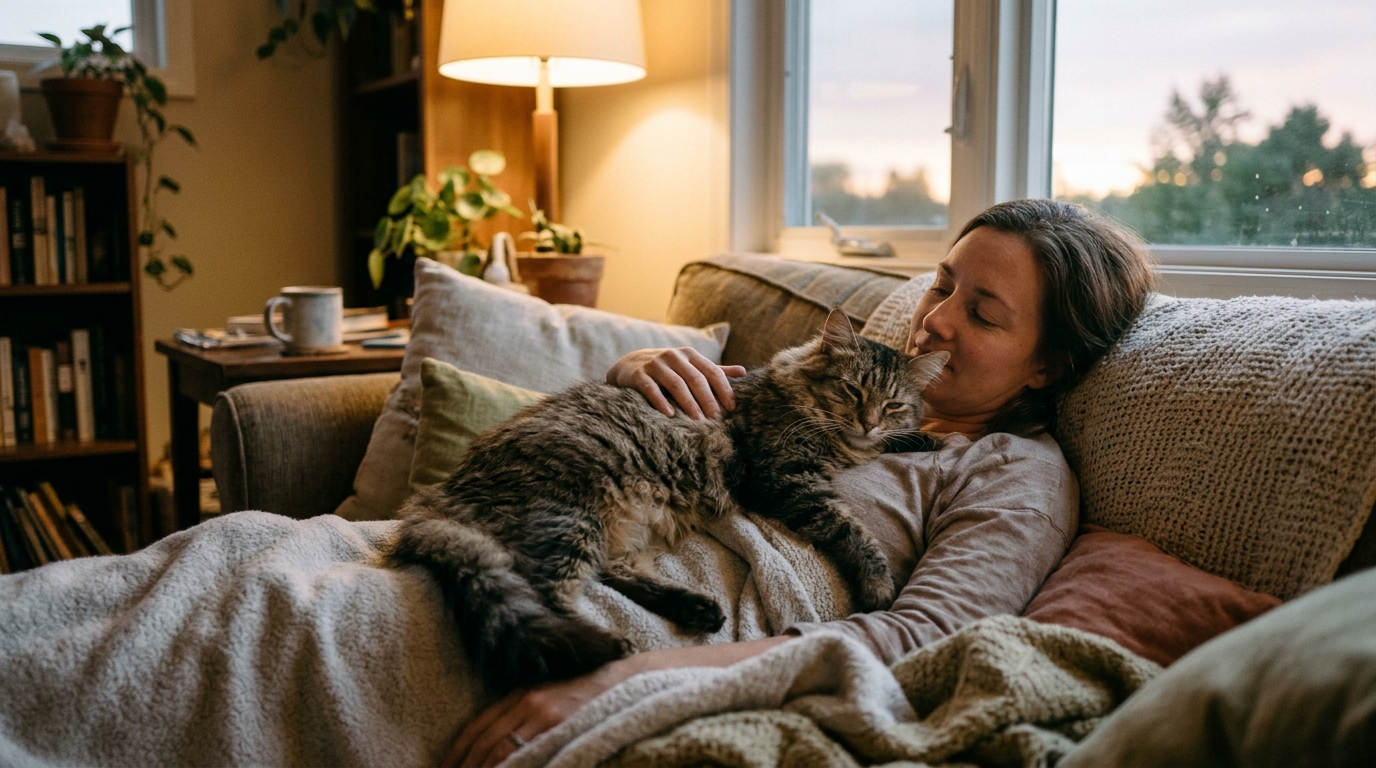
- The climb: He walks up the length of her body and lies down on her chest, facing her chin.
- The purr: A low, steady rumble that continues until her breathing slows to match it.
On nights when Margaret gets up for a glass of water, Biscuit follows her to the kitchen and back. When she was ill with the flu last winter, he did not leave the bed for three days, even to eat. She had to carry his bowl to the nightstand.
What the Science Says (and What It Cannot Explain)
Veterinary behaviorists note that cats often seek out warmth, rhythm, and the sound of a heartbeat. A person’s chest offers all three. The purr itself, which typically vibrates between 25 and 150 hertz, has been studied for its possible calming effects on both cats and the people near them.
But Margaret does not need a study to tell her what she already knows.
‘Walter used to rest his hand on my chest when I couldn’t sleep,’ she says quietly. ‘Just let it sit there until I drifted off. I never told anyone that. I didn’t realize how much I’d been missing it until Biscuit did the same thing, in his own way.’
Some call it coincidence. Others call it instinct. Margaret calls it company.
The Gentle Work of Staying
There is something worth pausing on here. Biscuit was a cat that two homes had returned, a cat described as distant and difficult. He did not change his nature to win Margaret over. He did not become playful or performative. He simply found a person who needed exactly what he had to offer: steady, unspoken presence.
It is a reminder that healing does not always arrive as a grand gesture. Sometimes it arrives as a small gray weight on the chest at the end of a long day, asking nothing and promising everything.
Lessons That Settle In at Dusk
- Presence is a gift. You do not always need the right words. Sometimes you only need to stay.
- The overlooked ones often have the most to give. Biscuit spent months in a cage because he did not know how to perform for strangers.
- Grief softens in the dark when it is not faced alone. The night is hardest when no one is breathing beside you.
- Routines can be a form of love. Showing up at the same hour, every day, says more than almost any speech.
An Evening Reflection
If you walked past Margaret’s house tonight, you would see a single lamp glowing in the upstairs window, warm and low. Inside, a woman in her seventies lies propped against two pillows, a paperback open and forgotten on the quilt. A gray cat with a torn ear is stretched across her chest, eyes half closed, paws tucked under, purring into the quiet.
She no longer lies awake counting the hours. Most nights now, she falls asleep before the chapter ends.
‘People ask if I rescued him,’ Margaret says, resting her hand on the soft, rising warmth of his back. ‘I tell them I’m not sure who rescued whom. I only know that every night, someone is waiting for me to come to bed. And that, at my age, is no small thing.’
So tonight, as the day winds down and the world grows still, perhaps take a moment to notice who is keeping watch beside you. It may be a pet, a friend, a memory, or a quiet kindness you have not yet thanked. The evening has a way of showing us what truly held us up all day long.
Sleep well. Someone small and steady may be waiting for you, too.