🎧 Listen to this story
Narrated by Kore · 6,605 characters
I did not set out to learn anything that summer. I set out to be polite. That is the honest truth of how it began, and I think it matters, because most of the lessons that change us arrive disguised as small obligations.
His name was Walter, and he lived two doors down from me for nine years before I ever sat on his porch. We waved. We commented on the weather. Once, during an ice storm, he shoveled my steps before I woke up and never mentioned it. That was the full extent of our friendship until the June he told me, in the same even voice he used to discuss tomato blight, that his doctors had given him until fall.
The Invitation
I remember standing there with my grocery bags, not knowing where to put my face. I said I was sorry. He waved it off and asked if I had a few minutes some evening, because he was tired of talking to people who spoke to him in hushed tones.
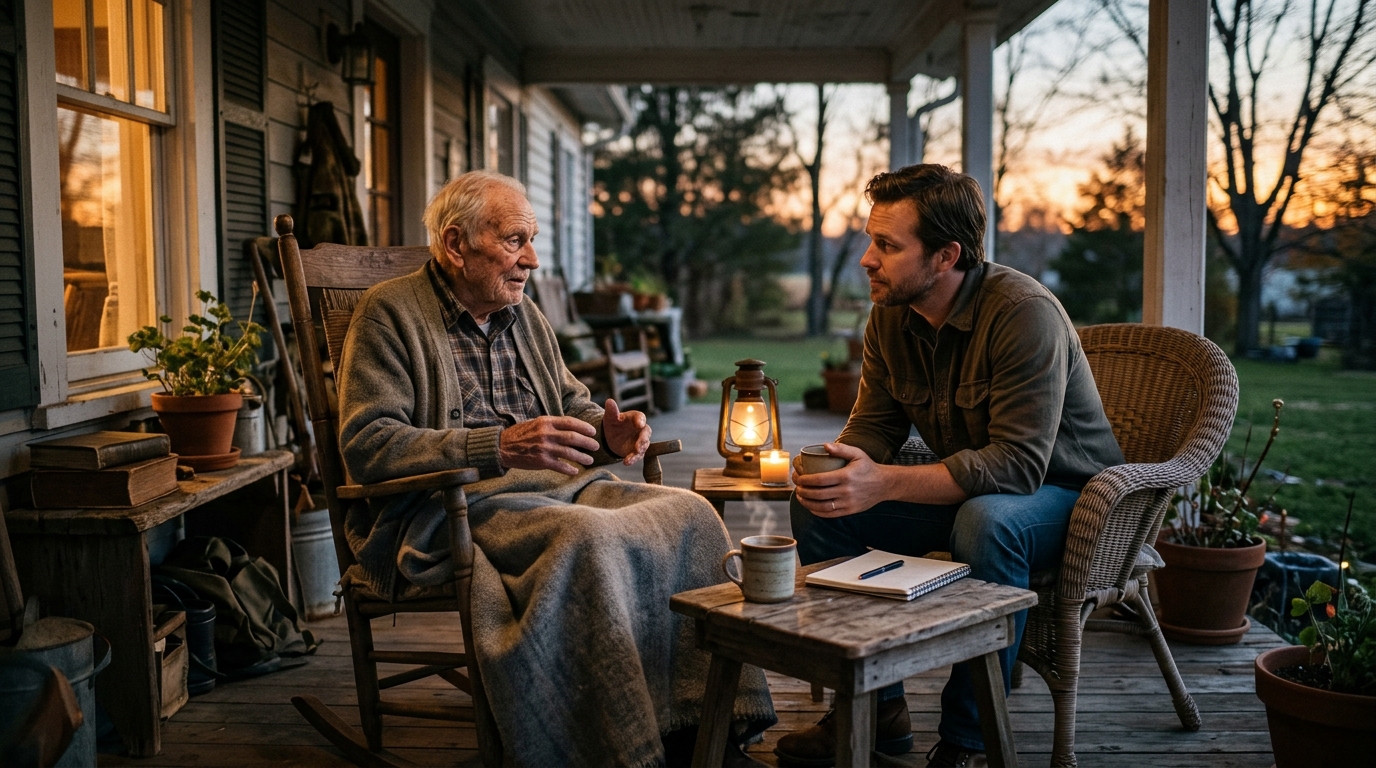
So I started coming by after dinner, around the time the heat softened and the streetlights flickered on one at a time. Walter had two wooden chairs and a small table between them, and a pitcher of lemonade he insisted on making himself, even when his hands shook too much to pour. I learned quickly not to help. Helping, I realized, was a kind of reminder, and he wanted to be reminded of nothing.
We sat together eleven times that summer. I know the number because after he was gone, I counted the evenings in my calendar, the way you count stairs in the dark.
Why the Evening Mattered
There is something about the end of a day that loosens people. In the morning, we armor up. By midday we perform. But on a porch at dusk, with the light going amber and then violet, the performance falls away.
Walter told me once that evenings had become his favorite part of living. “Everything gets quiet enough to hear itself,” he said. “You spend your whole life too busy to notice that the sun sets every single day, and then one day you have a limited number left, and suddenly you can’t look away from it.”
I have thought about that sentence almost every night since.
What He Actually Taught Me
I had expected wisdom to arrive in grand declarations. It did not. It came in the small, plain things he said while watching the street go dim. Here is what stayed with me.
1. Ask better questions than “How are you?”
Walter hated that question. Not because it was unkind, but because everyone asked it and no one wanted the real answer. Instead, he asked me things like: “What was the best ten minutes of your day?” It forced me to actually look back over my hours and find something worth keeping. Some nights it was a good cup of coffee. Some nights it was a stranger’s laugh at the bus stop. It trained my eyes to hunt for small good things.
2. Unfinished business is mostly just fear in a costume
He had a brother he had not spoken to in sixteen years over a disagreement about their mother’s house. He told me the argument itself had grown so small he could barely remember its edges, but the silence had grown enormous. In July, he finally wrote a letter. He would not tell me what it said. He only told me that writing it felt like setting down a bag he had carried so long he had forgotten it was heavy.
3. Presence is the only gift that costs nothing and means everything
People brought Walter casseroles and flowers and well-meaning advice. He appreciated it all. But he told me the best visits were the ones where someone simply sat down and stayed, without trying to fix or soothe or fill the silence. “A person who can sit with you in the quiet,” he said, “is worth more than a person who knows the right thing to say.”
4. Gratitude is a practice, not a feeling
Every evening, before I left, Walter named three things he was thankful for. Not grand things. A cool breeze. The neighbor’s dog who always stopped to be petted. The fact that his lemonade had turned out just right. He said gratitude was a muscle, and he was surprised to find it growing stronger even as the rest of him weakened.
The Evening I Almost Did Not Go
I want to be honest about something. There was one evening in August when I almost did not go. I had a hard day, my inbox was a disaster, and I told myself that Walter would understand if I skipped a night.
I went anyway, mostly out of guilt. And that was the night he told me about his wife, Eleanor, who had passed twelve years earlier. He described how she hummed while she cooked and never once remembered the words to any song. He laughed until he coughed. Then he went quiet, and we watched the fireflies rise out of the grass, and neither of us said anything for a very long time.
It was the most meaningful hour of my entire summer, and I nearly traded it for an email.
The Last Evening
The eleventh evening arrived in early September, when the air had begun to carry that first thin edge of autumn. Walter was weaker. He sat wrapped in a blanket despite the warmth, and he did not pour the lemonade. I poured it for him, and he let me, which told me everything.
He did not give a farewell speech. He asked me to describe the sunset, because his eyes were tired. So I did. I told him about the way the sky went peach and then rose and then a deep bruised blue, and how the first star had come out above the Hendersons’ maple tree. He listened with his eyes closed and a small smile.
“That’s enough,” he said quietly. “That’s plenty.”
He passed two weeks later.
What I Do Now
These days, I keep a small ritual. Most evenings, I step outside for ten minutes, even in the cold, even when I am tired. I watch the light change. I name three things I am grateful for, out loud if no one is around. And I ask myself Walter’s question: what was the best ten minutes of my day?
Sometimes I think about how close I came to never knowing him. Nine years of waving, and a single summer of actually seeing someone. I wonder how many Walters are out there, two doors down, waiting for someone to sit in the empty chair.
A Gentle Invitation
If you take anything from this story, let it be this: the people near you are carrying whole worlds you have never been invited into. Sometimes all it takes is saying yes to a lemonade, a porch, and a quiet hour at the end of the day.
- Say yes to the small invitation, even when you are tired.
- Ask a question that cannot be answered with “fine.”
- Stay a little longer than is comfortable.
- Notice the sunset. It is free, and it is promised every night.
Walter’s chair is empty now, but I like to think the evening light still falls across it the same way. And every time the sky turns amber, I whisper the same thing he taught me to say: that’s enough. That’s plenty.