🎧 Listen to this story
Narrated by Kore · 7,973 characters
For eleven months after her husband died, Margaret Ellison did the same thing every evening. At the first sign of dusk, she drew the curtains, turned on every lamp in the house, and put on the television loud enough to fill the silence. The dark, she explained later, had become the hour when the loss pressed down hardest. Daylight was for errands and phone calls and being brave. Night belonged to the empty chair at the kitchen table.
Then, one October evening, something in the old oak at the back of her yard made a sound she had never heard before, and everything about her evenings began to change.
A Sound at the Edge of Dusk
Margaret, seventy-one, had lived in the same small house on the edge of a wooded ravine for forty-four years. Her husband, Walter, had planted most of what grew in the yard: the lilacs, the crooked apple tree, the row of hostas he swore would never survive the frost. The oak, though, had been there long before either of them.
That October evening she had stepped onto the back porch to bring in a flowerpot before the temperature dropped. The light was nearly gone, that thin gray-violet hour when the trees turn to silhouettes. And from somewhere above her came a low, quavering whinny, almost like a horse laughing very quietly, followed by a soft, rolling trill that seemed to drift down through the branches.
She stood perfectly still, flowerpot in her arms, heart pounding. She did not know what it was. But for the first time in nearly a year, she did not rush back inside.
Meeting the Neighbors
It took her a few days of lingering on the porch to work out what she was hearing. A neighbor who bird-watched told her it sounded like an eastern screech-owl, a small, compact owl that nests in tree cavities and calls most often at twilight. She looked up photographs that night and felt an odd stir of recognition. The sound matched exactly.
Over the following weeks, she began to notice more. A pair of pale, round shapes tucked into a hollow in the oak’s lower trunk. A flicker of movement at dusk as one bird slipped out to hunt. Later, in the early spring, a pair of tiny, fluffy owlets that peered out of the hollow like children at a window, blinking at the world with enormous eyes.
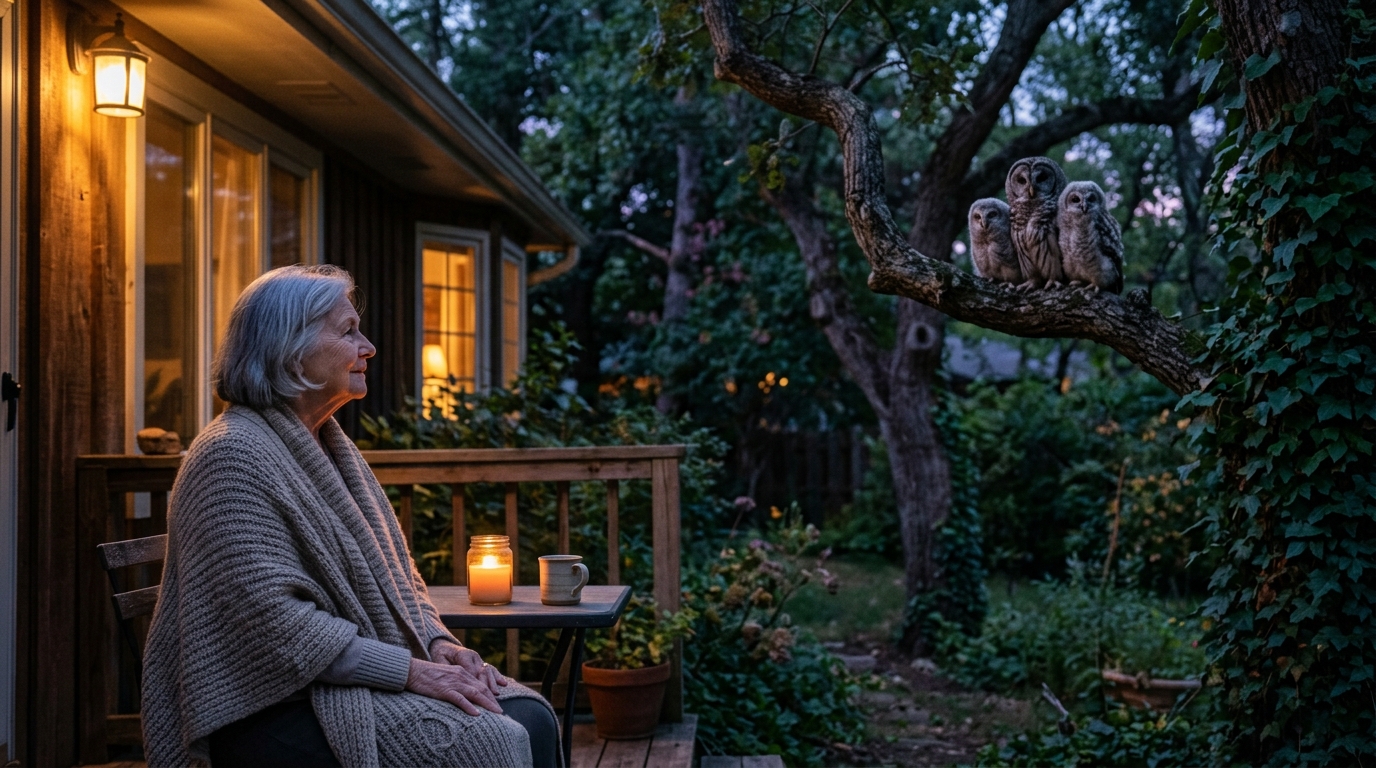
Margaret began carrying a kitchen chair out to the porch. At first she stayed only a few minutes. Then she brought a blanket. Then a thermos of tea. Within a month, she had stopped turning on the television altogether.
What the Evenings Taught Her
She told me, when I spoke with her, that she had not expected the owls to change anything. She had simply been curious. But something about their routine caught hold of her. Every evening, the same small ritual unfolded. The adult owls would emerge as the light faded. They would sit for a while at the mouth of the hollow, shifting and fluffing their feathers, as if gathering themselves for the night’s work. Then, one by one, they would lift off silently and vanish into the dusk.
“They weren’t afraid of it,” Margaret said. “The dark. It was their whole world. It was when they woke up.”
That thought stayed with her. For months she had thought of nightfall as an ending, a door closing on a day she had barely survived. Watching the owls, she began to see it differently, as a beginning for creatures who thrived in it. The same hour that had felt unbearable now held something alive and watchful and quietly beautiful.
The Small Rituals She Built
Margaret never set out to make a routine out of her owl-watching, but one grew anyway, piece by piece:
- The porch chair at sunset. She began sitting outside about twenty minutes before dusk, long enough to settle in and let the day’s noise drain away.
- A notebook on her knee. She started jotting down what she saw: the time the owls emerged, the weather, the way the owlets’ feathers changed week to week.
- One lamp, not ten. She learned to leave the house mostly dark so her eyes could adjust, trading the glare of every light for the softer glow of a single window behind her.
- Walter’s old binoculars. She found them in the hall closet, still in their worn leather case, and used them every evening. It felt, she said, like sharing the view with him.
The Stillness Between Sunset and Night
There is a particular kind of quiet that settles over a yard in the hour after sunset. The birds of the day go still. The air cools. Colors drain out of the world, leaving everything in soft shades of blue and charcoal. Margaret said she had spent forty-four years in that yard without ever really noticing it.
“I was always inside by then,” she said. “Making supper, doing dishes, getting ready for bed. I never just sat in it. Now I think that hour is the best part of my day.”
Grief, she told me, had a way of making time feel enormous and shapeless. The owls gave it edges again. Their schedule was reliable: emerge, stretch, call, depart. Whatever else was uncertain in her life, she could count on that small unfolding each evening, and the counting itself was a comfort.
A Lesson in Paying Attention
Researchers who study eastern screech-owls note that these birds are devoted to their territories and often return to the same nesting cavity year after year. They are also remarkable for their patience, spending hours motionless at a roost before moving. Margaret found herself learning that patience by imitation. She would sit just as still, watching the hollow, waiting for a sign of life.
“You can’t rush them,” she said. “You just have to be there and let them come out when they’re ready.”
She admitted that this was a kind of lesson she needed. For most of that first year, she had treated grief as something to be hurried through or hidden from, bright lights and loud noise to keep it at bay. The owls suggested another way: sit with the dark, quietly, and let what is waiting there reveal itself in its own time.
Not a Cure, but a Companion
Margaret is careful not to overstate any of this. The owls did not heal her, she says, and she still has hard evenings. There are nights when the empty chair still aches, when she cannot find the words to describe how much she misses Walter’s voice reading the paper aloud in the next room.
But the owls gave her something to look toward when evening came. Instead of dreading dusk, she began anticipating it. Instead of filling the silence with noise, she learned to listen to what the silence held: the rustle of wings, the soft call from the oak, the small domestic drama of a family going about its life just yards from her kitchen door.
The Owlets Take Flight
In late spring, the owlets left the hollow. Margaret watched the first one hop clumsily to a lower branch, wobble, flap, and finally lift into the dusk on silent wings. She cried a little, she admitted, though she could not say whether from sadness or joy.
The family stayed in the area through the summer, and she could still hear them calling at twilight. When autumn came again, she was sitting in her porch chair, notebook on her knee, when the old familiar whinny drifted down from the oak. A year to the evening since she had first heard it.
“I thought, well, there you are,” she said, smiling. “Welcome home.”
What We Might Take From a Widow and Her Owls
Stories like Margaret’s are quiet by nature. There is no dramatic rescue, no grand gesture, no sudden transformation. There is only a woman, a chair, and an old oak tree, and the slow work of learning to be present in the hour she once feared most.
If her story has a lesson, it might be this: sometimes what we need is already at the edge of our yard, waiting for us to sit still long enough to notice. And sometimes the thing we dread most, the dark, the quiet, the end of the day, holds a gentle surprise for anyone willing to step outside and meet it.
Tonight, as the light fades where you are, consider pausing before you reach for the switch. Step to a window or a doorway. Listen. You may find that the evening has been trying to tell you something all along.