🎧 Listen to this story
Narrated by Schedar · 7,521 characters
The Forest Has a Secret Language
Walk into any old-growth forest and you might feel something you cannot quite name. A stillness, yes. A coolness beneath the canopy. But also something deeper, something that feels almost like presence. For centuries, humans have described forests as alive in ways that go beyond simple biology. It turns out, they were more right than they knew.
Over the past two decades, forest ecologists have uncovered something that reads less like a science paper and more like a nature documentary narrated by someone who truly believes in magic. Trees, it appears, are not just growing beside each other. They are communicating, sharing resources, and in many documented cases, keeping their sick and dying neighbors alive on purpose.
This is not metaphor. This is mycorrhizal fungi, root chemistry, and decades of peer-reviewed research. And once you understand it, you will never walk through a forest the same way again.
Meet the Wood Wide Web
Beneath every healthy forest floor lies one of the most sophisticated networks on the planet. Scientists call it the mycorrhizal network, but writers and educators have taken to calling it the “Wood Wide Web,” and honestly, that name earns its keep.
Here is how it works:
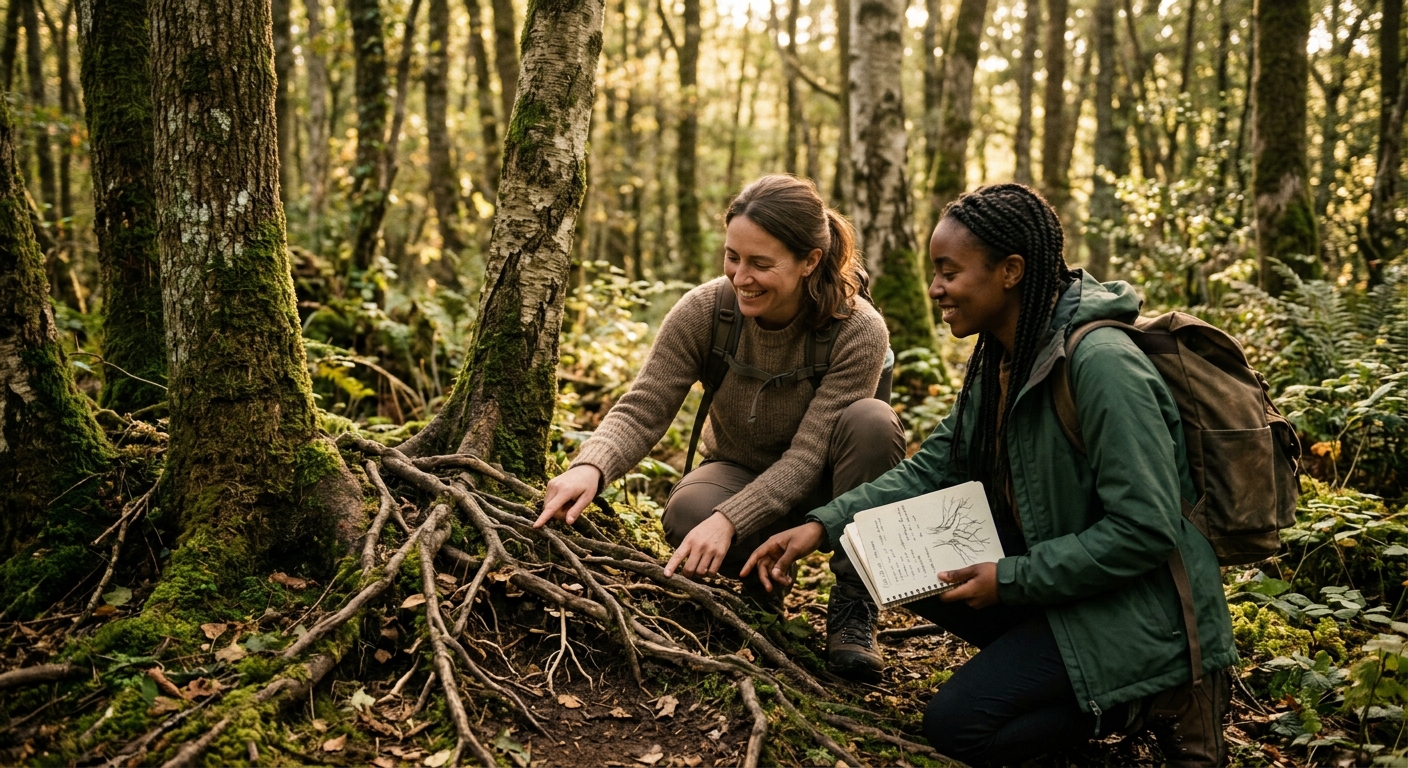
- Fungal threads called hyphae extend outward from tree roots in every direction, sometimes stretching for miles.
- These threads connect to the roots of neighboring trees, forming a living network of filaments beneath the soil.
- Through this network, trees can exchange carbon, water, phosphorus, nitrogen, and chemical distress signals.
- A single teaspoon of healthy forest soil can contain several miles of these fungal threads.
Dr. Suzanne Simard, a forest ecologist at the University of British Columbia, spent decades studying these networks in the forests of Canada. Her research revealed something that turned conventional forestry thinking on its head: trees do not simply coexist. They actively support one another, and the oldest trees in any given forest, those she calls “Mother Trees,” appear to play a central, nurturing role in the health of the entire community.
How Trees Care for Their Sick
Here is where the story moves from fascinating to genuinely moving.
When a tree is diseased, damaged by insects, drought-stressed, or dying from lack of light, something remarkable can happen. Neighboring trees, connected through the mycorrhizal network, begin sending additional carbon and nutrients toward that struggling individual. In some observed cases, trees that should have died from severe shading or root damage were found to be receiving a steady supply of sugars through the network, effectively being kept alive by their neighbors.
Simard’s research documented stumps of trees that had been cut centuries ago still showing signs of living tissue. The only explanation was that surrounding trees had been feeding those stumps through root connections for decades, perhaps out of something resembling recognition or ecological memory.
The Chemistry of Care
Beyond nutrients, trees also communicate danger. When one tree is attacked by insects or pathogens, it releases chemical signals both through the air via volatile organic compounds and through the soil network. Neighboring trees receive these signals and respond by ramping up their own chemical defenses, producing tannins, resins, and other protective compounds before the threat even reaches them.
In one well-documented study, acacia trees in Africa were observed releasing ethylene gas when giraffes began feeding on their leaves. Neighboring acacias, downwind, began increasing their tannin production within minutes. The trees were warning each other. And the other trees were listening.
Mother Trees: The Elders of the Forest
Perhaps the most emotionally resonant finding from Simard’s work involves what she calls Mother Trees, the oldest and largest trees in a forest stand. These giants have the most extensive root and fungal connections, linking them to hundreds of younger trees in the surrounding area.
When a Mother Tree is dying, something extraordinary happens. In the weeks and months before death, these trees appear to download enormous quantities of carbon and defense information into the network, essentially passing on a legacy to the next generation. Seedlings connected to dying Mother Trees show measurable increases in stress resistance compared to those without that connection.
It reads, in ways that are difficult to ignore, like a grandmother making sure her grandchildren are taken care of before she goes.
What This Means for How We Manage Forests
The implications of this research are enormous, and they have put Simard at odds with traditional logging practices for much of her career. When a forest is clearcut, the mycorrhizal network collapses. Young replanted trees, stripped of their elder connections, struggle to establish themselves and are far more vulnerable to disease and drought. Monoculture tree farms, planted in neat rows of a single species, have almost none of the network complexity of natural forests.
The forest, it turns out, is not a collection of individual trees competing for sunlight and water. It is a community. And communities need their elders, their diversity, and their connections to thrive.
7 Things We Learn From the Way Forests Care for Each Other
- Community is infrastructure. The strength of a forest lies not in any single tree but in the density and health of its connections. The same is true for neighborhoods, families, and friendships.
- The oldest among us carry the most vital knowledge. Mother Trees do not just provide shade. They hold decades of chemical and biological information that younger trees need to survive. Our elders carry something similar.
- Caring for the vulnerable is not weakness. Trees do not abandon their sick neighbors to conserve resources. They share what they have. The forest is stronger because of it.
- Warning others costs you very little. When trees signal danger, they lose very little energy doing so. The act of saying “watch out” is almost always worth the effort.
- Diversity protects everyone. Forests with more species variety have richer, more resilient networks. Homogeneity, whether in trees or in thought, makes the whole system fragile.
- Invisible connections matter most. You cannot see the mycorrhizal network. You cannot see empathy, loyalty, or love either. That does not make them any less real or any less essential.
- What we leave behind can nourish others long after we are gone. The carbon a Mother Tree passes on at the end of her life feeds the forest for generations. Legacy is not always a monument. Sometimes it is a quiet transfer of everything you have learned.
A New Way of Walking Through the Woods
There is something profoundly comforting about this science. In a world that often rewards individual achievement and punishes vulnerability, the forest offers a different model. One where strength is communal, where care flows toward those who need it most, and where the oldest and largest among us spend their final energy ensuring that the young ones will be okay.
Next time you walk beneath a canopy of tall trees, consider what is happening beneath your feet. Consider the signals moving through the soil, the sugars flowing from root to root, the quiet and ongoing act of one living thing choosing, in whatever way a tree can choose, to keep another alive.
It is not sentimentality. It is biology. And sometimes, biology is the most beautiful thing in the world.