
🎧 Listen to this story
Narrated by Schedar · 7,132 characters
A Moment That Defied Explanation
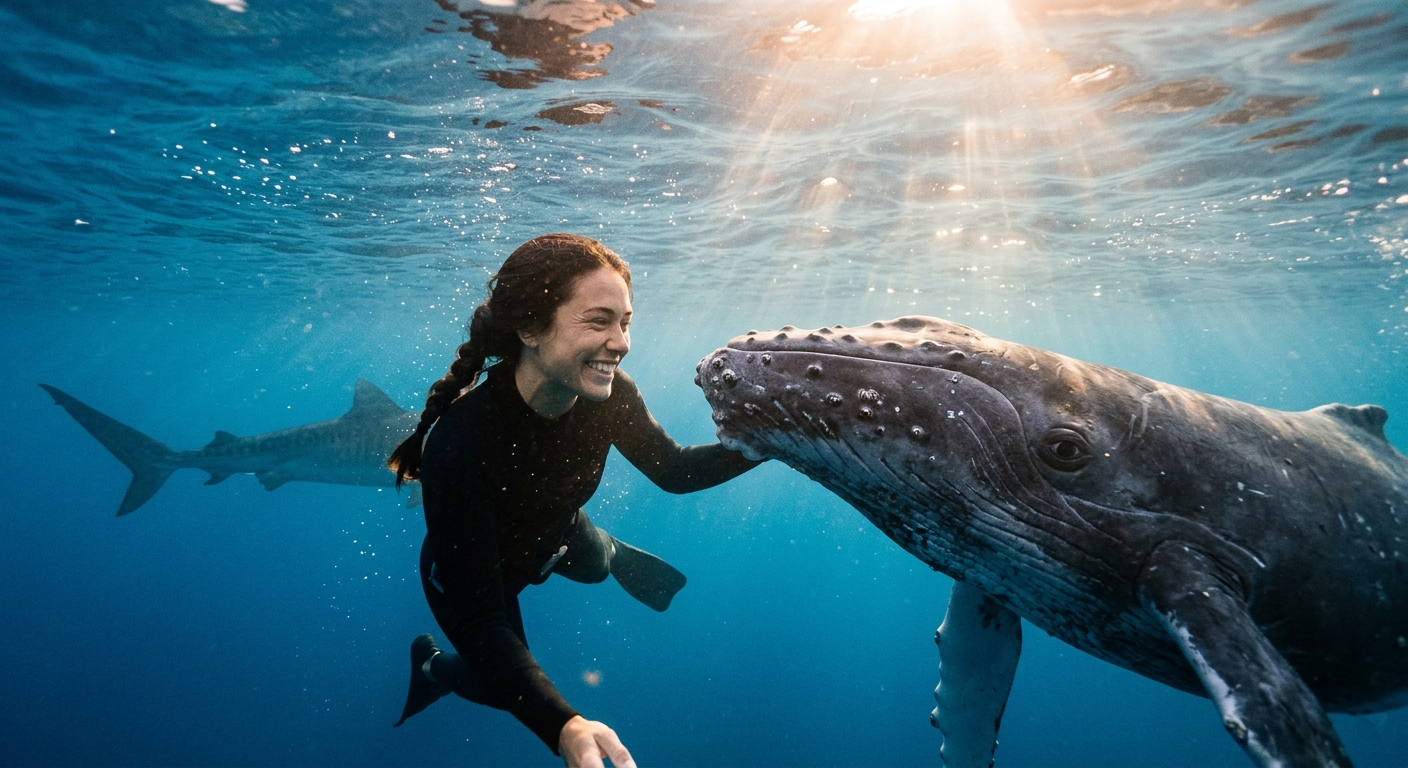
On a sun-drenched afternoon in the South Pacific, marine biologist Nan Hauser was doing what she had spent decades doing: swimming alongside the creatures she loved. The water was warm, the visibility was clear, and the day felt ordinary. Then, without warning, a 50,000-pound humpback whale began pushing her through the water with its enormous head.
At first, she was terrified. She thought the whale might accidentally kill her. But what happened next became one of the most remarkable stories in the history of human-animal interaction, one that scientists, ocean lovers, and everyday people are still talking about years later.
This is not a fairy tale. This is a documented account of an encounter that raises profound questions about animal cognition, empathy, and the mysterious bonds that can form between species.
Who Is Nan Hauser?
Nan Hauser is no ordinary ocean enthusiast. She is the president and director of the Center for Cetacean Research and Conservation, and she has spent over 28 years studying whales in the Cook Islands. She knows their behavior, their communication patterns, and their personalities better than almost anyone alive.
So when a humpback whale began behaving strangely around her during a research dive in October 2017, she paid close attention, even as panic began to creep in.
The whale was enormous, approximately 25 feet long, and it was doing something she had never witnessed before. It was actively, deliberately tucking her beneath its pectoral fin and pushing her through the water. When she tried to swim away, it followed. When she surfaced briefly, it maneuvered her back under. For nearly 10 minutes, this continued.
The Threat She Could Not See
From the research boat above, her crew watched in a mixture of awe and alarm. Then someone spotted it: a 15-foot tiger shark circling just beneath the surface, not far from where Nan was submerged.
The whale, it appeared, had seen the shark before Nan did. And it had made a decision.
Tiger sharks are among the most dangerous predators in the ocean. They are opportunistic, powerful, and unpredictable. A single encounter can be fatal. Nan, focused on the confusing behavior of the whale, had been completely unaware of the danger lurking nearby.
The whale kept her tucked close, shielding her with its body, repositioning her whenever she drifted. A second humpback was also present nearby, slapping the surface of the water with its tail, a behavior that researchers believe may have been intended to deter the shark from approaching.
What the Scientists Are Saying
After the encounter, Nan was overwhelmed, both emotionally and intellectually. As a scientist, she knew the implications of what had just happened. She described the event in detail in interviews and noted that the whale’s behavior showed clear intentionality.
Several key observations stood out to researchers who reviewed the footage:
- The whale repeatedly repositioned Nan when she drifted away from its body, suggesting awareness of her location relative to the threat.
- The second whale’s tail slapping is a known cetacean distress and deterrent signal, implying coordinated behavior between the two animals.
- The whale did not leave until the threat had passed, at which point it appeared to guide Nan toward her research boat.
Dr. Hauser herself said, in a widely shared interview: “I never touch a whale. And I try to maintain a proper scientific distance. But this whale was not giving me a choice. I was being tucked under a pectoral fin that was the size of a car.”
Have Humpbacks Done This Before?
As extraordinary as Nan’s experience sounds, it may not be entirely without precedent. There are several documented and anecdotal accounts of humpback whales intervening when other animals were in danger, not just humans.
In one widely studied case from 2009, researchers observed a group of humpback whales in the Antarctic repeatedly interfering with a pod of killer whales that were attempting to hunt a Weddell seal. The humpbacks drove off the orcas and even used their bodies to lift the seal out of the water, keeping it safe until the threat passed.
Scientists have a term for this kind of behavior: interspecies altruism. It is rare, it is not fully understood, and it continues to challenge the assumptions we hold about which animals are capable of empathy and compassion.
What Drives This Behavior?
The honest answer is: we are not entirely sure. Several competing theories exist among marine biologists and animal behaviorists:
- Instinctive anti-predator response: Some researchers suggest humpbacks have a deeply ingrained instinct to interfere with shark or orca predation, possibly because orcas prey on humpback calves. This instinct may activate regardless of the species being threatened.
- Social intelligence and empathy: Others argue that humpback whales, which have complex social structures, long-range communication, and some of the largest brains in the animal kingdom, may possess a form of empathy that extends beyond their own species.
- Learned cultural behavior: Some scientists propose that certain behaviors, including protective interventions, may be passed between whales through social learning, much like cultural traditions in human communities.
None of these theories is mutually exclusive. The truth may be a combination of all three.
What This Story Teaches Us
Beyond the science, there is something deeply moving about this encounter. A wild animal, under no obligation to protect a creature from a different species, chose to place itself between a human being and danger. It acted not out of domestication, not out of training, and not out of reward. It simply acted.
In a world where humans and nature are increasingly at odds, where ocean ecosystems are under threat from pollution, overfishing, and climate change, stories like this one carry a particular kind of weight. They remind us that the ocean is not just a resource to be managed. It is a world of intelligent, feeling beings who, under the right circumstances, may extend something that looks unmistakably like kindness.
Nan Hauser, the scientist who spent her life advocating for whales, found herself on the receiving end of what may have been an act of care from one of those same animals. The symmetry of that is not lost on her.
“I will spend the rest of my life trying to protect them,” she said. “And on that day, one of them protected me.”
A Reminder From the Deep
We often assume that compassion, awareness of others, and the impulse to protect are uniquely human qualities. Stories like this one quietly dismantle that assumption. They ask us to look again at the creatures we share this planet with, and to consider what they might understand about connection that we are only beginning to learn.
The ocean holds many mysteries. Perhaps the most profound is not the depth of its trenches or the scale of its ecosystems, but the depth of feeling that may be alive within its creatures.
Nan Hauser swam home that day because a humpback whale decided she should. And that, in any language, is a gift worth honoring.