🎧 Listen to this story
Narrated by Schedar · 7,844 characters
A Stack of Envelopes, a Worn-Out Pen, and 300 Strangers Who Feel Less Alone
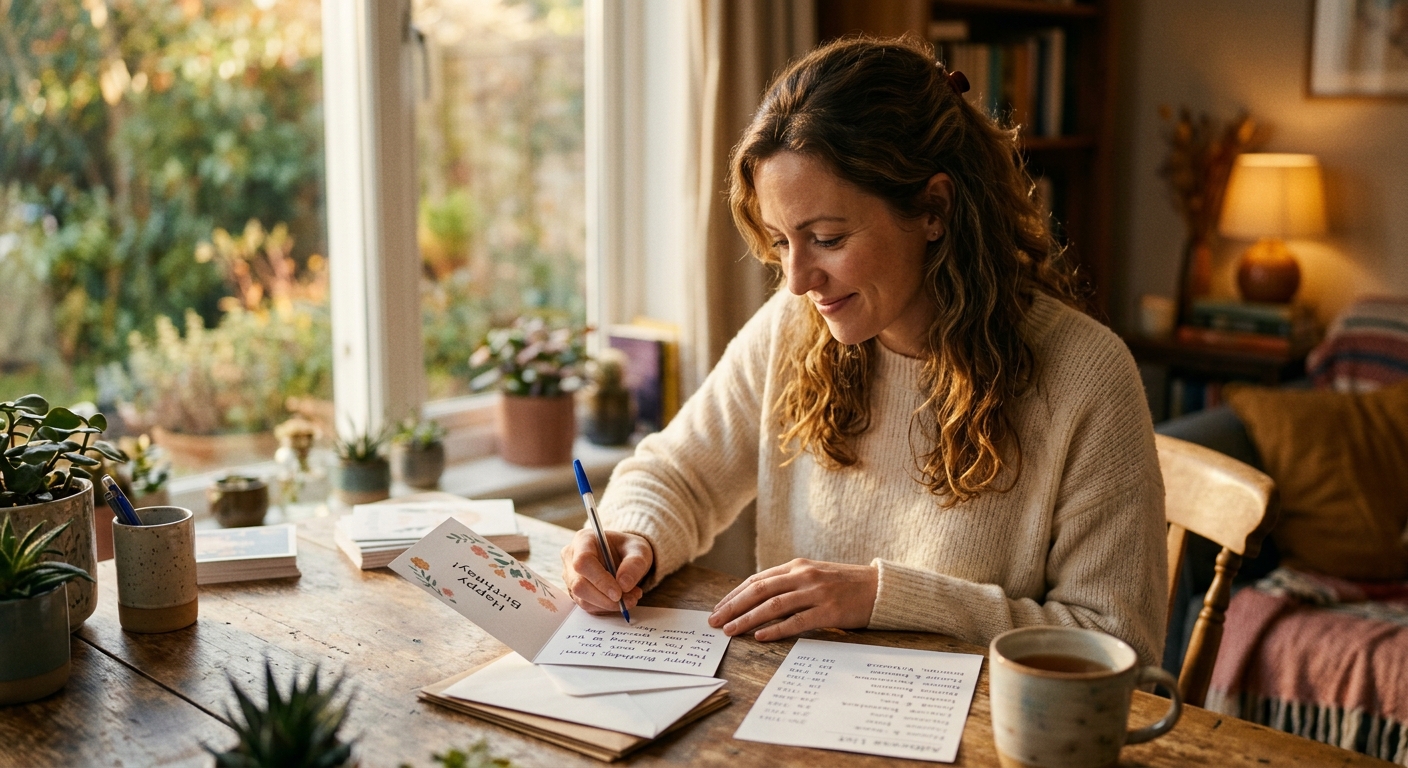
Every morning in late October, Margaret Elspeth Chen sits down at her kitchen table in Boise, Idaho, with a cup of chamomile tea, a box of colorful envelopes, and a list that most people would find completely baffling. It is a spreadsheet of names, birthdays, and addresses belonging to people she has never met, never spoken to, and in many cases, never even seen a photograph of.
She picks up her pen, and she starts writing.
By the end of each year, Margaret will have mailed over 300 handwritten birthday cards to strangers across the United States and, increasingly, around the world. Each card is personal. Each card is warm. And each card, according to the people who receive them, arrives at exactly the right moment.
How It All Started: A Birthday Nobody Remembered
Margaret was 54 years old when her own birthday passed without a single card in the mailbox. Her husband had passed away two years prior. Her children were scattered across the country, busy with jobs and babies and the relentless pace of modern life. A few texts came through. A Facebook notification or two. But nothing she could hold in her hands.
“I remember sitting at the kitchen table, and the mailbox was just empty,” she recalls. “Not angry empty. Just quiet empty. And I thought, how many people feel this way today? Not just me. How many people woke up this morning and felt completely invisible?”
Rather than sitting with that sadness, Margaret made a decision that would quietly change hundreds of lives. She would become the person who remembered. She would be the presence in someone else’s mailbox that she had wished for in her own.
She started small. She posted in a local community Facebook group, asking if anyone wanted to receive a handwritten birthday card from a stranger. Forty-two people responded in the first 24 hours. Within a week, she had over a hundred names on her list.
The Process: More Intentional Than You Might Think
People often assume that sending 300 cards must feel mechanical after a while, like stuffing envelopes at a telethon. Margaret pushes back on that idea firmly.
“Each card takes me at least ten minutes,” she says. “Sometimes twenty. I ask people to share a little about themselves when they sign up. Their favorite color. Something they are proud of. A hard thing they are going through. And then I write to that. Not to a name on a list. To a person.”
Her system is organized but deeply human. She keeps a binder with dividers for each month of the year. Inside each section are printed sheets with each person’s details, written in her own shorthand. A small star means someone is going through grief. A smiley face means they mentioned they love jokes. A tiny heart means they specifically said they feel lonely.
She sources her cards from local artists, small print shops, and occasionally makes her own using watercolors on rainy afternoons. She refuses to use generic store-bought cards because, as she puts it, “a card that was made with care deserves words that were written with care.”
What Recipients Have Said
The responses Margaret receives back are, by her own description, the fuel that keeps the whole project running. She has collected many of them in a scrapbook she keeps on the shelf above her writing desk.
Here is a small selection of what people have written back to her:
- A 34-year-old nurse in Tennessee: “I was working a double shift on my birthday and cried in the break room when I opened your card. In the best way possible.”
- A retired veteran in Oregon: “Nobody has sent me a birthday card since my mother died in 2009. I did not know how much I needed this until I held it.”
- A college freshman in Michigan: “I was having a really dark week and your card felt like proof that someone out there gives a damn. I taped it to my dorm wall.”
- A grandmother in rural Georgia: “I read it three times and then read it to my dog. We both felt better.”
That last one, Margaret says, is one of her favorites.
The Ripple Effect Nobody Expected
What began as one woman’s quiet response to loneliness has grown into something with real cultural momentum. Margaret now runs a small volunteer network of twelve other card writers who have joined her cause. Together, they call themselves The Mailbox Project, though Margaret insists it is not an organization so much as “a few people who believe the postal service is still magic.”
Several recipients have gone on to start their own card-writing practices in their own cities. A schoolteacher in Phoenix now sends handwritten encouragement notes to students who seem withdrawn. A retired mail carrier in Vermont started sending cards to elderly neighbors who live alone. A teenager in Illinois started mailing cards to pediatric patients at the hospital where his younger sister was treated for leukemia.
None of these people were asked to pay it forward. None of them were handed a manual or a mission statement. They simply received something unexpected in the mail on a day that mattered, and they felt moved to pass that feeling along.
What Margaret Wants You to Know About Loneliness
Margaret is careful not to present herself as a hero or her project as a solution to a complex social crisis. She is clear-eyed about what a card can and cannot do. But she does believe, with considerable conviction, that physical mail carries something digital communication cannot replicate.
“When someone texts you happy birthday, it takes three seconds,” she says. “And that is fine. That is lovely. But when someone sits down, picks up a pen, and writes your name with their hand, there is something in that act that says: you were worth my time. Not my click. My time.”
Research, it turns out, tends to agree with her instincts. Studies on loneliness and social belonging consistently show that perceived effort in communication matters as much as frequency. A single thoughtful gesture often outweighs a dozen casual ones in its emotional impact. The physical act of receiving a handwritten letter activates different neurological responses than reading a screen, engaging memory, touch, and a slower, more reflective form of attention.
Margaret did not know any of that when she started. She just knew how her empty mailbox had felt.
How to Join, or Start Your Own Version
The Mailbox Project accepts new recipients on a rolling basis, and Margaret is always looking for volunteers who want to become card writers. She is also, characteristically, very willing to help anyone who wants to start their own version of this in their own community.
Her advice for anyone considering it is practical and generous:
- Start with ten people, not a hundred. Sustainability matters more than scale.
- Ask recipients to share something real about themselves. Generic cards feel generic, no matter how pretty they are.
- Do not worry about being a great writer. Warmth matters more than eloquence.
- Set a regular time each week to write. Treat it like an appointment with someone who is counting on you, because they are.
- Accept that you will never know the full impact of what you send. That is part of the gift.
A Table With a Worn-Out Pen and an Endless List
Every morning, Margaret sits back down. The tea cools. The pen moves. Somewhere across the country, a nurse is heading into a long shift, a veteran is sorting through a quiet house, a college student is watching their phone for a notification that will not come.
And somewhere in a postal truck, making its way down a street those people have walked a thousand times, there is a small colored envelope with their name on it, written by hand, by someone who has never met them and decided that was no reason not to care.
The mailbox, it turns out, is still magic. You just have to be willing to believe in it enough to put something in it.