
🎧 Listen to this story
Narrated by Rasalgethi · 6,756 characters
A Small Habit That Quietly Changed Everything
Most people return library books the same way they borrow them: quickly, without much thought, sliding them through a slot or stacking them on a counter. But for 67-year-old retired schoolteacher Margaret Eloise Vann of Asheville, North Carolina, returning a book was never just the end of a story. It was the beginning of someone else’s.
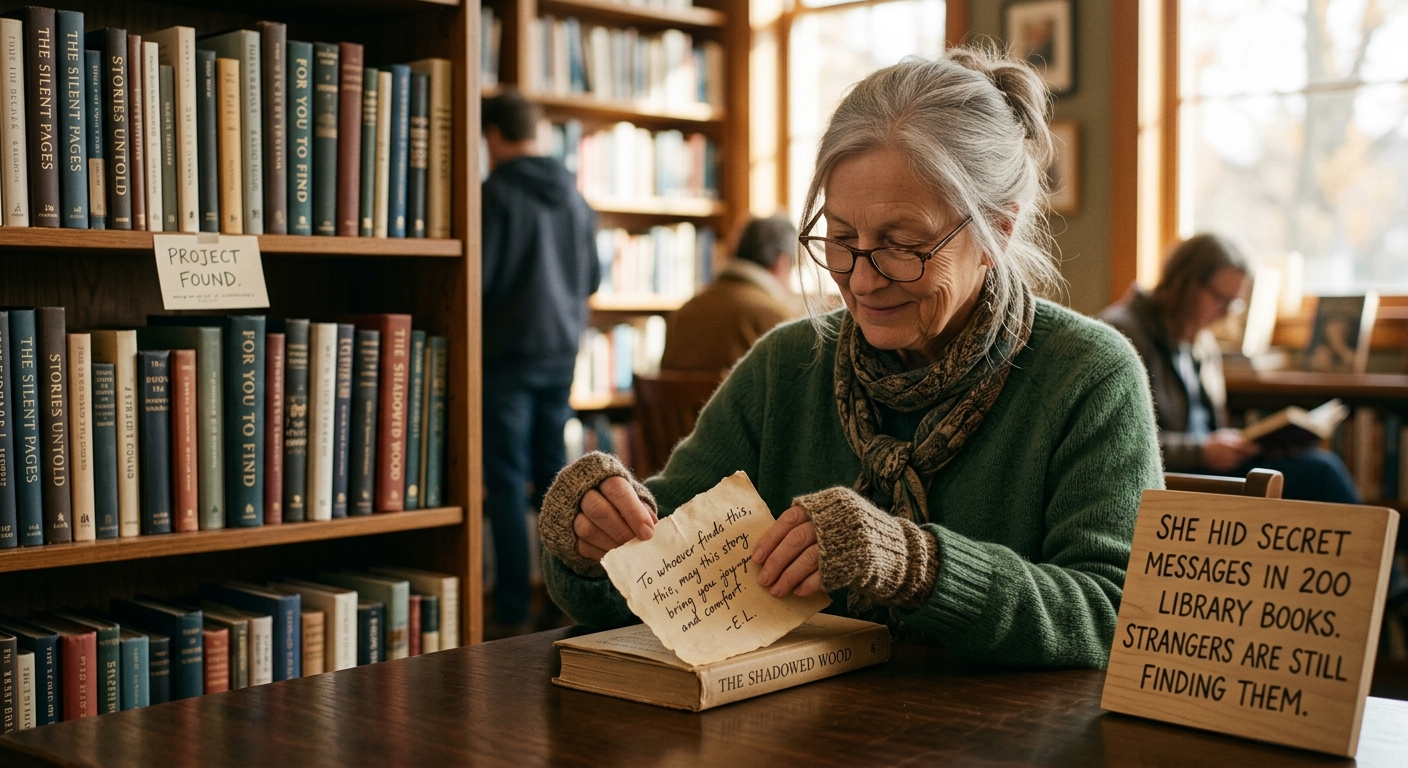
For nearly fourteen years, Margaret tucked a small handwritten note inside every single library book she returned. Not a bookmark. Not a receipt. A genuine, thoughtful, personalized message of encouragement written on a folded index card, placed somewhere between the pages where the next reader would eventually stumble across it.
She never signed her full name. She never expected a response. She simply wrote, and left, and walked away.
She has done this over 200 times.
Where the Idea Came From
Margaret says the habit started during one of the harder chapters of her life. In 2009, she was recovering from a difficult surgery and spending a lot of time alone. Reading became her lifeline, her way of staying connected to the world when her body wouldn’t cooperate.
“I was reading a novel about a woman rebuilding her life,” Margaret recalled in a conversation with a local community newsletter, “and I thought, whoever reads this next might need this story as much as I did. And then I thought, what if I could tell them that?”
So she did. She tore a card from an old recipe box, wrote a few sentences, and slipped it between the pages before returning the book. She didn’t think much of it at the time. But the next week, she did it again. And the week after that.
“It just felt right,” she said. “Like leaving a little light on for someone.”
What the Notes Actually Say
Margaret’s notes are not generic. That is what makes them remarkable. She tailors each message to the book she just finished, often reflecting on a specific passage, a character’s struggle, or a theme that resonated with her personally.
Some examples of what she has written over the years include:
- “This book reminded me that grief doesn’t have a deadline. Be patient with yourself. You are doing better than you think.”
- “Chapter 12 made me cry for twenty minutes. I hope it finds you at exactly the right moment.”
- “If you are going through something hard right now, the woman in this story gets through it. So will you.”
- “This one is slow at first. Stay with it. The ending is worth everything.”
- “You were meant to find this book today. I genuinely believe that.”
She writes in a careful, unhurried cursive that her former students would recognize immediately. She always ends each note with the same two words: “With hope.”
The Readers Who Found Them
Word of Margaret’s notes began to spread quietly through the Asheville community after a young woman named Dana Trillo posted about one on a local Facebook group in 2021. Dana had been borrowing books from the Pack Square branch of the Buncombe County Public Library while going through a painful divorce. Inside a memoir about resilience, she found a card tucked near the final chapter.
“It said, ‘Whoever you are, you picked up this book for a reason. Trust that,'” Dana shared in her post. “I sat in my car and cried for ten minutes. I needed that more than I can explain.”
Her post received over 400 comments from people sharing similar discoveries. Slowly, it became clear that Margaret’s notes had been circulating for years, quietly doing their work inside paperbacks and hardcovers and large-print editions across multiple branches.
A librarian named Carol Hennessy confirmed that staff had been finding the notes for years and had quietly made a policy of leaving them in place. “We never removed them,” Carol said. “They were clearly doing something good.”
Why This Matters More Than It Might Seem
It would be easy to dismiss Margaret’s habit as a small, sweet quirk. But there is something worth examining more closely here, something about the particular power of an unexpected message from a stranger.
Psychologists who study social connection have long noted that even brief, anonymous expressions of care can have measurable effects on a person’s sense of belonging and hope. We are wired to feel seen, and when we are seen by someone who has nothing to gain from seeing us, the impact is often disproportionately large.
Margaret is not a therapist. She is not a life coach. She is a retired teacher who loved books and decided, during a quiet season of her own struggle, to make her reading life an act of generosity.
That decision has now touched over 200 strangers. And counting.
A Lesson in the Art of Small Gestures
When asked if she ever wondered whether her notes were making any difference, Margaret paused for a long moment before answering.
“I think we underestimate how much people need to hear that someone, even a stranger, is rooting for them,” she said. “I don’t need to know it worked. I just need to believe it might.”
That might be the most important thing she has ever taught anyone, and she taught it without a classroom, a curriculum, or even a signature.
How to Start Your Own Small Tradition of Kindness
Margaret’s story is not meant to be replicated exactly. It is meant to be a prompt. A nudge. A reminder that kindness does not require resources, recognition, or a plan. It requires only a moment of intention and the willingness to act on it.
Here are a few ways to carry the spirit of what Margaret does into your own everyday life:
- Leave a note in a book you donate to a thrift store, Little Free Library, or community book exchange.
- Write a specific, genuine compliment and leave it on a coworker’s desk anonymously.
- Text someone you haven’t spoken to in a while just to say you thought of them and hope they are doing well.
- Leave a kind note for your postal carrier, sanitation worker, or building superintendent during an ordinary week, not just a holiday.
- Write a review for a small business that helped you, and be specific about why it mattered.
None of these things take more than a few minutes. All of them have the potential to land at exactly the right moment for exactly the right person.
The Last Chapter Isn’t Written Yet
Margaret Vann is still borrowing books. She is still returning them with notes tucked inside. She says she has no plans to stop.
Somewhere in Asheville right now, a person is pulling a library book off a shelf. They are flipping through the pages, maybe looking for where they left off, maybe starting fresh. And if they are lucky, if they are one of the ones, they will find a small folded index card written in careful cursive, ending with two quiet, generous words.
With hope.
And for a moment, just a moment, they will feel a little less alone in the world.