🎧 Listen to this story
Narrated by Kore · 7,477 characters
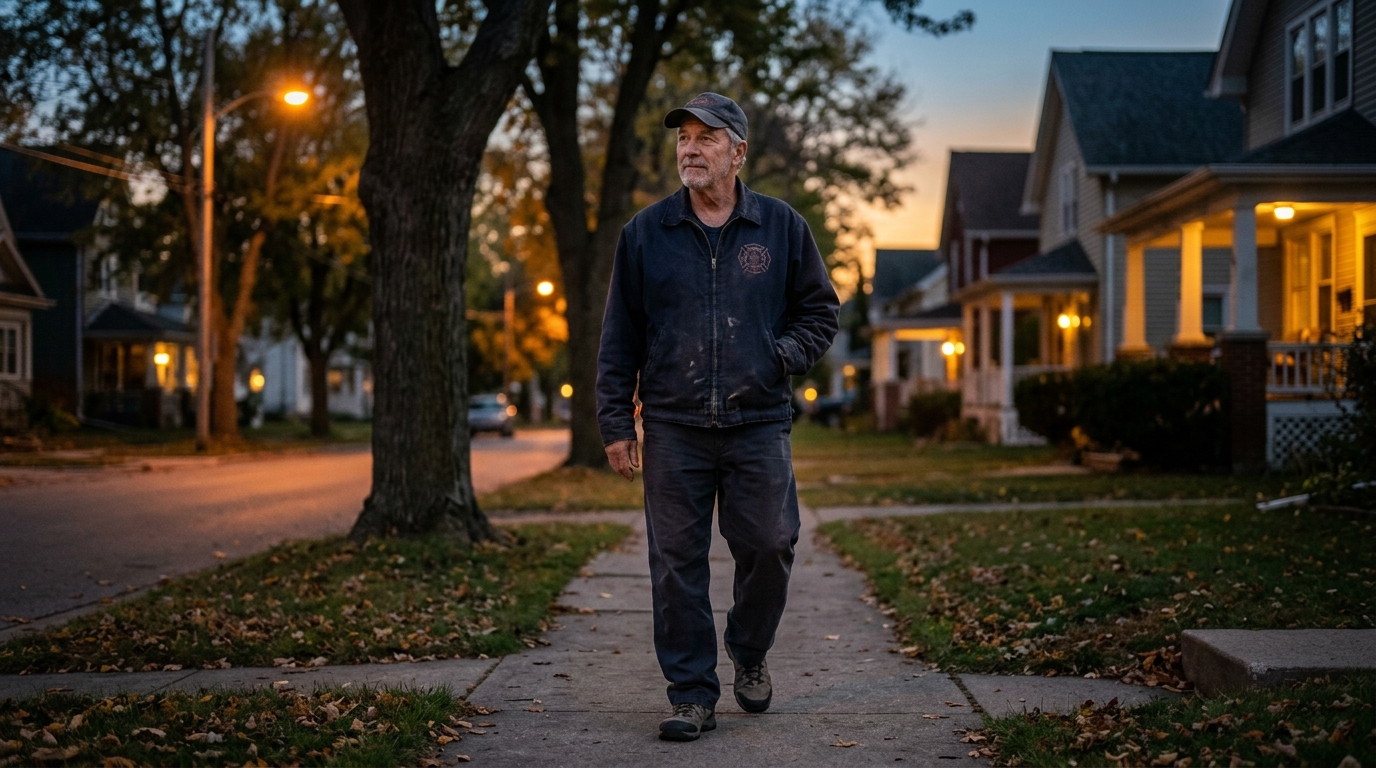
There is a particular hour on Alder Lane when the sprinklers click off, the porch lights flicker on, and a man in a faded navy windbreaker steps out of his front door with a small ladder tucked under one arm. The neighbors have stopped asking what he is doing. They know. Walt Henderson, retired after thirty-one years with the fire department, is making his evening rounds.
The Walk That Starts When the Light Goes Gold
Walt does not call it a patrol. He calls it “checking in.” Every evening, just as the sun slides low and the street turns the color of warm honey, he walks the length of the block, stopping at each house where someone has given him permission, which at this point is nearly all of them. He presses the test button on the smoke detector in the hallway. He listens for the shriek. He nods, makes a small mark in a spiral notebook, and moves on.
“People think a quiet street is a safe street,” he told me one evening as we walked. “Fire does not care about quiet. Fire loves quiet. It starts when everybody is winding down, when the dishes are done and the lights are low and nobody is paying attention.”
That is the thing Walt understands better than most. Evening is the hour when families relax, and it is also the hour when small hazards go unnoticed: the space heater left running, the candle burning down, the dryer vent clogged with lint. He spent three decades responding to those calls. Now he spends his evenings trying to make sure no one on his street ever has to make one.
How It Began
Walt retired six years ago. For the first few months, he said, the quiet nearly undid him. After thirty-one years of sirens and adrenaline and the strange brotherhood of the firehouse, the days stretched out long and shapeless.
Then one October evening, he was visiting his elderly neighbor, Mrs. Delgado, to return a casserole dish. While he stood in her kitchen, he noticed the smoke detector on her ceiling had a loose cover and no blinking light. He asked if he could check it. The battery had been dead, she guessed, for over a year. She had been sleeping every night beneath a device that could not warn her of anything.
“I stood there with a nine-volt battery in my hand,” Walt said, “and I thought about every house fire I ever worked where the detector was silent. And I thought, I know exactly what to do about this.”
He went home, found his old ladder, and the next evening he knocked on another door.
What the Evening Rounds Look Like
Walt’s routine is simple, and he has refined it over the years. Here is what a typical night involves:
- The test: He presses the button on each detector and listens for a clear, loud alarm.
- The battery swap: Every six months, on the days the clocks change, he replaces batteries at every house, whether they need it or not.
- The date check: He flips each detector over to read the manufacture date. Anything older than ten years gets replaced, because the sensors wear out even when the alarm still sounds.
- The conversation: He asks about the family’s escape plan. Does everyone know two ways out of every bedroom? Where is the meeting spot outside?
- The notebook: Every house gets a line, with the date of the last check and anything he wants to follow up on.
He pays for the batteries himself. Over the years, a few neighbors have tried to chip in, and he waves them off. Eventually the hardware store down the road started setting aside a box of nine-volts for him at cost, saying nothing, the way people do when they want to help without making a fuss.
The Stillness After the Check
What struck me most, walking beside Walt, was how the work seemed to settle him as much as it protected the street. By the time he reaches the last house, the sky has deepened to violet, and the windows up and down Alder Lane glow with the soft yellow of kitchen lights and television screens. Families are sitting down to dinner. A child is being coaxed toward a bath. Somewhere a dog is barking at nothing.
“This is my favorite part,” he said, pausing at the end of the block with his ladder resting against his hip. “Every one of those lights is a family I did something small for. They do not even think about it. And that is exactly how it should be. The best thing I can give them is a night where they never have to think about it.”
He stood there for a minute, just listening to the neighborhood breathe. Then he turned and walked home, the way he does every evening, to write down the date.
The Night It Mattered
Three winters ago, a faulty extension cord in the Okafor family’s basement began to smolder at two in the morning. The detector Walt had tested just eleven days earlier tore through the house with a sound that woke all five of them. They were outside, barefoot in the cold, before the flames reached the stairs. The fire department, arriving to a house with a family already safe on the lawn, contained it to the basement.
Mr. Okafor knocked on Walt’s door the next morning, still in a borrowed coat that smelled of smoke, and could not find the words. Walt, as the story goes, simply handed him a mug of coffee and told him to sit down.
“I never told anybody this,” Walt admitted to me, “but I do not think of it as saving anyone. I just think of it as showing up. The detector did the saving. I just made sure it was awake.”
What Walt’s Evenings Teach Us
It would be easy to file Walt’s story under the heading of one remarkable man. But the longer I thought about it, the more I saw a set of lessons any of us can carry into our own evenings:
1. Protection is mostly invisible
The best acts of care often leave no trace. A working smoke detector never announces itself. A neighbor who quietly checks on you does not seek applause. Much of what keeps us safe happens in the background, and it deserves our gratitude precisely because we never notice it.
2. Skills do not expire when the job ends
Walt retired from the firehouse, but not from being a firefighter. Whatever you know how to do, whatever you spent years learning, there is likely a person on your street who needs exactly that. Retirement can be a redirection rather than an ending.
3. Small, consistent habits beat grand gestures
Walt did not launch a campaign or found a nonprofit. He picked up a ladder and walked down the block. Do it every day for six years and you have changed the odds for an entire neighborhood.
4. Evening is a good time to look after each other
There is something about the end of the day that makes us tender. The noise fades, the defenses lower, and we remember who matters. Walt’s rounds happen at dusk because that is when families are home, and it is also, I think, when a person is most likely to say yes to a knock on the door.
A Small Challenge Before Bed
Tonight, before you turn out the lights, consider doing what Walt does, just once. Walk to your hallway and press the test button on your smoke detector. If it sounds, good. If it chirps, stays silent, or is more than ten years old, put a new one on tomorrow’s list. Then think of one neighbor, perhaps someone elderly or living alone, and ask whether theirs works too.
It takes less than five minutes. It might be the quietest, most important thing you do all week.
As for Walt, he is out there again this evening, ladder under his arm, the street glowing gold around him. If you pass Alder Lane at dusk, you might hear the faint, familiar shriek of an alarm being tested, and then silence. In his world, that silence is the sound of a job well done.