🎧 Listen to this story
Narrated by Kore · 6,333 characters
At 7:40 on a Tuesday evening, the sky behind the Harbor Lane Animal Shelter turns the color of a ripe peach, and most of the volunteers have already gone home. The front desk is dark. The adoption posters curl a little at the corners. But in the long concrete hallway of the kennel wing, a sixteen-year-old named Marcus Odell is clipping a worn blue leash onto the collar of a graying beagle mix named Pickle.
This is the part of the day nobody asked him to do. It is also, by his own telling, the most important part.
The Hour Nobody Plans For
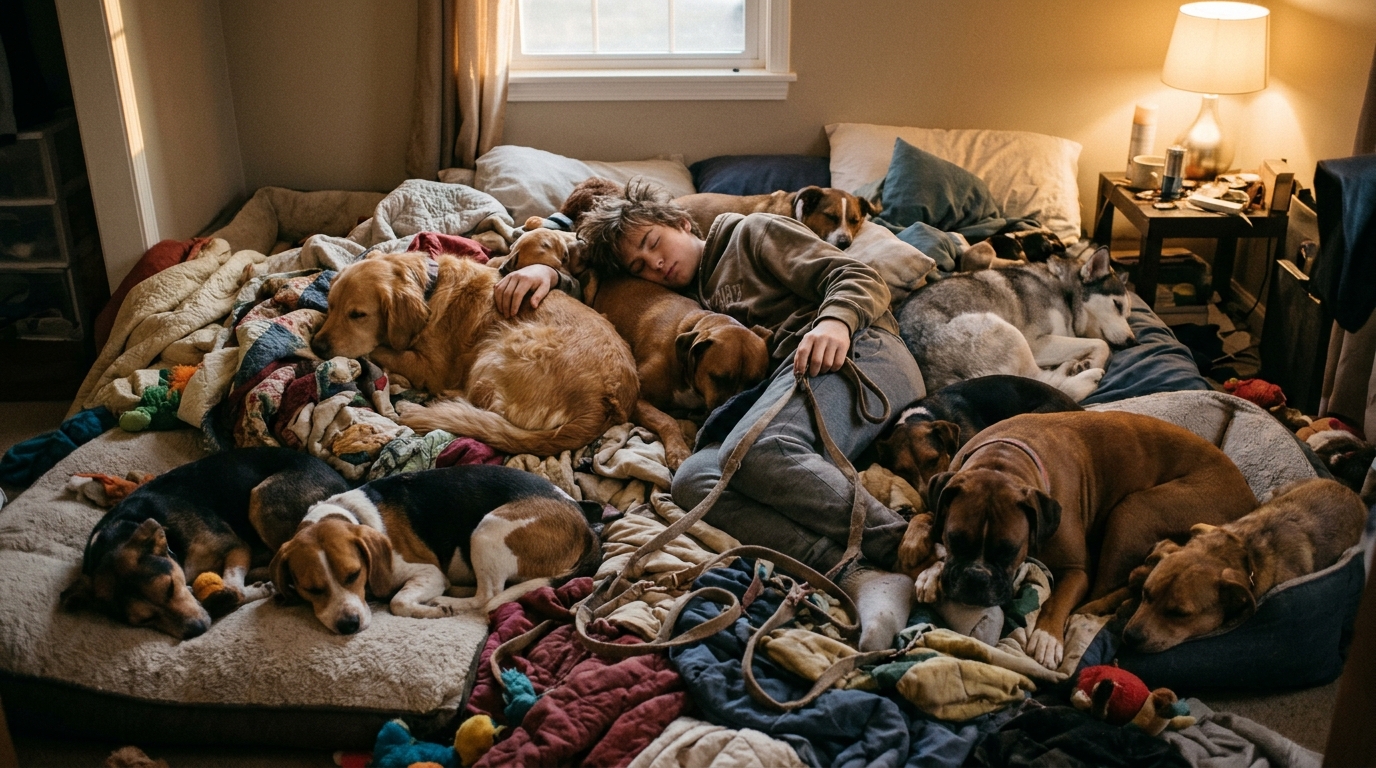
Shelters run on schedules. Morning feedings, midday cleanings, afternoon adoption hours. By the time dusk settles, the building exhales. The noise drops. The dogs, who spent the day barking and performing for strangers walking by, grow quiet in a way that staff say is not always peaceful.
“The evenings are when it gets heavy for them,” says Dolores Vance, the shelter’s operations manager, who has worked at Harbor Lane for eleven years. “Daytime is distraction. Nighttime is just them, a blanket, and the sound of the dog next door.”
Marcus noticed this the way kids often notice what adults have learned to step around. He started volunteering at fifteen, assigned to the Saturday morning shift, scooping and scrubbing. One late afternoon in October, he stayed past his hours waiting for a ride, and he heard it: a low, rhythmic whimper from the last kennel on the left.
The dog was a shepherd mix named Bishop, surrendered three weeks earlier when his elderly owner moved into assisted living. Bishop had stopped eating well. He had stopped greeting people at the gate.
Marcus asked if he could take him outside. Just for ten minutes.
What Ten Minutes Became
Ten minutes turned into a loop around the back lot. The loop turned into a habit. Within a month, Marcus was arriving at six-thirty every evening after soccer practice, still in his cleats half the time, and walking every dog in the wing before the lights went off at eight.
There are fourteen kennels. He does not rush. He told me, when I asked how he decides who goes first, that he lets the dogs decide.
“The ones who are pressed up against the front of the kennel, that’s them saying, pick me. But I’ve learned the quiet ones in the back need it more. So I always start with them.”
His routine is simple, and he follows it the same way every night:
- Start with the quietest dog. The ones who hang back are usually the ones who have given up asking.
- Walk slowly. No rushing to the next kennel. Each dog gets as long as the walk takes, even if the walk is mostly sniffing a single fence post.
- Say their name out loud. Many of the dogs have only been called “buddy” or “hey” by strangers. Marcus uses their names, over and over.
- End at the kennel door, not the gate. He tucks each dog in, checks the blanket, and says goodnight before moving on.
The Lesson That Settles In After Dark
I asked Marcus why the evening. Why not mornings, when the light is better and the dogs are livelier?
He took a long time to answer, scratching Pickle behind one velvety ear. “Because that’s when you feel alone,” he said. “I remember that. When I was twelve my parents were going through a divorce, and the days were fine. School, friends, whatever. But at night, in my room, it was like all the noise left and just the thing I was scared of was still there.”
He said it matter-of-factly, the way teenagers say the truest things, without decoration. Then he shrugged. “A walk would’ve helped. So.”
That, more than anything, is the quiet lesson at the center of this story. Loneliness is not loudest in a crowd or in daylight. It arrives in the stillness, in the hour when the distractions run out. And the people who understand that, who have felt it themselves, are often the ones who know exactly where to show up.
What the Dogs Give Back
The shelter staff say they have noticed changes. Dogs who used to pace their kennels at night now settle faster. Bishop, the shepherd mix who started it all, was adopted in December by a retired schoolteacher, but not before Marcus spent his final evening with him, walking the back lot twice.
“I cried a little,” Marcus admitted. “But then I thought, that’s the whole point. You do this so they can leave.”
Dolores Vance says the shelter’s overnight stress behaviors, the pacing, the excessive barking, the refusal to eat, have measurably dropped in the wing Marcus covers. “We can’t prove it’s just him,” she says. “But I’m not going to argue with the results either.”
A Small Ritual With a Wide Reach
Other volunteers have started staying later. A pair of retirees now handle the second wing on weeknights. A local high school club has asked about creating a rotation. What began as one kid’s quiet habit has become something quietly contagious, which is how the best kindnesses tend to spread: not with announcements, but by someone being seen doing the thing and deciding to join in.
The Last Walk of the Night
It is nearly eight now. Marcus has made it through thirteen kennels. The last one belongs to a small, trembling terrier mix named Juniper, who arrived only two days ago and has not yet decided whether to trust anyone.
He saved her for last on purpose. He opens the kennel door slowly, crouches down, and does not reach for her. He just sits on the cold floor and waits.
After a minute, Juniper creeps forward and presses her nose into his open palm.
“There you go,” he whispers. “I’ve got you. You’re not by yourself tonight.”
Outside, the last orange light slides off the roof of the shelter. Inside, the lights click off one bank at a time. Fourteen dogs settle into fourteen blankets, each one a little less alone than they would have been.
A Gentle Thought to Carry Into Your Own Evening
You do not need a shelter or a leash to do what Marcus does. Somewhere in your life, there is someone for whom the end of the day is the hardest part: a neighbor, a parent, a friend, a coworker who goes quiet around dinnertime. The kindness does not have to be large. It can be a ten-minute phone call at dusk, a text that says I was thinking of you, a knock on a door.
Tonight, before the lights go out in your own house, consider who might be sitting in the quiet. Then go sit with them, even for a little while. That is all Marcus does, fourteen times a night, and it is more than enough.