🎧 Listen to this story
Narrated by Kore · 7,429 characters
There is a particular hour at the Maple Ridge Animal Shelter that the volunteers have quietly come to treasure. It arrives around six o’clock, when the afternoon light turns the color of weak tea and the kennel hallway grows hushed. The last dog walks are done. The food bowls are empty. And in the corner run nearest the front window, a gray-muzzled hound mix named Biscuit climbs onto his folded blanket, rests his chin on the sill, and watches the parking lot.
He has done it every evening for eleven weeks. This is the story of why, and of what happened when the wait finally ended.
The Dog Who Kept Watch
Biscuit arrived at the shelter in late September, a stray found trembling beneath a porch after a week of heavy rain. He was thin, about nine years old by the vet’s best guess, with a graying face and one ear that never quite stood up straight. He was gentle with the staff, patient with the other dogs, and he ate his meals without fuss. But something about him seemed to be elsewhere, as though part of him had been left behind.
Dana Whitlock, a kennel attendant who has worked at the shelter for six years, noticed the pattern first. ‘Most dogs get restless at the end of the day,’ she told me. ‘They pace, they bark, they bounce off the walls. Biscuit did the opposite. Every evening, right around the time the sun started to drop, he’d walk to the front of his run and sit very still, looking out at the lot. If a car pulled in, his whole body would lift. If it wasn’t the right one, he’d settle back down. Slowly. Like he’d practiced being disappointed.’
A Ritual of Hope
The staff began to look forward to the ritual, and to worry about it. Someone tucked a second blanket onto the windowsill so the stone wouldn’t be cold under his chin. A volunteer named Ruth started staying ten minutes past her shift just to sit on the floor beside his kennel while he kept his vigil.
‘I’d talk to him,’ Ruth said. ‘Nothing important. I’d tell him about my garden, or what I was making for dinner. He’d glance at me, wag once, and go right back to the window. He wasn’t being rude. He was just committed.’
By the third week, nearly everyone on the staff had a theory. Perhaps he had belonged to someone who worked long hours and came home at dusk. Perhaps he was simply a creature of routine. Or perhaps, as Dana suspected, he was waiting for one specific person to walk back through a door he remembered.
The Clue in the Collar Marks
The shelter had scanned Biscuit for a microchip when he arrived and found nothing. There was no tag and no collar, though the fur around his neck showed the faint flattened band of one worn for years. Someone had loved him once. Someone had also, for reasons nobody could know, stopped being there.
The staff posted his photo online and on the community board outside the grocery store. They waited. Weeks passed with no calls. By week eight, a volunteer gently raised the question everyone was avoiding: how long could they hold a senior dog nobody seemed to want?
The Truck in the Lot
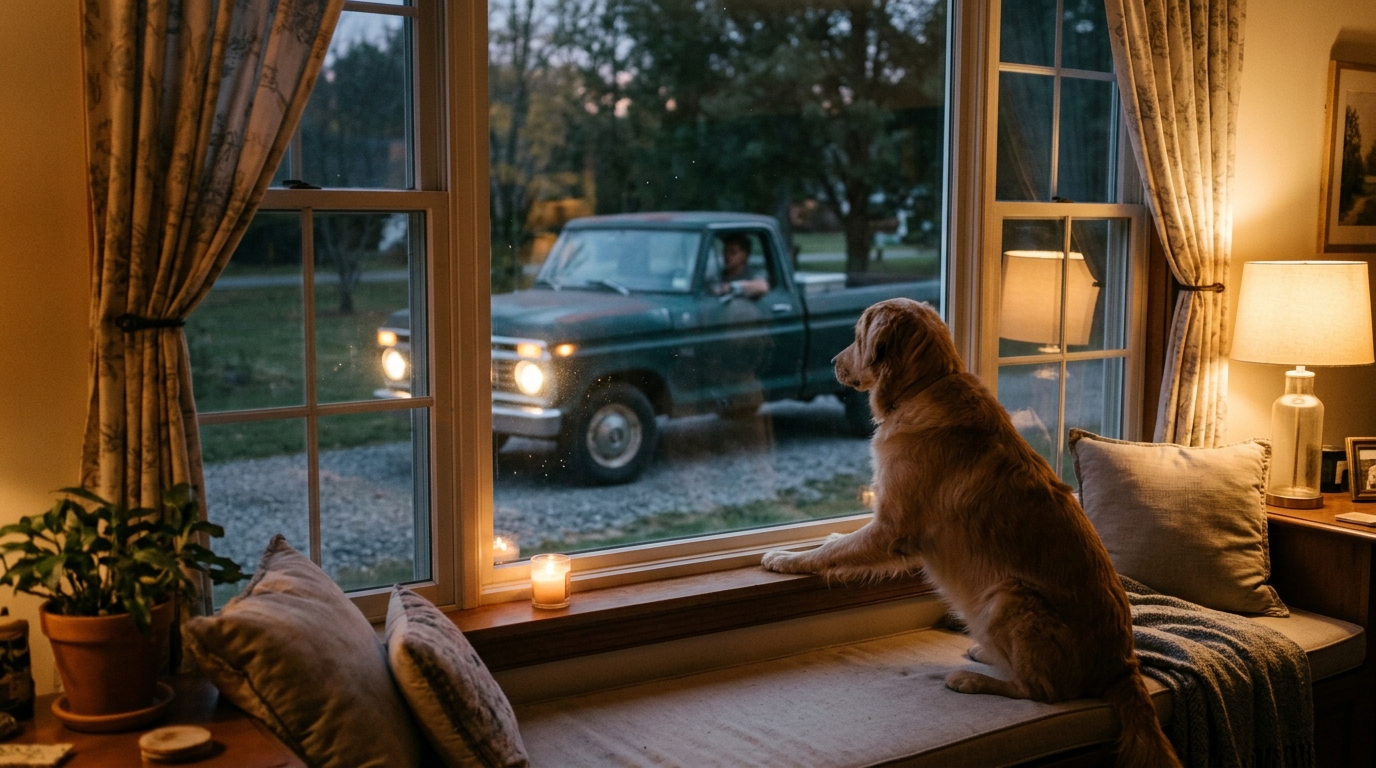
On a Thursday evening in early December, the sky was streaked pink and orange, and the shelter was nearly empty. Dana was wiping down the front counter when she heard Biscuit make a sound she had never heard from him before. It was a thin, rising whine, almost a question.
She looked up. A dusty green pickup was pulling slowly into the lot.
Biscuit was already on his feet, paws on the sill, tail sweeping so hard his entire back end swayed. The truck door opened, and an elderly man stepped out. He wore a canvas jacket and a faded cap, and he moved with the careful stiffness of someone who had recently been unwell. He stood in the parking lot for a long moment, looking at the building as though gathering his courage.
Then he walked inside.
What the Man Told Them
His name was Walter Brandt, and he was seventy-six. Two months earlier he had suffered a stroke and been rushed to a hospital two counties away. Biscuit, left alone in the house, had slipped out through a gate that was not latched. By the time Walter’s niece thought to check on the dog, he was gone.
‘I spent weeks in rehabilitation learning to hold a fork again,’ Walter said, his voice rough. ‘And every night I lay there thinking about that dog sitting by the door, waiting for me. I couldn’t stand it. The day they let me drive, I started checking every shelter within fifty miles.’
Dana led him down the hallway. She said she would remember the next moment for the rest of her life. Biscuit did not bark or leap. He pressed his whole body against the kennel door, trembling, and when Walter knelt down and said one quiet word, the dog collapsed against him like something that had been holding its breath for eleven weeks and could finally let it go.
‘He’d waited at that window every evening,’ Walter said later, when he could speak again. ‘Of course he did. That’s when I always came home.’
What the Evening Teaches Us
I keep returning to this story in the quiet hours when the day has finally let go of me. There is something about dusk that makes us tender toward the things we are waiting for. The light thins, the noise recedes, and the longing we managed to ignore at noon settles into the room beside us.
Biscuit never gave up, and not out of foolishness. Hope, for him, was not a feeling but a practice, a small and faithful act repeated at the same hour each day. Here is what his vigil seems to say to those of us winding down at the end of a long day:
- Faithfulness is quiet. It rarely announces itself. Often it looks like sitting still and showing up at the same window, again and again.
- Waiting is not the same as giving up. We tend to treat patience as passive, but Biscuit’s patience was active, a daily decision to keep believing.
- Someone may be looking for you, too. Walter spent weeks relearning to walk and write his name, with a single destination in mind.
- Small kindnesses add up. The extra blanket, Ruth’s ten minutes on the floor, the photo pinned to a community board: none of it felt significant, and all of it kept a lonely dog company until his person arrived.
A New Evening Routine
Walter filled out the adoption paperwork anyway, insisting on doing it properly, one slow signature at a time, while Biscuit sat pressed against his leg. When the two of them finally walked out into the lot, the sun had slipped nearly below the tree line and the whole sky glowed amber.
Dana stood at the window, the very one Biscuit had kept watch from, and watched the old man lift the truck door and the old dog climb in without hesitation, like a thing he had rehearsed a thousand times in his sleep.
The shelter staff still talk about that evening. The corner run by the window has a new resident now, a young terrier who has not yet learned to wait. But Ruth still stays ten minutes past her shift, sitting on the floor in the fading light. ‘You never know,’ she says, ‘who might be on their way.’
Walter sends the shelter a photo every few weeks. In the most recent one, the two of them are on a porch at sunset, a blanket across their knees. The old man looks tired and content. The dog looks like he has nowhere left to watch for.
Tonight, as the day softens and the windows go dark, maybe we can borrow a little of Biscuit’s faith. Not a frantic hope, but a steady one. The kind that sits down at the end of the day, rests its chin on the sill, and trusts that somewhere, someone is making their way home.