🎧 Listen to this story
Narrated by Kore · 7,384 characters
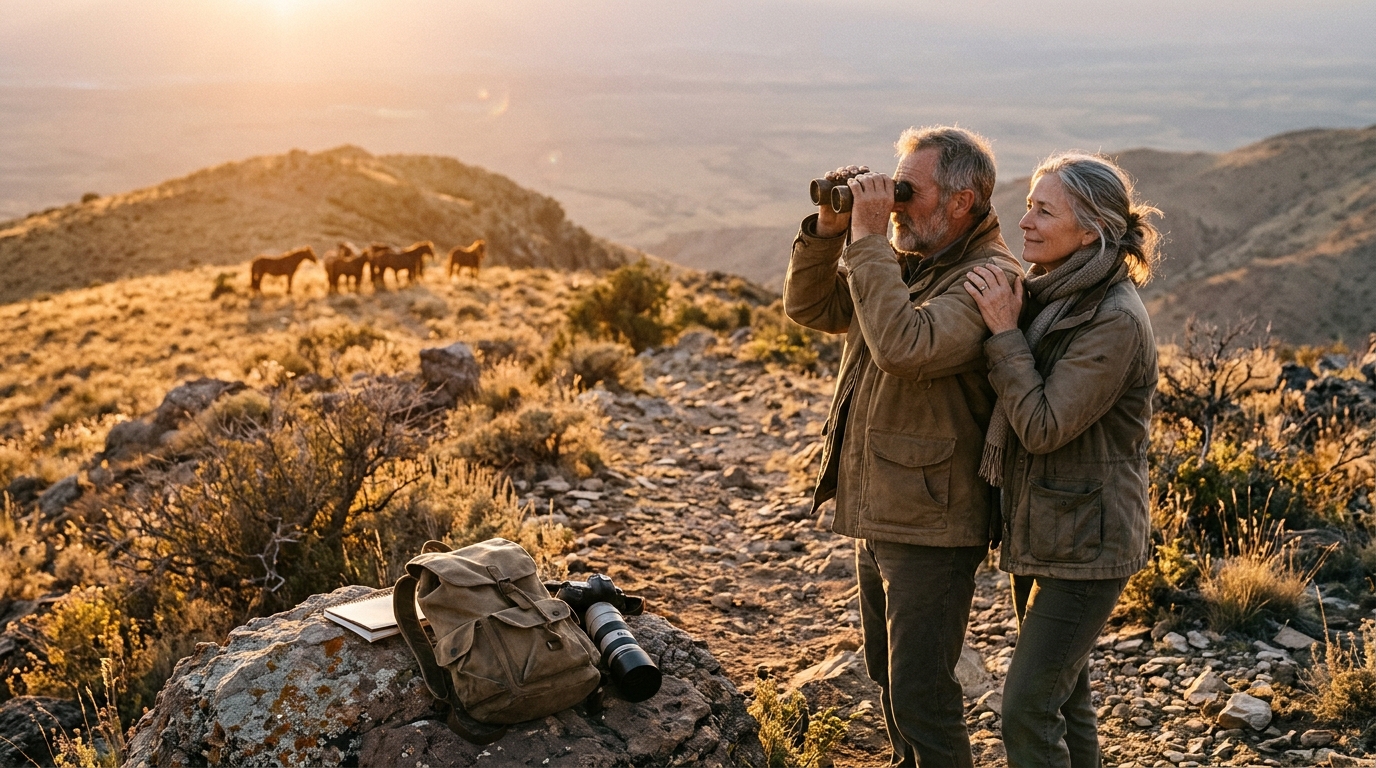
The first time Marguerite Okafor-Lindqvist noticed the horses, she was carrying a basket of laundry toward the clothesline and the sky behind the ridge had just turned the color of apricot jam. Eleven silhouettes stood along the crest, perfectly still, as if someone had placed them there for a painting. She set the basket down and watched until the light failed.
That was eleven years ago. The horses have come back almost every evening since, and for most of that time, nobody could say why.
A Ridge, a Herd, and a Habit
The ridge sits at the edge of a stretch of high desert rangeland, where sagebrush gives way to bare rock and the wind carries the smell of warm dust. The herd is a band of wild horses, descendants of animals that have roamed the region for generations. They are not tame, and they do not pretend to be. They graze in the cool hours of the morning, drift toward water at midday, and then, as the sun starts its slow slide toward the horizon, they walk single file up the same worn path to the same flat shoulder of rock.
They stay until the light is gone. Then they come down in the dark, quiet as breath.
Marguerite, a retired schoolteacher who lives in the nearest farmhouse, started keeping a notebook in the second year. She is the kind of person who writes things down because writing things down is how she thinks. Her entries are short and plain.
- Day 41: All eleven present. The gray mare arrived last, as always.
- Day 212: Storm threatening. They came anyway, stood in the wind.
- Day 590: A new foal. She stayed pressed against her mother’s side the whole hour.
- Day 1,904: Snow. They climbed through it. I do not understand it, but I am glad of it.
The Theories Pile Up
Over the years, the ridge became a small local mystery, the kind that people bring up at the feed store and over church potlucks. Everyone had a theory, and every theory had its charm.
The Practical Explanations
A rancher down the valley insisted it was about the wind. The ridge catches a steady evening breeze that keeps biting insects away, and horses are not fools. That made sense, until Marguerite pointed out that the horses came on still evenings too, when the air hung heavy and the flies were thick.
A visiting wildlife student suggested the ridge was a lookout, a high point from which the herd could scan for predators before settling in for the night. Reasonable again, except that the horses never scanned. They faced west, toward the dying light, and most of them seemed to doze on their feet.
The Gentler Explanations
Then there were the softer theories, the ones people offered with a little embarrassment. Maybe the horses simply liked the view. Maybe it was ritual, the way people have favorite chairs. Maybe, a child at the local school suggested, they were saying goodnight to the sun.
Marguerite never dismissed that one. After a long day, she said, she had done much the same thing from her own porch.
The Evening Everything Changed
The answer, when it came, arrived quietly, the way most true things do.
In the autumn of the eleventh year, a retired equine behaviorist named Dr. Anselm Verhoeven came to stay with his sister, who rented a cottage down the lane from Marguerite. He had spent his career studying how herd animals structure their days. He heard about the ridge over dinner and, mostly out of politeness, agreed to walk up one evening and see for himself.
He brought a folding stool and a pair of binoculars. He sat for an hour without speaking.
Afterward, walking back down in the blue dusk, he asked Marguerite a single question: where was the oldest horse buried?
She stopped on the path. She had never mentioned a burial. She had not thought of it in years.
What the Ridge Remembered
The oldest mare of the original herd, a weathered gray the locals called Duchess, had died on that ridge in the winter of Marguerite’s first year of watching. She had been the matriarch, the one who led the band to water and decided when to move. When she grew too frail to follow, the herd stayed with her. Marguerite had watched them stand vigil around her for two full days before the end came, and then she had gone inside because it felt wrong to keep looking.
The horses had not left the ridge that night. In the morning, Duchess was gone, and the herd had drifted away, and Marguerite had assumed that was the end of it.
It was not the end. It was the beginning of the habit.
Dr. Verhoeven explained, carefully, that he could not claim to know what a horse feels. But he had seen enough in his career to recognize the shape of what was happening. Herd animals build their lives around the places that hold their social history. A spot where the matriarch fell, where the group gathered in a moment of shared loss, can become a fixed point in the herd’s mental map. The younger horses, born years after Duchess died, had never known her. They climbed the ridge anyway, following the older ones, learning a ritual whose reason they could not have spelled out.
The habit had outlived its origin. The meaning had been handed down the way meaning always is, through repetition and presence, not explanation.
The Quiet Lesson of Dusk
There is something about the end of the day that invites this kind of remembering. The noise fades. The light goes soft and slanted. The mind, no longer busy with tasks, turns toward what it has been carrying all along.
Marguerite thinks about this often now, sitting on her porch as the horses climb. She has her own ridges, she says: the chair her husband used to sit in, the hour after supper when the house goes quiet, the particular slant of evening light that still makes her catch her breath. We do not always know why we return to the places we return to. Sometimes we only know that the returning matters.
The horses taught her that grief does not have to be loud to be faithful. It can be as simple as showing up, day after day, at the same quiet place, and standing together while the light goes out.
Ways to Honor Your Own Evening Rituals
You do not need a herd or a ridge to borrow a little of this wisdom. A few small practices can help you find your own place of remembering:
- Choose a fixed spot. A porch step, a window seat, a corner of the yard. Let it become the place where you pause at day’s end.
- Face the fading light. Even five minutes of watching the sky change can settle a restless mind.
- Remember someone on purpose. Let one person, living or gone, come to mind each evening, and simply think of them kindly.
- Keep it wordless. Not every ritual needs a reason. Sometimes presence is the whole point.
- Invite someone to join you. Rituals deepen when they are shared, just as the young horses learned theirs from the old.
Still Climbing
The herd is larger now, nineteen at last count. Not one of the original eleven remains, but the path is as clear as ever, pressed into the rock by generations of hooves. Marguerite still watches from her porch, notebook on her knee, though she writes less than she used to. Some evenings she just watches.
When the last of the light slips behind the hills and the silhouettes begin their slow descent, she lifts a hand, a small wave to nobody and everybody. Then she goes inside, turns down the lamp, and lets the quiet settle over the house like a blanket.
Tomorrow, at sunset, they will be there again. Some things do not need explaining. They only need to be kept.