🎧 Listen to this story
Narrated by Kore · 8,431 characters
There is a particular hour in the evening when a house exhales. The dishes are done, the lamps are low, and the sounds of the day finally settle into something gentler. For most of us, this hour is just the tail end of a long day. For a blind dog named Biscuit, it is the hour when the whole world makes the most sense.
This is the story of how a shelter dog nobody knew what to do with learned to read his world through sound, and how one family learned to listen right back.
The Dog in the Corner Kennel
When Biscuit arrived at a small county shelter, he was about two years old, a shaggy mix of terrier and something nobody could quite name. He had been found wandering near a rural road, thin but alert, bumping gently into fence posts and then stopping to tilt his head as if asking a question.
The vet exam confirmed what the staff had already suspected. Biscuit had been blind since early puppyhood, likely from a condition he was born with. His eyes were cloudy and sightless, but the rest of him was wide awake.
The shelter volunteers did what they could. They moved him to a quiet corner kennel, away from the chaos of barking, thinking it would be kinder. Instead, something heartbreaking happened. Biscuit stopped exploring. He pressed himself against the back wall and stayed there, learning a world that had shrunk to four feet by six.
What the Volunteers Noticed
One of the longtime volunteers, a retired schoolteacher named Marguerite, began staying late after her shift. She would sit outside his kennel as the afternoon light faded through the high windows and simply talk to him. She noticed something the others had missed.
- His ears swiveled toward every sound, tracking footsteps down the hallway like radar.
- When she clicked her tongue softly, he lifted his head and moved toward her, every time.
- He relaxed when the building grew quiet in the evenings, as though the lowered noise finally gave him room to think.
“He wasn’t broken,” she later told a local reporter. “He was just working in a different language. We needed to learn it.”
Learning a Language of Sound
Marguerite began experimenting. She taped a small bell to the corner of his bed so he could find his way back to it. She taught him that a gentle two-note whistle meant “come to me.” She trained a single word, “step,” to warn him of a curb or a stair.
Within a few weeks, Biscuit’s confidence began to return. He started moving along the edges of the play yard, nose low, ears forward, building a map in his head from echoes and scent. He learned that a hollow thump underfoot meant a wooden ramp. He learned that the jingle of a particular set of keys meant Marguerite was close.
How Blind Dogs Map Their World
Dogs who lose or never have their sight often adapt remarkably well, and many experts note that their other senses grow more refined as they rely on them. Biscuit’s world was a layered web of information:
- Sound: Echoes and the pitch of footsteps helped him sense walls, open doorways, and the size of a room.
- Smell: A trail of scent became a kind of invisible road he could follow from the kitchen to the back door.
- Touch: His whiskers and paws read the texture of floors, grass, gravel, and carpet.
- Routine: Predictable layouts and predictable evenings gave him the safety to move freely.
That last point mattered most. Biscuit thrived on a steady rhythm, and the shelter, however loving, was loud and unpredictable. He needed a quiet place that stayed the same from one day to the next.
The Family Who Understood
The Alvarez family had not been looking for a special-needs dog. They had come to the shelter on a rainy Saturday with their eight-year-old daughter, Lucia, who had been asking for a dog for two years.
They walked past the bright, bouncing puppies. It was Lucia who stopped at the corner kennel. She had noticed that the dog inside was not barking for attention. He was simply listening.
“Why isn’t he looking at me?” she asked.
When Marguerite explained that Biscuit could not see, Lucia was quiet for a moment. Then she said something her parents would repeat for years afterward: “Then I’ll have to talk to him a lot so he knows where I am.”
The First Evening Home
The first night was the hardest. Biscuit paced the unfamiliar house, bumping into table legs and a stray laundry basket, his claws clicking on the hardwood floor. The family kept a gentle running commentary. “Couch on your left, Biscuit. Water bowl by the fridge.”
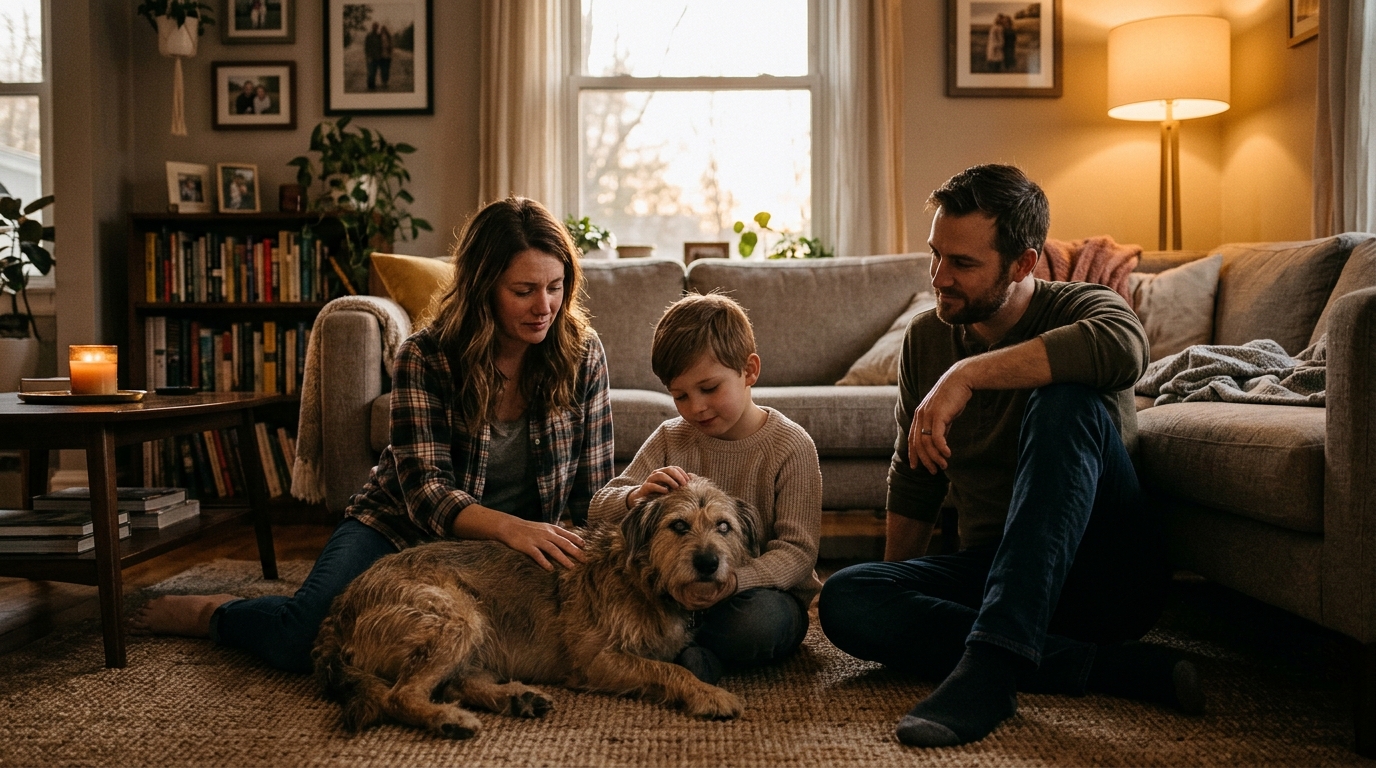
Then, as the evening wound down and the television went dark, the house grew quiet. Lucia’s father dimmed the lamps and the family sat on the living room floor. Without the clatter of dinner and dishes, the sounds of the home became clear and readable: the tick of the kitchen clock, the low hum of the refrigerator, the soft creak of the stairs.
Biscuit stopped pacing. He lifted his nose, turned his head slowly, and seemed to take it all in. Then he walked, without a single bump, straight across the room and settled his chin on Lucia’s knee.
“It was like watching someone finally find their glasses,” her mother said.
Building a Home He Could Read
The family made small, thoughtful changes that turned the house into a place Biscuit could navigate with confidence:
- They kept furniture where it was. Once Biscuit memorized the layout, they avoided rearranging so his mental map stayed reliable.
- They added sound cues. A soft wind chime marked the back door, and a small bell hung near the stairs.
- They used texture markers. A rubber mat at the top of the stairs and a rug runner in the hallway told his paws exactly where he was.
- They narrated. Calling out “I’m here” and “coming through” prevented startles and built trust.
Within a month, Biscuit could run from the front door to the kitchen at full speed, pivot at the exact spot where the tile met the carpet, and skid to a stop at his food bowl. He rarely collided with anything anymore, and when he did, he shook it off with a happy sneeze.
What the Evening Taught Them
Over time, the Alvarez family noticed that Biscuit had changed their evenings as much as they had changed his life.
Before Biscuit, the hours after dinner were a blur of screens and half-finished conversations. Now, the family found themselves winding down together, lowering the volume, speaking softly so Biscuit could follow the sounds of the house. They began taking a slow evening walk around the block, Biscuit trotting at Lucia’s side on a loose lead, his ears catching the rustle of leaves and the distant bark of other dogs.
“We used to rush through the evening just to get to the next thing,” Lucia’s father admitted. “Now we just sit in it. Biscuit taught us how to listen.”
A Gentle Reminder
There is a quiet lesson in Biscuit’s story, one that tends to settle in around the time the day’s noise fades. We so often assume that what someone lacks defines them. We see the missing piece and forget the full, vivid world that remains.
Biscuit never needed pity. He needed patience, a little creativity, and people willing to meet him in the language he already spoke.
If You’re Thinking of Adopting a Special-Needs Pet
Stories like this are heartening, but they also remind us that countless wonderful animals wait in shelters because they are labeled “hard to place.” If you are curious about opening your home to a blind, deaf, or otherwise special-needs companion, here are a few thoughts to keep in mind:
- Talk with shelter staff and volunteers who know the animal’s personality and abilities.
- Keep your home consistent and clutter-free so they can learn the layout.
- Use sound, scent, and texture to create reliable landmarks.
- Be patient through the first weeks, as confidence builds gradually.
- Consult your veterinarian about any ongoing care needs.
Goodnight, Biscuit
These days, when the Alvarez house grows still at the end of the day, a familiar ritual unfolds. The lamps dim. The kitchen clock ticks. Lucia says a soft goodnight, and from the foot of her bed comes the small thump of a tail against the blanket, a signal that Biscuit has heard her and understood.
He cannot see the moon through the window or the stars scattered above the rooftop. But he knows the sound of his family settling in, the gentle rhythm of breathing in the dark, the comfort of a home that finally makes sense. And as the last light of the evening fades, he sighs, curls into a warm circle, and sleeps like a dog who has never once doubted that he belongs.